
Sales Training For Remote Teams: The Complete 2026 Guide To Building Elite Virtual Selling Organizations

Understanding the Remote Sales Training Landscape in 2026
The shift to remote and hybrid work models has fundamentally transformed how organizations approach sales training for remote teams. What began as an emergency response to global events has evolved into a permanent operational model for most B2B organizations. Today's sales leaders face the unique challenge of building cohesive, high-performing teams without the benefit of traditional in-person coaching sessions, shadowing opportunities, or impromptu desk-side mentoring.
Remote sales teams now represent over 67% of all B2B selling organizations, yet many struggle with inconsistent performance across distributed team members. The core challenge isn't technology access it's creating standardized, scalable training experiences that drive measurable behavior change regardless of geographic location. Sales managers in Technology, Healthcare, and Financial Services sectors report that remote team training consistency remains their top operational concern heading into 2026.
Traditional training approaches that relied on quarterly in-person workshops, ride-alongs, and conference room role-plays have become obsolete. Modern sales training for remote teams requires a digital-first methodology that combines asynchronous learning, real-time practice opportunities, and data-driven coaching insights. Organizations that have successfully transitioned report 34% faster ramp times and 28% higher quota attainment among remote sellers compared to those still relying on legacy training models.
The 7 Critical Challenges in Remote Sales Training
Building effective sales training for remote teams requires addressing specific obstacles that don't exist in traditional office environments. Understanding these challenges is the first step toward implementing solutions that actually work.
1. Loss of Observational Learning Opportunities
In traditional office settings, new sales representatives naturally absorb techniques by overhearing successful calls, watching demonstrations, and observing senior team members in action. Remote environments eliminate these passive learning opportunities entirely. New hires miss the organic skill transfer that happens through proximity, creating knowledge gaps that formal training alone cannot fill.
2. Inconsistent Practice and Accountability
When sales managers can't physically observe team members practicing their pitches or conducting mock calls, ensuring consistent skill development becomes exponentially harder. Remote sellers often avoid uncomfortable practice sessions when left to self-directed learning, leading to representatives entering real conversations underprepared. The lack of structured cold calling training in remote contexts directly impacts conversion rates.
3. Delayed Feedback Loops
Real-time coaching corrections that take seconds in an office environment require scheduling video calls, reviewing recordings, or waiting for one-on-one sessions in remote setups. This delay significantly reduces the effectiveness of feedback, as representatives may repeat ineffective behaviors for days or weeks before receiving corrective guidance. The gap between action and coaching diminishes skill retention and lengthens improvement cycles.
4. Technology Fragmentation and Learning Curve
Remote sales teams often juggle multiple disconnected platforms for CRM, communication, training content, and performance tracking. This fragmentation creates friction in the learning process, with representatives spending more time navigating systems than actually developing skills. Integration challenges and technology fatigue reduce engagement with training initiatives across distributed teams.
5. Building Team Culture and Cohesion
Sales training isn't just about individual skill development it's about establishing shared methodologies, common language, and team identity. Remote environments make it significantly harder to build the cultural cohesion that drives peer learning, healthy competition, and collaborative problem-solving. Without intentional design, remote teams fragment into isolated individual contributors rather than cohesive units.
6. Extended Onboarding and Ramp Time
New remote sales representatives typically require 23% longer to reach full productivity compared to their in-office counterparts, according to research from leading sales organizations. The combination of reduced observational learning, delayed feedback, and limited informal mentorship extends the costly ramp period. Organizations struggle to maintain consistent sales onboarding standards across different hiring cohorts and geographic regions.
7. Difficulty Measuring Training Effectiveness
Traditional training metrics like attendance and completion rates reveal nothing about actual skill development or behavior change. In remote environments, sales leaders lack the direct observation data that once informed coaching decisions. Without proper measurement frameworks, organizations invest in training programs with no clear understanding of ROI or which specific interventions actually drive performance improvements.
AI-Powered Solutions Transforming Remote Sales Training
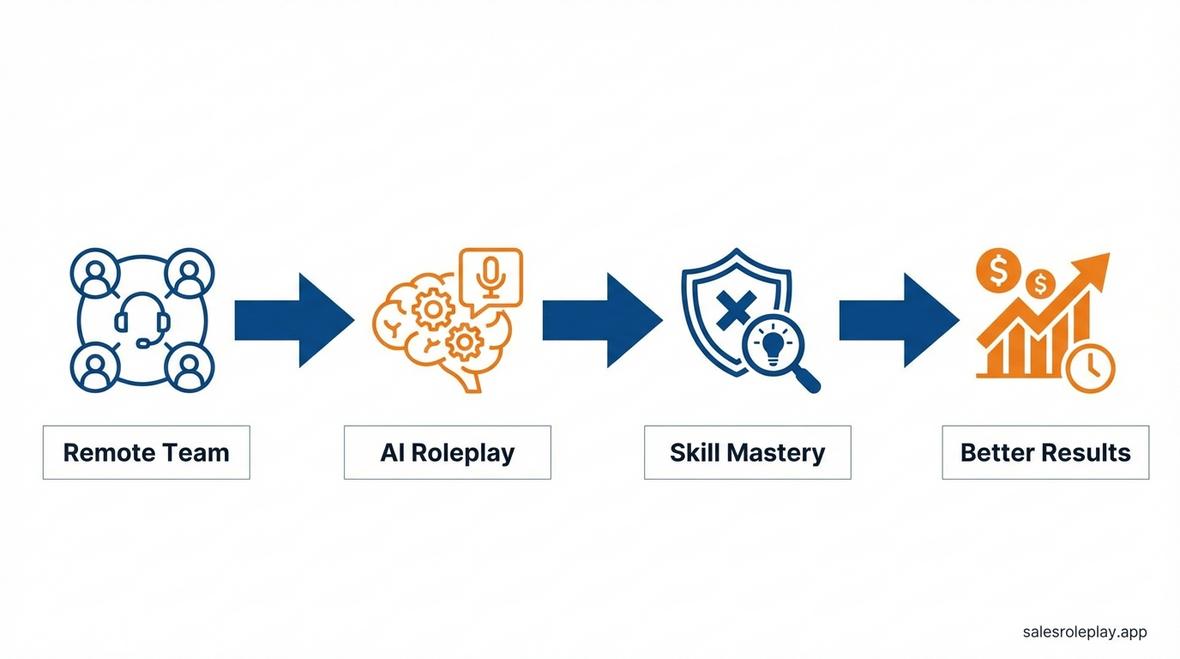
The emergence of artificial intelligence has fundamentally changed what's possible in sales training for remote teams. Modern AI platforms address the core challenges of remote training by providing scalable, personalized, and measurable skill development experiences that were impossible just a few years ago.
Intelligent Roleplay and Simulation Technology
AI-powered sales roleplay platforms enable remote team members to practice realistic sales conversations anytime, from anywhere, without requiring another person's time. These systems simulate various buyer personas, objection patterns, and conversation scenarios, providing representatives with unlimited practice opportunities. Unlike traditional peer-to-peer roleplay, AI systems deliver consistent scenario difficulty, eliminate scheduling friction, and remove the social discomfort that often reduces practice quality.
Advanced platforms now incorporate voice analysis, conversation flow assessment, and real-time adaptive responses that mirror actual buyer behavior. Representatives can practice discovery call techniques, objection handling, and closing strategies in a safe environment that provides immediate, objective feedback. This technology essentially replicates the observational learning and repetitive practice that once happened naturally in office environments.
Automated Call Scoring and Performance Analytics
Modern AI call scoring systems analyze every sales conversation across remote teams, identifying specific behavior patterns that correlate with successful outcomes. These platforms automatically evaluate factors like talk-to-listen ratio, question quality, objection handling effectiveness, and adherence to proven methodologies. Sales managers gain unprecedented visibility into individual and team performance patterns without manually reviewing hours of call recordings.
This data-driven approach transforms coaching from subjective opinion into objective, evidence-based guidance. Managers can identify specific skill gaps across their remote teams, compare performance against benchmarks, and track improvement over time with precision that was impossible in traditional training environments. The automation eliminates the time constraints that once limited coaching to top performers or struggling representatives, enabling personalized development for every team member.
Personalized Learning Paths and Adaptive Training
AI systems analyze individual performance data to create customized training recommendations for each remote team member. Rather than forcing everyone through identical generic content, modern platforms identify specific skill gaps and prescribe targeted practice scenarios. A representative struggling with objection handling receives different training exercises than someone who needs improvement in discovery questioning.
This personalization dramatically improves training efficiency and engagement. Remote sellers work on relevant skills at their own pace, receive immediate feedback, and can track their progress against clear benchmarks. The adaptive nature of AI-powered training ensures that as representatives master foundational skills, the system automatically introduces more advanced scenarios and challenges, maintaining optimal learning progression.
Building a Comprehensive Remote Sales Training Program
Implementing effective sales training for remote teams requires more than just selecting the right technology it demands a structured approach that addresses all dimensions of skill development, performance management, and cultural cohesion.
Establishing Foundational Methodology Alignment
Before implementing any training technology, remote sales organizations must establish clear, documented methodologies that define exactly how the team approaches each stage of the sales process. Whether your organization follows MEDDIC, Challenger, Sandler, or a proprietary approach, every remote team member needs explicit training on the specific framework your organization employs.
Documentation becomes exponentially more important in remote contexts where informal knowledge transfer doesn't happen naturally. Create comprehensive playbooks that outline your organization's approach to prospecting, qualification, discovery, demonstration, objection handling, and closing. These resources serve as the foundation for both initial onboarding and ongoing skill development across distributed teams.
Implementing Structured Onboarding Sequences
Remote sales onboarding programs should follow clear, time-bound sequences that combine product knowledge, methodology training, and progressive skill practice. Effective programs typically span 60-90 days and include specific milestones that new representatives must achieve before advancing to the next phase.
The most successful remote onboarding programs incorporate daily or weekly practice requirements using AI roleplay platforms, scheduled one-on-one coaching sessions with managers, peer shadowing through call recording libraries, and progressive real-world application with increasing responsibility. Clear assessment checkpoints throughout the onboarding journey ensure new hires develop requisite skills before handling critical opportunities.
Creating Continuous Skill Development Cadence
Beyond initial onboarding, remote teams require structured ongoing development programs that prevent skill atrophy and drive continuous improvement. High-performing organizations implement weekly practice requirements, monthly skill assessments, quarterly advanced training modules, and annual methodology refreshers.
The key to sustaining engagement with continuous training is making practice activities short, relevant, and directly connected to current business priorities. Rather than quarterly all-day training events, modern remote programs incorporate 15-20 minute daily practice sessions that representatives can complete between meetings. This microlearning approach fits naturally into remote work patterns and drives better retention than traditional marathon training sessions.
Establishing Data-Driven Coaching Frameworks
Remote sales managers need structured coaching frameworks that leverage AI-generated insights to drive consistent development conversations. Implement weekly or bi-weekly one-on-one coaching sessions that follow a predictable format: review performance data from the period, identify 1-2 specific improvement areas, practice those skills using roleplay scenarios, and establish clear expectations for the coming week.
The best sales coaching approaches for remote teams combine quantitative performance data with qualitative conversation review. Managers should review both outcome metrics (meetings booked, opportunities created, deals closed) and behavior metrics (call volume, email activity, practice completion) to understand the full picture of each representative's performance and development needs.
Measuring Training ROI and Effectiveness
Justifying investment in sales training for remote teams requires demonstrating clear return on investment through both leading and lagging indicators that prove the program drives actual business results.
Essential Training Metrics and KPIs
Comprehensive training measurement tracks multiple categories of metrics: engagement metrics (practice completion rates, platform login frequency, content consumption), skill development metrics (roleplay scores, certification passage rates, competency assessments), behavior change metrics (call quality scores, methodology adherence, activity levels), and business outcome metrics (ramp time, quota attainment, win rates, deal velocity).
Leading sales organizations establish baseline measurements before implementing new training initiatives, then track monthly progress across all metric categories. This approach enables clear before-and-after comparisons that isolate the impact of specific training interventions from other variables affecting sales performance.
ROI Calculation Framework
Calculate training ROI by comparing the total cost of your program (platform fees, content development, management time, representative time) against the incremental revenue generated through improved performance. Key factors include reduced ramp time (each week faster to productivity generates significant value), increased quota attainment (even 5-10% improvements across a team create substantial revenue), improved win rates (higher conversion at each funnel stage), and reduced turnover (retaining trained representatives avoids replacement costs).
Organizations implementing comprehensive AI-powered remote training programs typically see 25-40% ROI within the first year, with returns increasing in subsequent years as the program matures and compounds previous improvements. The key is maintaining rigorous measurement and attribution discipline to ensure you're accurately capturing all benefits.
Industry-Specific Considerations for Remote Training
While core principles of sales training for remote teams apply universally, certain industries face unique challenges that require specialized approaches.
Technology and SaaS Sales
Technology sales organizations deal with complex products, lengthy sales cycles, and technical buyer personas. Remote training programs must incorporate deep product knowledge, technical demonstration skills, and consultative selling capabilities. Technology sales teams benefit from scenario-based training that simulates multi-stakeholder conversations and technical objection handling specific to their product category.
Healthcare and Medical Device Sales
Healthcare sales representatives face strict regulatory requirements, clinical credibility challenges, and restricted access to decision-makers. Remote training for medical sales must address compliance considerations, clinical evidence communication, and value-based selling in complex healthcare environments. Practice scenarios should reflect actual clinical settings and incorporate healthcare-specific objections and concerns.
Financial Services Sales
Financial services sellers navigate complex regulatory environments, fiduciary responsibilities, and high-stakes conversations about client wealth. Financial services training must emphasize compliance adherence, trust-building communication, and sophisticated needs analysis capabilities. Remote programs should include regular regulatory updates and practice scenarios that test representatives' ability to navigate sensitive financial conversations appropriately.
Step-by-Step Implementation Roadmap
Successfully launching sales training for remote teams requires a phased approach that builds capability systematically while maintaining business continuity.
Phase 1: Assessment and Planning (Weeks 1-4)
Begin by conducting comprehensive skills assessments across your remote team to establish baseline capabilities and identify priority development areas. Document current training processes, gather feedback from representatives and managers about existing gaps, and define clear success metrics for your new program. Research and evaluate potential technology platforms, considering factors like ease of use, integration capabilities, content customization options, and pricing models.
Phase 2: Pilot Program (Weeks 5-12)
Launch a pilot program with a subset of your remote team typically 10-20 representatives and 2-3 managers. This controlled rollout enables you to test processes, refine content, gather feedback, and demonstrate results before full deployment. Focus the pilot on one or two specific skills (like cold calling or discovery) rather than attempting comprehensive training initially. Track pilot metrics rigorously and use insights to optimize the program before broader implementation.
Phase 3: Full Team Deployment (Weeks 13-20)
Based on pilot learnings, roll out the complete training program across your entire remote sales organization. Provide comprehensive onboarding for all team members on new platforms and processes, establish clear expectations for participation and practice frequency, and ensure managers receive coaching training to leverage new tools effectively. Maintain high communication frequency during the first month to address questions and reinforce program importance.
Phase 4: Optimization and Scaling (Ongoing)
After initial deployment, enter continuous improvement mode. Analyze performance data monthly to identify content gaps or process improvements, gather regular feedback from representatives and managers, update training scenarios to reflect evolving market conditions or product changes, and expand the program to address additional skills or sales roles. High-performing organizations treat remote training as a dynamic system requiring constant refinement rather than a 'set it and forget it' initiative.
Remote Training Best Practices from High-Performing Teams
Organizations leading in sales training for remote teams share common practices that maximize program effectiveness and representative engagement.
Make Practice Non-Negotiable
The most successful remote training programs treat practice like any other required sales activity. Representatives have clear weekly practice requirements (typically 3-5 roleplay sessions of 10-15 minutes each), managers review practice completion in one-on-ones, and practice activity factors into performance evaluations. This accountability ensures consistent skill development rather than sporadic engagement.
Leverage Peer Learning and Competition
Remote environments reduce natural peer learning, making it essential to create structured opportunities for team members to learn from each other. Implement sales leaderboards that recognize top performers in both practice and real-world metrics, share best practice call recordings across the team, facilitate virtual peer coaching partnerships, and celebrate specific examples of excellent execution in team meetings.
Directly Connect Training to Revenue Activity
Representatives engage more deeply with training that clearly connects to their ability to hit quota and earn commissions. Design practice scenarios based on actual deals in your pipeline, time training initiatives around critical selling periods (like quarter-end pushes), and explicitly show correlation between practice activity and closed deals. When representatives see direct cause-and-effect between training participation and their income, engagement dramatically increases.
Personalize Development Paths
Avoid one-size-fits-all training approaches in favor of individualized development plans based on each representative's specific strengths and improvement areas. Use AI-generated insights to identify unique skill gaps, allow representatives some choice in which skills they prioritize developing, and adjust training difficulty based on demonstrated competency. Personalization increases relevance and maintains appropriate challenge levels that drive growth.
Integrate Training Seamlessly Into Daily Workflow
The best remote training programs require minimal context-switching or additional tool adoption. Look for platforms that integrate with your existing CRM and communication tools, enable mobile practice from any device, and fit naturally into representatives' daily routines. Friction in accessing or completing training directly correlates with reduced participation and effectiveness.
Future Trends in Remote Sales Training
The evolution of sales training for remote teams continues accelerating as new technologies and methodologies emerge. Forward-thinking sales leaders should monitor several key trends shaping the future of distributed team development.
Advanced AI Coaching and Real-Time Guidance
Next-generation AI systems will provide real-time coaching during actual sales conversations, offering representatives instant guidance on question optimization, objection responses, and closing opportunities. These systems will analyze prospect engagement signals and suggest tactical adjustments mid-conversation, essentially providing every representative with an expert coach present on every call.
Virtual Reality and Immersive Training Environments
VR technology is beginning to enable truly immersive sales training experiences that replicate in-person interactions with remarkable fidelity. Representatives can practice reading body language, navigating conference room dynamics, and delivering presentations in virtual environments that feel substantially more realistic than traditional video-based roleplay. As VR hardware becomes more accessible, expect rapid adoption in high-value sales training contexts.
Predictive Performance Analytics and Proactive Intervention
Machine learning models will increasingly predict which representatives are at risk of missing quota or leaving the organization based on behavior patterns, skill development trajectories, and engagement metrics. These predictive insights will enable managers to intervene proactively with targeted coaching or support before performance issues become critical, fundamentally shifting from reactive to preventive performance management.
Common Implementation Mistakes to Avoid
Many organizations stumble when launching sales training for remote teams by making predictable errors that undermine program effectiveness.
Treating Training as a Technology-Only Solution
Simply purchasing an AI training platform doesn't create behavior change. Technology must be wrapped in clear processes, manager accountability, and cultural expectations. Organizations that focus exclusively on tool selection without investing in change management, manager training, and ongoing reinforcement see minimal results despite significant technology investment.
Failing to Establish Clear Accountability
Without explicit expectations and consequences, remote training participation remains optional in practice regardless of stated requirements. Representatives naturally prioritize activities with immediate quota impact, meaning training gets perpetually postponed unless managers actively monitor completion and make it a performance evaluation factor.
Using Generic, Non-Specific Content
Off-the-shelf training content rarely addresses the specific challenges your representatives face with your products, your market, and your buyer personas. Invest in customizing scenarios, scripts, and practice exercises to reflect your actual selling environment. Generic content feels irrelevant to representatives and fails to prepare them for real-world situations they'll encounter.
Neglecting Measurement and Optimization
Organizations that don't rigorously track training metrics can't identify what's working or justify continued investment. Establish clear measurement frameworks from day one, review data regularly, and continuously refine the program based on what the numbers reveal about effectiveness and engagement.
Frequently Asked Questions
How long does it take to see results from remote sales training programs?
Most organizations observe initial improvements in skill assessment scores and practice engagement within 2-4 weeks of program launch. Measurable business impact on metrics like conversion rates and quota attainment typically becomes apparent within 60-90 days as representatives apply newly developed skills in real selling situations. Full ROI realization generally occurs within 6-12 months as the program matures and compounds improvements across multiple skill areas.
What's the ideal practice frequency for remote sales teams?
High-performing organizations typically require 3-5 practice sessions per week, with each session lasting 10-15 minutes. This cadence balances skill development with time constraints, ensuring representatives maintain proficiency without excessive time away from revenue-generating activities. Daily brief practice proves more effective than weekly marathon sessions due to improved retention from spaced repetition.
How do you maintain engagement with remote training over time?
Sustained engagement requires: regularly updating content to reflect current market conditions and product changes, recognizing and rewarding top practitioners through leaderboards and team celebrations, directly connecting training to quota achievement and commissions, providing clear manager accountability and coaching reinforcement, and personalizing development paths based on individual skill gaps and interests. Variety and relevance are key to preventing training fatigue in remote contexts.
Should remote sales training be synchronous or asynchronous?
The most effective programs combine both approaches. Asynchronous elements (AI roleplay practice, recorded content consumption, self-paced learning modules) provide flexibility for distributed teams across time zones while enabling unlimited repetition. Synchronous components (live coaching sessions, team workshops, peer learning forums) build culture, enable real-time feedback, and create accountability. A typical split might be 70% asynchronous practice and content with 30% synchronous coaching and team development.
What budget should organizations allocate for remote sales training?
Industry benchmarks suggest allocating 2-5% of total sales team compensation toward training and development, with remote teams typically requiring investments at the higher end of this range due to technology requirements. For a 20-person remote sales team with $2M in total compensation, this translates to $40,000-$100,000 annually for training platforms, content development, and management time. Organizations with complex sales requiring longer ramps may invest 5-8% to accelerate productivity.
Conclusion
Effective sales training for remote teams has transitioned from a temporary accommodation to a permanent competitive advantage for B2B organizations. The combination of AI-powered practice environments, data-driven coaching insights, and structured development frameworks enables remote teams to achieve performance levels that exceed traditional in-office configurations. Success requires more than technology adoption it demands comprehensive programs that address methodology alignment, continuous skill development, manager accountability, and cultural cohesion across distributed teams. Organizations that invest in building these capabilities position themselves to attract top talent unrestricted by geography while maintaining the consistent execution standards that drive predictable revenue growth. The future of sales training is remote, intelligent, and measurable and the organizations embracing this reality today will dominate their markets tomorrow.
Ready to Transform Your Sales Training?
See how Salesroleplay can help you transform your sales training.