
Sales Roleplay Training For SDRs: The Complete 2026 Guide To Building Elite Sales Development Teams

Introduction
Sales Development Representatives (SDRs) are the frontline soldiers of revenue generation. They're responsible for initiating conversations, qualifying prospects, and setting the stage for closed deals. Yet, despite their critical role, most SDRs receive minimal training before being thrown into high-stakes conversations with potential buyers. According to Forrester's research on B2B sales training ROI, organizations using structured roleplay see 25% higher quota attainment for SDRs in discovery calls and objection handling. This dramatic performance lift underscores why sales roleplay training for SDRs has become a non-negotiable investment for forward-thinking sales leaders.
Traditional onboarding methods shadowing calls, reading playbooks, or occasional manager feedback simply don't scale. Modern B2B selling demands proficiency in cold calling, objection handling, discovery questioning, and relationship building from day one. Sales roleplay training for SDRs bridges this gap by providing safe, repeatable environments where new hires can practice real-world scenarios before engaging live prospects. This comprehensive guide explores how AI-powered roleplay platforms are transforming SDR training, reducing ramp time, and driving measurable revenue impact across Technology, Healthcare, and Financial Services sectors.
Why Sales Roleplay Training for SDRs Is Critical in 2026
The sales development landscape has evolved dramatically. Buyers are more informed, gatekeepers are more sophisticated, and competition for executive attention has intensified. SDRs must navigate complex objections, personalize outreach at scale, and demonstrate value in under two minutes all while maintaining compliance in regulated industries. Here's why sales roleplay training for SDRs has become essential:
Accelerated Ramp Time
New SDRs typically require 3-6 months to reach full productivity. During this period, they consume manager time, miss quota, and potentially damage brand reputation through poorly executed outreach. Structured sales roleplay training compresses this timeline by allowing reps to practice hundreds of scenarios before making their first live call. AI-powered platforms enable unlimited practice sessions, instant feedback, and personalized coaching paths that adapt to individual skill gaps.
Consistent Skill Development Across Teams
When SDR training relies solely on manager availability, quality varies wildly. Some reps receive extensive coaching while others learn through trial and error. Sales roleplay training for SDRs standardizes the learning experience, ensuring every team member masters core competencies like cold calling frameworks, objection responses, and discovery methodologies. This consistency is particularly valuable for distributed teams where in-person coaching isn't feasible.
Safe Practice Environment
Live prospect calls carry real consequences burned leads, damaged relationships, and lost revenue opportunities. Roleplay creates a risk-free space where SDRs can experiment with different approaches, fail safely, and refine their messaging before stakes are high. This psychological safety accelerates learning and builds confidence faster than live-fire training alone.
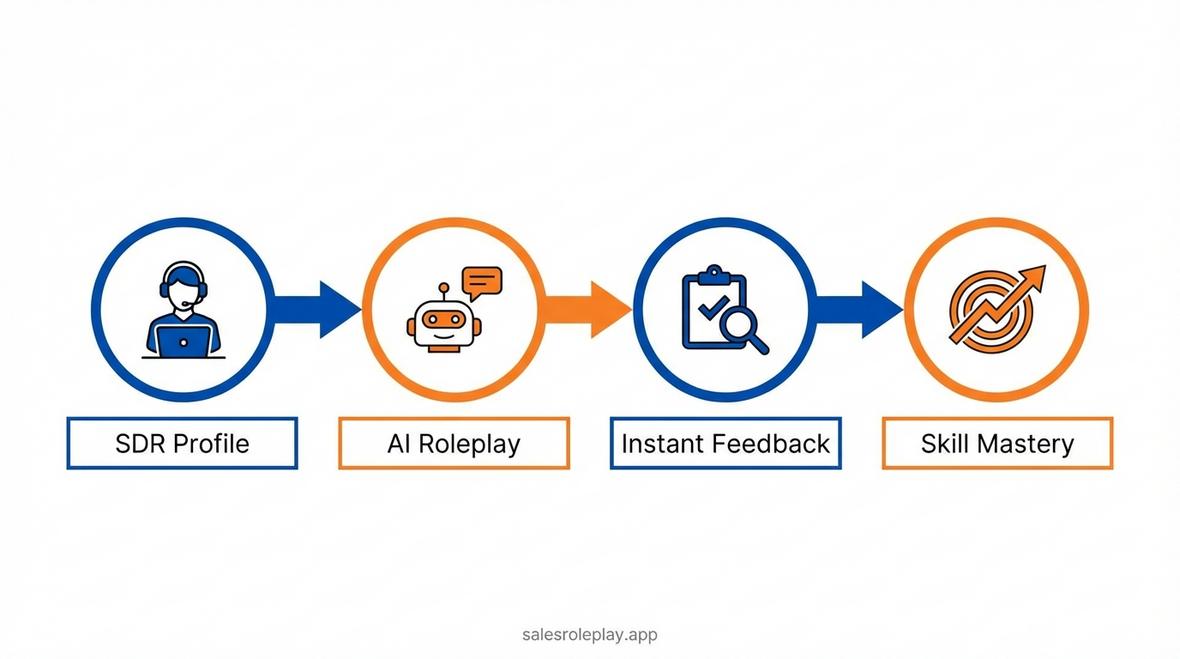
Core Competencies Developed Through Sales Roleplay Training
Effective sales roleplay training for SDRs targets specific skills that directly impact pipeline generation and conversion rates. Leading sales organizations focus their training scenarios on these critical competencies:
Cold Calling Mastery
Cold calling remains one of the highest-ROI prospecting activities, yet most SDRs approach it with anxiety and inconsistent execution. Cold calling training through roleplay addresses this by simulating realistic gatekeeper interactions, voicemail scripts, and objection handling. SDRs practice tonality, pacing, and permission-based openers until they become second nature. AI buyers can replicate difficult personas the skeptical CFO, the busy operations manager, the dismissive executive assistant allowing reps to develop resilience and adaptability.
Objection Handling Techniques
Every SDR encounters objections: 'We're already working with a vendor,' 'Send me some information,' 'We don't have budget right now.' How reps respond determines whether conversations continue or die. Sales roleplay training for SDRs should include scenario libraries covering the 15-20 most common objections in your industry. Practicing responses builds muscle memory, so SDRs can confidently address concerns without hesitation. Advanced platforms track how often reps successfully overcome specific objections, identifying patterns for additional coaching.
Discovery Call Execution
Once an SDR secures a meeting, the discovery phase becomes critical for qualification and opportunity creation. Discovery call training through roleplay teaches SDRs to ask probing questions, actively listen, and uncover pain points that align with your solution. Scenarios should mirror realistic buyer situations companies exploring options, leaders facing specific challenges, or organizations undergoing digital transformation. Roleplay allows SDRs to practice frameworks like MEDDPICC or SPIN selling in controlled environments before applying them with actual prospects.
Email and Messaging Personalization
While often overlooked, written communication is equally important for SDR success. Modern sales roleplay training for SDRs extends beyond voice calls to include email response scenarios, LinkedIn outreach simulations, and follow-up message crafting. AI tools can evaluate message clarity, personalization depth, and call-to-action effectiveness, providing feedback that improves written communication alongside verbal skills.
The AI-Powered Sales Roleplay Training Revolution
Traditional roleplay relied on manager availability, peer participation, or external trainers all limited resources. AI has fundamentally changed the economics and scalability of sales roleplay training for SDRs. Here's how intelligent platforms are transforming the training landscape:
Unlimited Practice Availability
AI buyer personas never tire, never call in sick, and are available 24/7. SDRs can practice during evening hours, weekends, or whenever their schedule allows. This on-demand access is particularly valuable for remote teams spanning multiple time zones or SDRs managing irregular schedules. Platforms like salesroleplay.app's AI Buyer simulate realistic buyer behaviors, objections, and conversation flows without requiring human counterparts.
Instant Performance Feedback
Traditional roleplay often lacks immediate, actionable feedback. Managers may provide general impressions hours or days after practice sessions. AI-powered sales roleplay training for SDRs delivers instant analysis across multiple dimensions: talk-to-listen ratio, objection handling success rate, question quality, filler word usage, and sentiment progression. This real-time feedback accelerates improvement by connecting actions to outcomes immediately.
Personalized Learning Paths
Not all SDRs struggle with the same skills. Some excel at cold calling but falter during discovery; others handle objections well but struggle with initial prospecting. Advanced AI platforms identify individual skill gaps and recommend targeted scenarios. A rep who consistently struggles with pricing objections receives more practice in that area, while someone weak on discovery questions gets additional coaching there. This personalization maximizes training efficiency and accelerates overall team performance.
Scalable Standardization
As sales teams grow, maintaining training consistency becomes increasingly difficult. AI-powered sales roleplay training for SDRs ensures every new hire experiences identical core training, regardless of when they join or which manager oversees onboarding. This standardization is critical for enterprises operating multiple offices, managing distributed teams, or scaling rapidly during growth phases.
Implementing an Effective Sales Roleplay Training Program for SDRs
Deploying sales roleplay training for SDRs requires more than purchasing technology. Successful implementations follow a structured approach that integrates training into daily workflows and measures business impact:
Define Success Metrics
Before launching any training initiative, establish clear KPIs: average ramp time, time-to-first-meeting, objection handling win rates, discovery call quality scores, or quota attainment at 30/60/90 days. These metrics provide baseline measurements and enable you to demonstrate ROI. Leading organizations track both activity metrics (calls made, emails sent) and outcome metrics (meetings booked, opportunities created) to understand training's full impact.
Build a Comprehensive Scenario Library
Effective sales roleplay training for SDRs requires scenarios that mirror actual selling situations. Work with top performers and sales leadership to document the 20-30 most common prospecting situations: initial cold calls, follow-up conversations, discovery meetings, objection scenarios, and qualification discussions. Include industry-specific contexts relevant to your target markets. For example, Financial Services SDRs need different scenarios than those selling into Healthcare or Technology sectors.
Integrate Training Into Onboarding
Sales roleplay training for SDRs should begin during onboarding, not after reps have already developed bad habits. Structure the first 30 days to include daily practice sessions covering foundational skills: company positioning, product messaging, cold calling frameworks, and core objection responses. Gradually increase scenario complexity as reps demonstrate proficiency. Many organizations use structured onboarding programs that combine roleplay with product training, shadowing, and live coaching.
Enable Continuous Practice
Training shouldn't end after onboarding. Top-performing organizations embed sales roleplay training for SDRs into ongoing development programs. Weekly practice sessions targeting specific skills (discovery questioning one week, objection handling the next) keep competencies sharp. Monthly competitions or gamified challenges create engagement and healthy competition. Platforms with leaderboards, achievement badges, and peer comparisons increase participation rates and sustain momentum.
Coach With Data-Driven Insights
AI-powered platforms generate detailed performance analytics that inform coaching conversations. Rather than relying on subjective impressions, managers can review specific call recordings, identify exact moments where reps struggled, and provide targeted guidance. This data-driven coaching is more efficient and more effective than traditional approaches. Tools offering AI call scoring automate quality assurance, freeing managers to focus on strategic development rather than administrative evaluation.
Measuring ROI of Sales Roleplay Training for SDRs
Sales leaders must justify training investments with concrete business outcomes. Sales roleplay training for SDRs delivers measurable impact across several dimensions:
Reduced Ramp Time
Organizations implementing structured roleplay training typically see 20-40% reductions in time-to-productivity. If your average SDR takes 90 days to reach full quota and training compresses that to 60 days, you've gained a full month of productive selling per rep. Multiply that across a 20-person team, and the productivity gain becomes substantial. Calculate the revenue value of that accelerated productivity to demonstrate training ROI.
Improved Conversion Rates
Better-trained SDRs convert more prospects at every funnel stage. Track metrics like contact-to-conversation rate, conversation-to-meeting rate, and meeting-to-opportunity rate before and after implementing sales roleplay training for SDRs. Even modest improvements (5-10% increases in each conversion rate) compound into significant pipeline growth. These improvements are particularly visible in objection handling and discovery call quality.
Higher Quota Attainment
The ultimate measure is revenue impact. Monitor quota attainment rates across your SDR team over time. Organizations with consistent training programs typically see 15-25% increases in team-wide quota achievement. Document baseline performance, track quarterly progress, and correlate improvements with training participation to build your ROI case.
Reduced Turnover
SDR roles suffer notoriously high attrition, often exceeding 30% annually. Much of this stems from frustration, lack of preparation, and inconsistent support. Sales roleplay training for SDRs improves confidence, accelerates success, and provides clear development paths all factors that increase retention. Calculate the cost of SDR replacement (recruiting, onboarding, lost productivity) to quantify retention improvements as part of training ROI.
Industry-Specific Applications of Sales Roleplay Training
While core sales skills apply universally, effective sales roleplay training for SDRs must address industry-specific challenges and scenarios:
Technology and SaaS
SDRs selling into the technology sector face highly informed buyers, complex competitive landscapes, and technical objections. Roleplay scenarios should include discussions around integration capabilities, security compliance, and ROI justification. Practice handling technical gatekeepers who understand product nuances and can challenge claims. B2B SaaS environments require SDRs to quickly establish credibility and differentiate from numerous competitors.
Financial Services
Regulated industries like banking, insurance, and investment management demand strict compliance alongside selling skills. Sales roleplay training for SDRs in Financial Services must incorporate regulatory considerations, risk disclosure language, and privacy protocols. Scenarios should simulate conversations with compliance-conscious buyers who require documentation and formal processes.
Healthcare and Medical Devices
Healthcare sales cycles involve multiple stakeholders, clinical evidence requirements, and procurement processes unique to the industry. SDRs need practice navigating hospital systems, engaging clinical and administrative buyers, and discussing outcomes data. Medical device scenarios might include value analysis committees, clinical trial discussions, and reimbursement conversations.
Best Practices for Maximizing Sales Roleplay Training Impact
To extract maximum value from sales roleplay training for SDRs, implement these proven best practices:
Make Training Mandatory and Measured
Optional training programs suffer low participation and inconsistent results. Make sales roleplay training for SDRs a mandatory component of onboarding and ongoing development. Set minimum practice requirements (e.g., three scenarios weekly) and track completion rates. Tie training participation to performance reviews and advancement opportunities to signal its importance.
Celebrate Progress and Wins
Recognition drives engagement. Publicly acknowledge SDRs who achieve training milestones, improve specific skills, or demonstrate consistent practice habits. Share success stories where training directly contributed to closed deals or overcome objections. This visibility reinforces training's value and motivates broader participation.
Iterate Scenarios Based on Real Calls
Your scenario library should evolve continuously. Regularly review actual SDR calls to identify new objections, emerging buyer concerns, or competitive challenges. Update roleplay scenarios to reflect these real-world situations, ensuring training remains relevant and practical. Platforms offering AI meeting recording capabilities can automatically surface common conversation patterns for scenario development.
Integrate Training With Your Sales Stack
Standalone training tools create adoption friction. Look for sales roleplay training for SDRs platforms that integrate with your CRM, sales engagement tools, and communication platforms. This integration enables automatic tracking of training completion, seamless incorporation into workflows, and correlation of training activities with sales outcomes.
Overcoming Common Challenges in Sales Roleplay Training Implementation
Even well-designed programs encounter obstacles. Anticipate and address these common challenges:
SDR Resistance to Practice
Some reps view roleplay as artificial or unnecessary, preferring to 'learn by doing' with live prospects. Address this by sharing concrete performance data showing training's impact, involving top performers as advocates, and making practice sessions engaging through gamification and competition. Demonstrate that successful reps practice regularly, normalizing training as part of high performance rather than remediation.
Limited Manager Bandwidth
Sales managers often lack time for extensive training activities. AI-powered sales roleplay training for SDRs solves this by automating practice sessions, feedback delivery, and performance tracking. Managers can focus their limited time on strategic coaching rather than administering basic practice. Provide managers with dashboards highlighting which reps need attention, making coaching time more efficient.
Difficulty Measuring Impact
Connecting training activities to revenue outcomes requires robust analytics. Implement tracking systems that correlate training participation with performance metrics: conversion rates, quota attainment, deal velocity, and win rates. Use control groups when possible compare performance of highly-trained cohorts against minimally-trained groups to isolate training impact.
The Future of Sales Roleplay Training for SDRs
Sales roleplay training for SDRs continues evolving rapidly. Several emerging trends will shape the next generation of training platforms:
Advanced Conversational AI
Next-generation AI buyers will exhibit even more realistic conversation dynamics: emotional responses, complex objection chains, and adaptive behavior based on rep performance. These sophisticated simulations will blur the line between practice and real calls, providing increasingly valuable preparation.
Virtual Reality Integration
VR-enabled sales roleplay training for SDRs will create immersive environments simulating office visits, trade show interactions, or conference presentations. This multisensory experience accelerates learning and builds confidence for in-person selling situations.
Predictive Performance Analytics
AI platforms will predict future SDR performance based on training patterns, identifying at-risk reps before they miss quota and recommending interventions. This proactive approach enables sales leaders to address skill gaps before they impact pipeline.
Multilingual and Cultural Training
As sales teams become increasingly global, sales roleplay training for SDRs will incorporate multilingual scenarios and cultural considerations. AI buyers will simulate regional communication styles, helping SDRs navigate international markets effectively.
Frequently Asked Questions
How often should SDRs participate in roleplay training?
New SDRs should practice daily during their first 30 days, focusing on foundational skills. After onboarding, successful organizations maintain weekly practice sessions targeting specific competencies. High-performing reps often self-initiate additional practice before important calls or when facing unfamiliar scenarios.
Can sales roleplay training replace live coaching?
No roleplay complements rather than replaces human coaching. AI platforms handle repetitive practice and basic feedback, freeing managers to provide strategic guidance, emotional support, and nuanced coaching that technology cannot replicate. The combination of AI-powered practice and human coaching delivers optimal results.
What's the typical ROI timeline for sales roleplay training programs?
Most organizations see measurable improvements within 60-90 days: reduced ramp time for new hires, improved conversion rates, and increased activity levels. Full ROI (including retention benefits and quota attainment improvements) typically becomes clear within 6-12 months of consistent implementation.
How do you prevent SDRs from 'gaming' AI roleplay systems?
Advanced platforms detect unnatural patterns repeated identical responses, rushed completions, or scripted answers. They introduce randomized scenarios, adaptive difficulty, and varied buyer personas to prevent gaming. Additionally, manager review of sample sessions and correlation with actual call performance reveals discrepancies between practice and execution.
Should roleplay scenarios be industry-specific or generic?
Both have value. Generic scenarios build foundational skills applicable across contexts. Industry-specific scenarios address unique challenges SDRs will encounter with your target buyers. Effective programs include 60-70% industry-specific content and 30-40% universal skill development.
Conclusion
Sales roleplay training for SDRs has evolved from occasional manager-led exercises to sophisticated, AI-powered development systems that deliver measurable business impact. Organizations implementing structured roleplay programs see accelerated ramp times, improved conversion rates, higher quota attainment, and reduced turnover all contributing to substantial ROI. As buyer expectations increase and competitive pressures intensify, providing SDRs with safe, scalable environments to practice critical skills becomes not just beneficial but essential. By following the frameworks, best practices, and implementation strategies outlined in this guide, sales leaders can build elite SDR teams capable of consistently generating qualified pipeline and driving predictable revenue growth. The future belongs to organizations that invest in continuous skill development through intelligent, data-driven training platforms like salesroleplay.app.
Ready to Transform Your Sales Training?
See how Salesroleplay can help you transform your sales training.