
Sales Roleplay Software: Complete 2026 Guide To Transforming Sales Team Performance

What Is Sales Roleplay Software and Why It Matters in 2026
Sales roleplay software represents a revolutionary shift in how B2B organizations train, develop, and scale their revenue teams. Unlike traditional training methods that rely on sporadic manager-led sessions or infrequent workshops, modern sales roleplay software leverages artificial intelligence to provide on-demand, scalable, and standardized practice environments for sales professionals across all experience levels.
For Chief Revenue Officers and Sales Managers in technology, healthcare, and financial services sectors, the challenge of reducing ramp time while improving close rates has never been more pressing. Sales roleplay software addresses this by creating realistic simulation environments where reps can practice cold calling, objection handling, and discovery calls without the risk of losing real prospects.
The core value proposition centers on three fundamental capabilities: AI-powered practice scenarios that adapt to individual skill levels, real-time feedback mechanisms that identify improvement areas instantly, and performance analytics that give leaders visibility into team readiness. This combination transforms sales training from a periodic event into a continuous improvement process embedded in daily workflows.
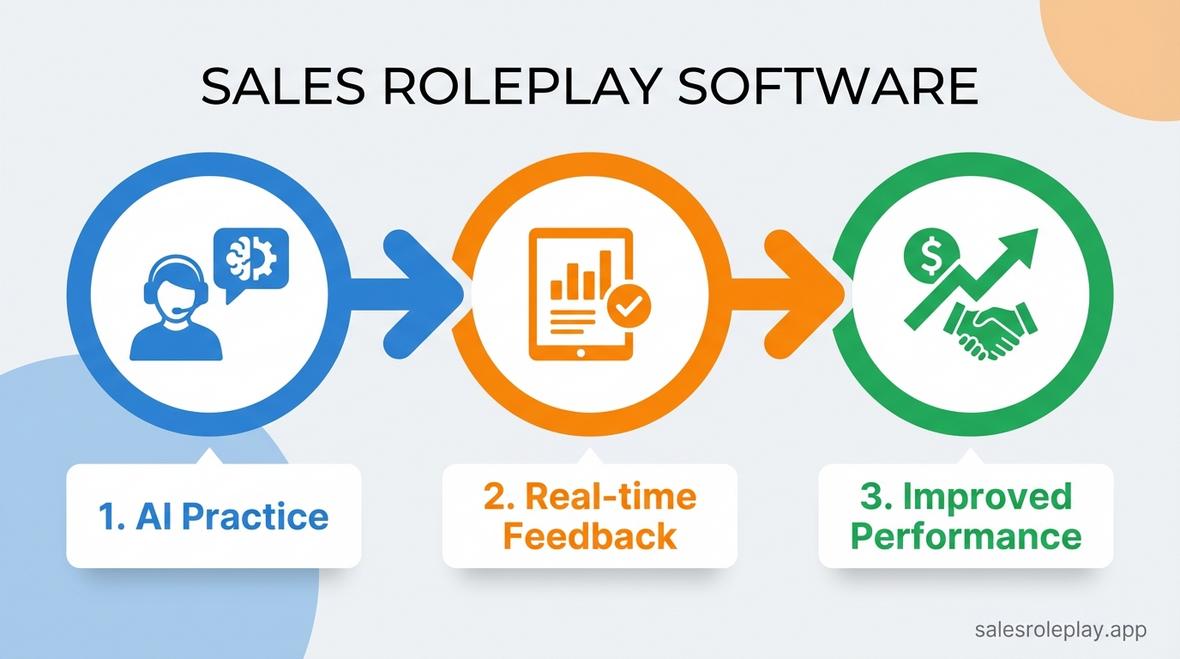
According to Forrester Research, companies investing in AI-driven sales training experience 2x higher customer retention rates and faster deal closures, making sales roleplay software a strategic investment rather than a discretionary expense for competitive B2B organizations.
Essential Features of High-Performance Sales Roleplay Software
AI-Powered Conversation Simulation
The foundation of effective sales roleplay software lies in its ability to simulate realistic buyer conversations. Advanced platforms utilize natural language processing to create AI buyers that respond dynamically to sales tactics, objections, and questioning strategies. This technology enables sales professionals to practice hundreds of scenarios without requiring manager availability or peer participation.
Modern AI buyer personas can be customized to match specific industries, buyer roles, and objection patterns relevant to your market. Sales teams in pharmaceutical sectors can practice navigating compliance requirements, while technology sales teams can rehearse complex technical discovery conversations.
Real-Time Performance Analytics and Feedback
Immediate feedback transforms practice into measurable improvement. Leading sales roleplay software platforms analyze conversation metrics including talk-to-listen ratios, filler word usage, objection handling effectiveness, and discovery question quality. This granular analysis provides actionable coaching points that accelerate skill development.
Sales managers gain access to aggregated team analytics, identifying skill gaps across their organization and enabling targeted coaching interventions. Research from MarketsandMarkets reports AI in sales enables 65% less time on data entry and administrative tasks, freeing sales leaders to focus on strategic development rather than manual evaluation.
Customizable Training Scenarios
Generic training scenarios produce generic results. The most effective sales roleplay software platforms allow organizations to build custom scenarios reflecting their specific products, buyer personas, and competitive landscape. This customization ensures practice translates directly to real-world performance improvement.
Organizations can create scenario libraries addressing common challenges like cold calling, discovery calls, and objection handling specific to their market position. This targeted approach dramatically reduces the time required for new representatives to reach full productivity.
How to Successfully Implement Sales Roleplay Software
Creating an Adoption Strategy That Works
Technology alone does not transform performance adoption does. Successful implementation of sales roleplay software requires a structured change management approach that addresses both the technical and cultural aspects of adoption. Sales leaders must position the platform as a career development tool rather than a performance surveillance mechanism.
Begin with a pilot program involving your top performers and early adopters. Their success stories and testimonials create social proof that accelerates broader team adoption. Establish clear expectations around practice frequency most high-performing teams require representatives to complete 3-5 practice sessions weekly to maintain skill sharpness.
Integration with Existing Sales Technology Stack
Modern sales roleplay software must integrate seamlessly with existing CRM, sales enablement, and learning management systems. This integration ensures practice activities connect to real sales activities, reinforcing the relevance of skill development to revenue outcomes.
Look for platforms offering native integrations with Salesforce, HubSpot, and other enterprise sales tools. These connections enable automatic scenario recommendations based on upcoming sales calls, pipeline stages, and historical performance patterns. The result is contextualized practice that directly supports active deals.
Measuring ROI and Business Impact
Quantifying the return on investment for sales roleplay software requires tracking both leading and lagging indicators. Leading indicators include practice frequency, skill assessment scores, and confidence ratings. Lagging indicators encompass ramp time reduction, quota attainment improvement, and win rate increases.
Establish baseline metrics before implementation and track progress monthly. Organizations typically observe measurable improvements within 60-90 days, with full ROI realization occurring within six months. The most significant impacts appear in new hire ramp time, which frequently decreases by 30-40% with consistent practice regimens.
Sales Roleplay Software Use Cases by Sales Role
Sales Development Representatives (SDRs)
SDRs face the highest volume of rejection and require exceptional resilience and skill refinement. Sales roleplay software provides unlimited practice opportunities for cold calling, email follow-up conversations, and qualification frameworks without burning through lead lists or annoying prospects.
Specific SDR training scenarios should focus on opener effectiveness, objection handling in the first 30 seconds, and qualification questioning sequences. Regular practice in these high-frequency activities builds muscle memory that translates to improved connect rates and meeting-set conversions.
Account Executives (AEs)
Account executives navigate longer, more complex sales cycles requiring sophisticated discovery and negotiation capabilities. Sales roleplay software enables AEs to practice multi-stakeholder conversations, executive-level communications, and competitive displacement strategies in risk-free environments.
Focus training scenarios on discovery call excellence, value articulation for different buyer personas, and handling sophisticated procurement objections. The account executive training methodology should emphasize consultative selling approaches rather than transactional tactics.
Sales Managers and Frontline Leaders
Sales managers require coaching skill development as much as representatives require selling skill development. Progressive organizations use sales roleplay software to train managers on effective coaching conversations, pipeline reviews, and performance improvement discussions.
Manager-specific scenarios should include delivering difficult feedback, conducting effective one-on-ones, and role-playing deal strategy sessions. This investment in sales manager capabilities creates a multiplier effect across the entire team's performance.
Industry-Specific Applications of Sales Roleplay Software
Technology and SaaS Sales
Technology sales teams face rapidly evolving products, intense competition, and technically sophisticated buyers. Sales roleplay software addresses these challenges by enabling continuous product knowledge reinforcement, competitive positioning practice, and technical objection handling rehearsal.
Organizations in the B2B SaaS sector benefit particularly from scenario-based training that simulates common buyer concerns around integration complexity, security requirements, and ROI justification. Regular practice ensures sales teams maintain messaging consistency as product capabilities evolve.
Healthcare and Medical Device Sales
Healthcare sales professionals navigate complex regulatory environments, clinical evidence requirements, and multiple stakeholder decision processes. Sales roleplay software provides a controlled environment to practice these sensitive conversations without risking patient relationships or compliance violations.
Specific applications for medical device sales include practicing clinical value conversations with physicians, navigating hospital procurement committees, and addressing safety and efficacy questions with evidence-based responses. This specialized training accelerates credibility development with clinical audiences.
Financial Services Sales
Financial services sales require exceptional trust-building capabilities and regulatory compliance adherence. Sales roleplay software enables representatives to practice complex product explanations, address fiduciary concerns, and navigate compliance requirements before engaging with actual clients.
Training scenarios for financial services professionals should emphasize needs-based discovery, risk tolerance assessment, and transparent communication about fees and product limitations. This practice-based approach reduces compliance risk while improving client outcomes.
Advanced Capabilities Transforming Sales Training
Voice Analysis and Communication Coaching
Beyond conversation content, how sales professionals communicate matters tremendously. Advanced sales roleplay software platforms analyze vocal characteristics including pace, tone variation, confidence indicators, and filler word frequency. This feedback helps representatives develop executive presence and communication credibility.
Voice analysis technology identifies patterns like speaking too quickly under pressure, monotone delivery that reduces engagement, or excessive filler words that undermine authority. Representatives receive specific, actionable feedback on communication mechanics that complement message content development.
Multilingual Training Capabilities
Global sales organizations require training scalability across languages and cultural contexts. Leading sales roleplay software platforms support multiple languages, enabling consistent training delivery across international teams while respecting regional selling approaches and cultural norms.
This capability proves particularly valuable for organizations expanding into new markets, ensuring sales messaging maintains consistency while adapting to local business customs and communication preferences. Representatives practice in their native language, accelerating comfort and competence development.
Mobile-First Practice Accessibility
Sales professionals work increasingly from mobile environments between meetings, during travel, or from home offices. Mobile-optimized sales roleplay software enables practice sessions anywhere, transforming downtime into development time without requiring desktop access or scheduled sessions.
Mobile accessibility dramatically increases practice frequency by removing friction from the training process. Representatives can complete a 10-minute practice session before an important call, reinforcing specific skills immediately before application.
Selecting the Right Sales Roleplay Software for Your Organization
Essential Evaluation Criteria
Choosing the appropriate sales roleplay software requires systematic evaluation across multiple dimensions. Begin by assessing your primary training objectives are you focused on new hire onboarding, continuous skill refinement, or specific competency development like objection handling or discovery effectiveness?
Evaluate platforms based on AI sophistication, customization flexibility, integration capabilities, analytics depth, and user experience quality. Request demonstration environments allowing your team to experience the platform firsthand rather than relying solely on vendor presentations. The best platform for your organization balances powerful functionality with intuitive usability.
Understanding Pricing Models and Total Cost
Sales roleplay software pricing typically follows per-user subscription models with tiering based on feature access and usage volume. Enterprise platforms may offer custom pricing for large deployments. Beyond subscription costs, consider implementation expenses, customization requirements, and ongoing content development investments.
Calculate total cost of ownership including training time, administrative overhead, and integration expenses. Compare this investment against expected benefits like reduced ramp time, improved quota attainment, and decreased turnover. Organizations typically achieve positive ROI within two quarters when implementation follows best practices.
Vendor Support and Partnership Approach
Technology selection represents only part of successful implementation. Evaluate vendors based on their customer success approach, implementation methodology, and ongoing support quality. The best vendor relationships feel like partnerships focused on your success rather than transactional software sales.
Request customer references in similar industries and organization sizes. Inquire about implementation timelines, typical challenges encountered, and how the vendor addressed obstacles. Understanding the post-sale experience proves as important as evaluating platform capabilities.
Future Trends Shaping Sales Roleplay Software
Predictive Skill Development and Personalization
Emerging sales roleplay software capabilities leverage machine learning to predict skill development needs before performance gaps become visible in pipeline metrics. These systems analyze practice patterns, conversation tendencies, and performance trajectories to recommend personalized development paths for each representative.
This predictive approach shifts training from reactive remediation to proactive skill building, ensuring representatives develop capabilities before encountering challenging sales situations. The result is smoother skill progression and reduced performance volatility.
Virtual Reality and Immersive Training
Virtual reality technology promises increasingly immersive practice environments that simulate not just conversation dynamics but physical presence, body language interpretation, and environmental distractions. While early-stage today, VR-enhanced sales roleplay software will likely become mainstream within 3-5 years as hardware costs decrease and content development simplifies.
These immersive experiences will prove particularly valuable for high-stakes sales situations like executive presentations, negotiation simulations, and crisis management scenarios where physical presence and non-verbal communication significantly impact outcomes.
Integration with Revenue Intelligence Platforms
The future of sales training technology involves deeper integration between practice environments and actual sales conversations. Revenue intelligence platforms that record and analyze real sales calls will increasingly connect with sales roleplay software, automatically recommending practice scenarios based on identified skill gaps from actual customer interactions.
This closed-loop approach ensures training remains perpetually relevant to current performance needs rather than relying on generic competency models. Representatives receive targeted practice recommendations addressing their specific development opportunities identified through real conversation analysis.
Building a Culture of Continuous Practice
Leadership Modeling and Participation
Sustainable adoption of sales roleplay software requires visible leadership commitment. When sales leaders actively participate in practice sessions, share their own development experiences, and celebrate improvement stories, representatives perceive training as career development rather than performance surveillance.
Sales managers should complete regular practice sessions themselves, demonstrating that skill development never stops regardless of experience level. This modeling creates psychological safety around imperfection and experimentation, essential elements of accelerated learning cultures.
Gamification and Recognition Programs
Human motivation responds powerfully to competition, achievement recognition, and progress visibility. Effective sales leaderboard implementations within sales roleplay software create healthy competition around practice frequency and skill assessment performance.
Design recognition programs celebrating both absolute performance and improvement trajectories. This dual approach motivates top performers while encouraging developing representatives. Monthly or quarterly awards for practice consistency, improvement velocity, and peer coaching contributions reinforce desired behaviors.
Integration into Daily Sales Workflows
The most successful organizations embed practice into daily routines rather than treating it as separate from selling activities. Encourage representatives to complete brief practice sessions before important calls, reinforcing specific skills immediately before application. This just-in-time development approach maximizes transfer from practice to performance.
Sales managers can incorporate practice discussion into weekly one-on-ones, reviewing recent sessions and connecting practice performance to pipeline activities. This integration signals that skill development represents core work rather than discretionary activity.
Overcoming Common Implementation Challenges
Addressing Resistance and Skepticism
Sales professionals often express skepticism toward new training technologies, particularly if previous initiatives produced minimal results. Address resistance through transparent communication about implementation rationale, demonstrated leadership commitment, and early success stories from peer adopters.
Allow voluntary participation initially, focusing energy on representatives eager for development tools. Their positive experiences and visible performance improvements create social proof that gradually converts skeptics. Avoid mandating participation before establishing cultural acceptance and demonstrated value.
Balancing Practice Time with Selling Time
Sales leaders frequently worry that practice time reduces selling time, creating tension between development and production. Reframe this concern by positioning practice as selling preparation that improves conversion efficiency, ultimately requiring less selling time to achieve quota.
Establish reasonable practice expectations typically 30-45 minutes weekly distributed across multiple short sessions. This modest time investment yields disproportionate performance returns when practice focuses on high-impact skills like discovery questioning and objection handling that directly influence win rates.
Maintaining Long-Term Engagement
Initial enthusiasm often fades after implementation, requiring deliberate strategies to sustain engagement. Continuously refresh scenario content, introduce new challenges aligned with current sales initiatives, and regularly communicate performance improvements attributable to practice.
Quarterly training campaigns focused on specific competencies create renewed focus and energy. These concentrated development periods, supported by leadership attention and recognition, prevent training from becoming routine background noise that representatives ignore.
Measuring Success and Demonstrating Value
Leading Indicators of Training Effectiveness
Track practice frequency, skill assessment score progression, and representative confidence ratings as early indicators of training impact. These metrics provide visibility into engagement and skill development before business results manifest in pipeline metrics.
Establish benchmarks for high-performing representatives and use these standards to identify development opportunities across the broader team. Representatives completing fewer than three practice sessions weekly typically show slower skill progression than those maintaining consistent practice cadence.
Business Impact and Revenue Metrics
Ultimate validation comes from improved business outcomes. Track ramp time for new hires, quota attainment trends, win rate progression, and average deal size evolution. Compare cohorts using sales roleplay software extensively against those with minimal engagement to isolate training impact.
Organizations implementing comprehensive practice programs typically observe 20-35% reductions in time-to-productivity for new hires, 10-18% improvements in overall quota attainment, and 5-12% increases in average deal size as representatives develop superior discovery and value articulation capabilities.
Continuous Program Optimization
Use data insights to continuously refine your training program. Identify scenarios generating greatest skill improvement, practice patterns correlating with performance excellence, and content gaps limiting development in specific competency areas. This analytical approach transforms training from static programs into dynamic learning systems.
Quarterly program reviews involving sales leadership, frontline managers, and representative feedback ensure training remains aligned with evolving business needs and market conditions. This adaptive approach maintains relevance and engagement over extended timeframes.
Conclusion
Sales roleplay software represents a transformative technology for B2B sales organizations committed to competitive excellence through continuous skill development. By providing scalable, AI-powered practice environments with real-time feedback, these platforms address the fundamental challenge of building consistently high-performing sales teams in increasingly complex selling environments.
For Chief Revenue Officers and Sales Managers, the strategic question is not whether to implement sales roleplay software but how quickly to deploy it and which platform best aligns with organizational needs. Organizations that successfully implement comprehensive practice cultures consistently outperform competitors in representative productivity, quota attainment, and revenue growth. The investment in structured skill development pays compounding returns as improved capabilities translate to enhanced customer experiences, higher win rates, and accelerated revenue outcomes. To explore how salesroleplay.app can transform your team's performance, consider starting with targeted pilot programs in high-impact areas before scaling across your entire organization.
Ready to Transform Your Sales Training?
See how Salesroleplay can help you transform your sales training.