
Sales Role Play Scenarios: 25+ Proven Exercises To Transform Your Team Performance In 2026

In today's competitive B2B landscape, sales leaders are constantly searching for innovative ways to accelerate rep development, reduce ramp time, and improve close rates. One of the most effective yet underutilized training methodologies is sales role play scenarios. These practical exercises simulate real-world selling situations, allowing sales teams to practice, refine, and master critical skills in a risk-free environment before engaging with actual prospects.
According to Forrester Research: Sales Enablement Training Impact on Close Rates, structured sales training programs that incorporate role-playing can increase close rates by up to 28% and reduce new hire ramp time by 35%. This data underscores why forward-thinking Chief Revenue Officers and Sales Managers are investing in comprehensive roleplay training programs powered by modern technology.
This comprehensive guide explores 25+ proven sales role play scenarios designed specifically for B2B organizations across Technology, Healthcare, and Financial Services. Whether you're training new reps or upskilling seasoned professionals, these scenarios address common challenges like cold calling, objection handling, discovery calls, and negotiation.
Understanding Sales Role Play Scenarios: The Foundation of Effective Training
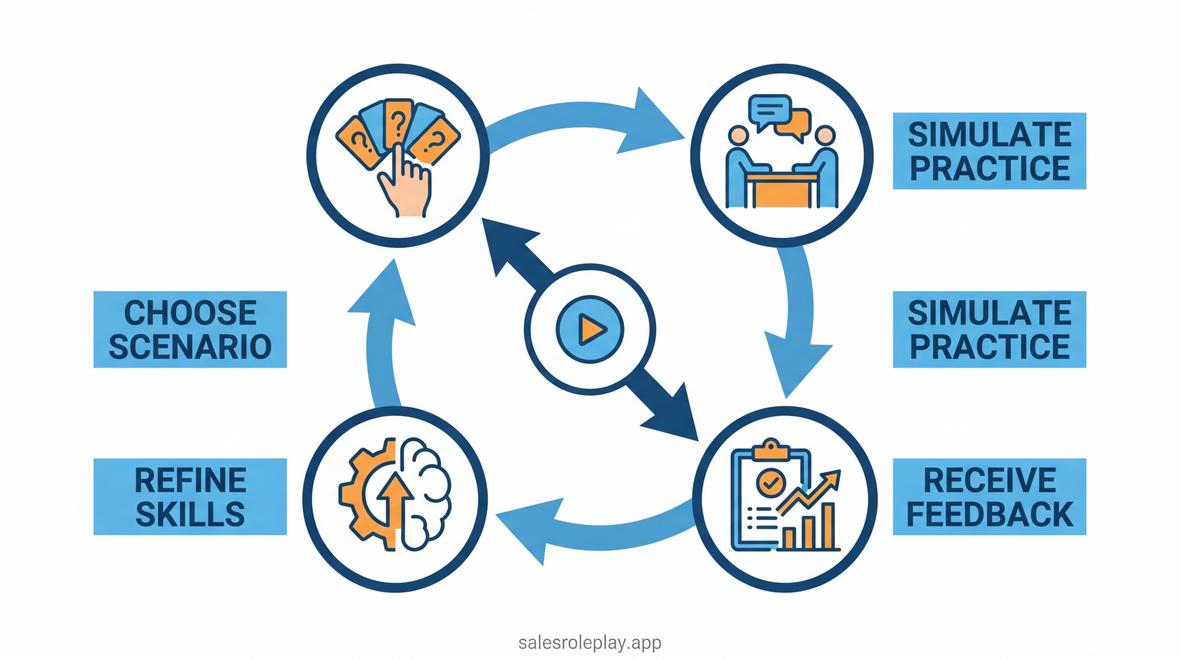
Sales role play scenarios are structured practice exercises where sales representatives act out specific selling situations with a colleague, manager, or AI-powered platform. One participant assumes the role of the salesperson while another plays the prospect or customer, complete with realistic objections, questions, and buying behaviors.
The primary goal is to create a safe learning environment where reps can experiment with different approaches, receive immediate feedback, and build muscle memory for handling challenging situations. When designed effectively, these scenarios replicate the psychological pressure and complexity of actual sales conversations.
Why Role Play Matters for B2B Sales Teams
Traditional lecture-based training often fails to translate knowledge into practical application. Sales role play scenarios bridge this gap by enabling experiential learning. When reps physically practice objection responses or discovery questions, they're far more likely to recall and execute them during real calls.
For sales leaders managing distributed teams, remote team management becomes significantly easier when roleplay training is standardized across the organization. Modern platforms allow managers to deploy consistent scenarios while tracking individual performance metrics.
Essential Cold Calling Scenarios for Outbound Success
Cold calling remains one of the most challenging yet valuable skills for B2B sales teams. These sales role play scenarios help reps overcome anxiety, handle gatekeepers, and deliver compelling opening statements.
Scenario 1: Gatekeeper Navigation
Objective: Practice getting past executive assistants to reach decision-makers.
Setup: The prospect plays an experienced executive assistant protecting their boss's calendar. The rep must demonstrate value quickly and professionally request a connection.
Key Skills: Respect, brevity, value articulation, relationship building
Success Metrics: Ability to secure a callback or direct transfer 60% of the time
Scenario 2: Cold Call Opening Statement
Objective: Deliver a compelling 30-second introduction that generates interest.
Setup: The prospect is busy and skeptical. The rep has one chance to differentiate themselves from the dozens of other cold calls received that week.
Key Skills: Pattern interrupt, value proposition clarity, question-based engagement
Sales teams looking to master this critical skill should explore comprehensive cold calling training programs that incorporate both traditional and AI-powered practice methods.
Scenario 3: Handling 'Not Interested' Objections
Objective: Convert initial rejections into productive conversations.
Setup: The prospect immediately responds with 'We're not interested' or 'Send me some information.' The rep must acknowledge the objection while creating curiosity.
Key Skills: Objection reframing, curiosity creation, persistence without pushiness
Discovery Call Role Play Scenarios: Uncovering True Needs
Discovery calls determine whether prospects become qualified opportunities or wasted pipeline. These scenarios develop the consultative questioning skills that separate top performers from average reps.
Scenario 4: Pain Identification Through Strategic Questioning
Objective: Use open-ended questions to uncover hidden pain points.
Setup: The prospect has a vague sense of dissatisfaction with their current solution but hasn't clearly articulated the business impact. The rep must guide them to quantify the problem.
Key Skills: Active listening, follow-up questions, pain quantification, business impact articulation
Organizations serious about improving discovery effectiveness should implement dedicated discovery call training that includes both methodology instruction and repeated practice.
Scenario 5: Stakeholder Mapping and Decision Process
Objective: Identify all decision-makers, influencers, and potential blockers.
Setup: The prospect is an end-user, not the ultimate decision-maker. The rep must diplomatically uncover the organizational structure and buying process without appearing manipulative.
Key Skills: Organizational navigation, political awareness, relationship building across levels
Scenario 6: Budget and Timeline Discussion
Objective: Qualify financial capacity and purchasing urgency without being pushy.
Setup: The prospect is interested but reluctant to discuss budget. The rep must frame the conversation around value and investment rather than cost.
Key Skills: Financial qualification, value-based selling, timeline establishment
Objection Handling Scenarios: Converting Resistance to Commitment
Every sales conversation includes objections. These sales role play scenarios prepare reps to view objections as opportunities rather than roadblocks.
Scenario 7: 'Your Price is Too High' Response
Objective: Reframe pricing discussions around value and ROI.
Setup: The prospect has received a proposal and immediately responds that your solution is 30% more expensive than a competitor. The rep must justify the premium without discounting.
Key Skills: Value articulation, ROI quantification, competitive differentiation
Sales teams struggling with pricing conversations can benefit from specialized objection handling scripts that provide proven frameworks for common resistance patterns.
Scenario 8: 'Now is Not the Right Time' Objection
Objective: Uncover whether timing is a real concern or a polite dismissal.
Setup: The prospect acknowledges value but claims they need to wait until next quarter or next year. The rep must determine if this is genuine or a stall tactic.
Key Skills: Objection diagnosis, cost of inaction articulation, urgency creation
Scenario 9: 'I Need to Check with My Boss' Response
Objective: Navigate organizational hierarchy without losing momentum.
Setup: After a strong presentation, the prospect reveals they lack final decision authority. The rep must either gain access to the true decision-maker or equip this champion to sell internally.
Key Skills: Champion development, multi-threading, internal selling coaching
Industry-Specific Sales Role Play Scenarios
Different industries present unique challenges that require specialized training. These scenarios address sector-specific objections and buying behaviors.
Scenario 10: Healthcare Compliance and Security Concerns
Objective: Address HIPAA, data security, and regulatory objections in healthcare sales.
Setup: A hospital IT director is interested but concerned about patient data protection and regulatory compliance. The rep must demonstrate expertise in healthcare regulations.
Key Skills: Industry knowledge, compliance articulation, risk mitigation communication
Organizations selling into healthcare should explore pharmaceutical sales and medical device-specific training programs.
Scenario 11: Financial Services ROI Justification
Objective: Quantify value in precise financial terms for CFO-level buyers.
Setup: A financial services CFO demands detailed ROI calculations, payback periods, and risk analysis. The rep must present a bulletproof business case.
Key Skills: Financial modeling, ROI calculation, risk assessment communication
Scenario 12: Technology Integration and Implementation Concerns
Objective: Address technical integration fears in complex software sales.
Setup: An IT leader loves your solution but worries about integration complexity, resource requirements, and potential disruption. The rep must provide a clear implementation roadmap.
Key Skills: Technical fluency, change management communication, implementation planning
Negotiation and Closing Scenarios
The final stages of the sales process require different skills than early-stage prospecting. These scenarios develop closing confidence and negotiation effectiveness.
Scenario 13: Multi-Point Contract Negotiation
Objective: Navigate complex negotiations involving price, terms, and contract length.
Setup: The prospect wants a 20% discount, month-to-month terms, and additional services included. The rep must protect margin while making the prospect feel they've won concessions.
Key Skills: Trade-based negotiation, value protection, creative problem-solving
Scenario 14: Competitive Displacement Closing
Objective: Win deals against entrenched competitors with existing relationships.
Setup: The prospect has worked with their current vendor for five years and is comfortable, despite acknowledged limitations. The rep must create enough urgency and differentiation to justify switching.
Key Skills: Competitive differentiation, change justification, risk mitigation
Scenario 15: Trial Close and Commitment Testing
Objective: Test buying commitment throughout the sales process.
Setup: After a successful demo, the rep must gauge genuine interest and next steps without appearing desperate or pushy.
Key Skills: Assumptive closing, commitment testing, next step establishment
Advanced Sales Role Play Scenarios for Experienced Reps
Seasoned professionals benefit from complex, multi-layered scenarios that challenge their strategic thinking and adaptability.
Scenario 16: Multi-Stakeholder Presentation with Conflicting Priorities
Objective: Present to a buying committee where different stakeholders have competing interests.
Setup: The CFO prioritizes cost reduction, the CTO wants technical innovation, and the VP of Operations needs quick implementation. The rep must address all concerns simultaneously.
Key Skills: Stakeholder management, priority balancing, consensus building
Scenario 17: Crisis Management and Customer Retention
Objective: Save an at-risk account considering cancellation or non-renewal.
Setup: A long-term customer is frustrated by implementation delays, unmet expectations, or competitive offerings. The rep must diagnose the true issue and present a recovery plan.
Key Skills: Active listening, accountability, solution design, relationship repair
Scenario 18: C-Level Executive Selling
Objective: Communicate value in strategic, business-outcome terms to senior executives.
Setup: The rep has 15 minutes with a CEO who doesn't care about features and has heard hundreds of pitches. The conversation must focus on business transformation and competitive advantage.
Key Skills: Strategic communication, business acumen, executive presence
AI-Powered Sales Role Play Scenarios: The Modern Approach
Traditional roleplay requires scheduling, willing partners, and often feels awkward. Modern AI sales roleplay platforms solve these challenges by providing on-demand practice with intelligent virtual buyers.
Scenario 19: Adaptive Objection Practice with AI
Objective: Practice handling objections that adapt based on rep responses.
Setup: An AI buyer presents realistic objections that evolve based on how the rep responds, creating a dynamic conversation that mirrors real prospect behavior.
Key Skills: Objection diagnosis, adaptive communication, strategic thinking
Scenario 20: Cross-Cultural Communication and Accent Adaptation
Objective: Develop comfort communicating with prospects from different cultural and linguistic backgrounds.
Setup: The AI buyer speaks with various accents and cultural communication styles, helping reps build global selling skills.
Key Skills: Cultural awareness, listening comprehension, communication adaptation
Scenario 21: Personalized Weakness-Focused Practice
Objective: Target individual rep weaknesses with customized scenarios.
Setup: Based on real call analysis, the AI creates scenarios specifically designed to address each rep's unique development areas.
Key Skills: Self-awareness, targeted improvement, continuous development
Implementing Sales Role Play Scenarios: A Strategic Framework
Even the best scenarios fail without proper implementation. Sales leaders must approach roleplay training systematically to drive meaningful performance improvement.
Establishing Psychological Safety
Many reps resist roleplay because they fear judgment or embarrassment. Leaders must create an environment where practice is celebrated and mistakes are viewed as learning opportunities. Frame roleplay as professional athletic training rather than testing.
Frequency and Consistency
Sporadic roleplay sessions produce minimal results. Top-performing organizations integrate sales role play scenarios into weekly routines, dedicating 30-60 minutes to structured practice. Consistency builds competence and confidence over time.
Feedback Methodology
Effective roleplay includes immediate, specific, actionable feedback. Rather than vague criticism like 'that wasn't great,' coaches should provide precise observations: 'When the prospect mentioned budget concerns, you immediately offered a discount rather than asking questions to understand the underlying issue.'
Organizations looking to scale coaching effectiveness should explore sales coaching platforms that provide structured feedback frameworks and performance analytics.
Measurement and Tracking
What gets measured gets improved. Track roleplay participation rates, scenario completion, and most importantly, the correlation between practice frequency and real-world performance metrics like conversion rates and deal velocity.
Measuring ROI: Quantifying the Impact of Sales Role Play Scenarios
Chief Revenue Officers need concrete evidence that training investments generate returns. Here's how to measure the business impact of roleplay programs.
Leading Indicators
- Roleplay completion rates: Percentage of reps completing assigned scenarios weekly
- Skill assessment scores: Improvement in specific competencies over time
- Confidence ratings: Self-reported comfort with challenging situations
- Certification achievement: Reps passing scenario-based competency tests
Lagging Indicators
- Ramp time reduction: Days until new reps reach quota productivity
- Win rate improvement: Percentage increase in opportunities won
- Average deal size: Growth in contract values due to improved negotiation
- Sales cycle length: Reduction in days from first contact to close
- Quota attainment: Percentage of team meeting or exceeding targets
For teams focused on accelerating new hire productivity, implementing comprehensive sales onboarding programs that incorporate daily roleplay can reduce time-to-productivity by 40% or more.
Industry-Specific Implementation Strategies
Different sectors require customized approaches to roleplay training based on sales cycle complexity, buyer sophistication, and regulatory environments.
Technology and SaaS Sales
Tech sales teams benefit from scenarios focused on product demonstration, technical objection handling, and competitive differentiation. The fast-paced nature of technology sales demands frequent practice with new features, competitive intelligence, and evolving buyer concerns.
Financial Services Implementation
Financial services sales require scenarios that address regulatory compliance, fiduciary responsibility, and complex ROI justification. Roleplay must include practice articulating value in precise financial terms that CFOs and finance committees demand.
Healthcare Sales Execution
Healthcare sales scenarios must address lengthy approval processes, committee-based decisions, and clinical efficacy questions. Reps need practice navigating hospital bureaucracy and communicating with both clinical and administrative stakeholders.
Common Pitfalls to Avoid in Sales Role Play Training
Many organizations invest in roleplay programs that fail to produce results. Avoid these common mistakes:
Unrealistic Scenarios
Generic, oversimplified scenarios that don't reflect actual buyer behavior waste time and reduce credibility. Scenarios must incorporate real objections, authentic buyer personas, and genuine complexity.
Lack of Follow-Through
One-time roleplay sessions create temporary awareness but don't build lasting skills. Improvement requires repeated practice over weeks and months.
Insufficient or Generic Feedback
Vague feedback like 'good job' or 'needs improvement' doesn't help reps understand what to change. Effective coaching identifies specific behaviors to continue, stop, or start.
Not Modeling Desired Behaviors
Sales managers who don't participate in roleplay themselves signal that practice isn't important. Leaders should regularly demonstrate techniques and participate alongside their teams.
The Future of Sales Role Play: AI, VR, and Adaptive Learning
The evolution of sales training technology is transforming how organizations approach roleplay. Modern platforms combine artificial intelligence, speech analysis, and adaptive learning to create unprecedented training experiences.
Conversational AI Buyers
Advanced AI platforms create realistic buyer personas that respond naturally to rep statements, ask challenging questions, and present objections that adapt based on the conversation flow. This enables unlimited practice without requiring manager time.
Real-Time Speech Analysis
Modern systems analyze speech patterns, tone, pacing, filler words, and confidence levels, providing instant feedback on communication effectiveness beyond just content.
Personalized Learning Paths
AI-driven platforms identify individual weaknesses and automatically generate customized scenario sequences that target each rep's specific development needs, accelerating improvement.
Virtual Reality Integration
Emerging VR technologies create immersive selling environments that simulate in-person meetings, trade shows, and boardroom presentations, preparing reps for high-stakes situations.
Frequently Asked Questions About Sales Role Play Scenarios
How often should sales teams practice roleplay scenarios?
Top-performing organizations integrate roleplay into weekly routines, with reps spending 30-60 minutes per week on structured practice. New hires benefit from daily scenarios during their first 30-60 days. Consistency matters more than duration regular short sessions outperform occasional marathon training events.
What's the difference between traditional and AI-powered roleplay?
Traditional roleplay requires scheduling with managers or peers, often feels awkward, and provides limited practice opportunities. AI-powered platforms offer on-demand practice 24/7, eliminate scheduling constraints, provide consistent scenarios, and deliver objective performance feedback based on speech analysis and conversation flow.
How do you measure the effectiveness of roleplay training?
Track both leading indicators (completion rates, skill assessment scores, confidence ratings) and lagging indicators (ramp time, win rates, average deal size, quota attainment). The strongest evidence comes from correlating practice frequency with actual sales performance improvements over time.
Can experienced reps benefit from roleplay, or is it just for new hires?
Experienced reps benefit significantly from advanced scenarios that challenge strategic thinking, executive communication, and complex negotiation skills. Top athletes practice fundamentals throughout their careers the same principle applies to sales professionals. Seasoned reps should focus on refining advanced techniques and staying sharp on new products or competitive intelligence.
What makes a good sales roleplay scenario?
Effective scenarios are realistic, relevant to actual buyer situations, appropriately challenging, focused on specific skills, and include clear success criteria. They should incorporate authentic objections, genuine buyer concerns, and complexity that mirrors real sales conversations rather than oversimplified scripts.
Conclusion
Sales role play scenarios represent one of the highest-ROI investments sales leaders can make in team development. By providing structured practice opportunities that simulate real-world challenges, organizations accelerate rep readiness, reduce ramp time, and improve critical metrics like close rates and deal velocity. The evolution from traditional peer-to-peer roleplay to AI-powered platforms has eliminated historical barriers like scheduling constraints and awkwardness, making consistent practice accessible to every team member. Whether you're training new hires on cold calling fundamentals or developing experienced reps for complex negotiations, implementing a systematic roleplay program grounded in realistic scenarios will differentiate your team's performance in competitive B2B markets throughout 2026 and beyond.
Ready to Transform Your Sales Training?
See how Salesroleplay can help you transform your sales training.