
Sales Onboarding Software: The Complete 2026 Guide To Accelerating New Rep Performance

Understanding Sales Onboarding Software in 2026
Sales onboarding software has evolved from simple learning management systems into sophisticated, AI-powered platforms that transform how organizations train and develop new sales representatives. In today's competitive B2B landscape, the difference between a high-performing sales team and one that struggles often comes down to how effectively new hires are onboarded during their critical first 90 days.
Modern sales onboarding software combines structured learning paths, interactive practice environments, real-time feedback mechanisms, and performance analytics to dramatically reduce ramp time while improving close rates. For sales leaders facing the dual challenge of maintaining revenue growth while integrating new team members, these platforms have become indispensable tools in their arsenal.
The traditional approach to sales onboarding shadowing experienced reps, reviewing slide decks, and occasional role-play sessions simply cannot match the scalability and consistency that technology-driven solutions provide. According to research from the Association for Talent Development, organizations with a formalized onboarding process experience 50% greater new hire retention and productivity. This statistic underscores why sales onboarding software has become a strategic priority for revenue organizations across Technology, Healthcare, and Financial Services sectors.
Why Sales Leaders Are Investing in Onboarding Technology
The search for effective sales onboarding software typically stems from several critical pain points that Chief Revenue Officers and Sales Managers encounter when scaling their teams. Understanding these challenges helps contextualize why the right technology investment delivers measurable ROI.
Extended Ramp Times Killing Revenue Potential
One of the most costly challenges facing sales organizations is the extended time it takes for new representatives to reach full productivity. Traditional onboarding approaches can take 6-12 months before a new hire begins contributing meaningfully to pipeline and revenue targets. During this period, organizations are investing heavily in salary, benefits, and training resources while receiving minimal return.
Sales onboarding software addresses this directly by providing structured, repeatable training experiences that compress learning curves. By enabling new hires to practice sales conversations in safe, simulated environments before engaging real prospects, these platforms help representatives build confidence and competence simultaneously.
Inconsistent Training Quality Across Teams
When onboarding depends primarily on individual managers or senior reps, the quality and completeness of training varies dramatically. One new hire might receive comprehensive mentorship while another gets minimal attention, creating performance disparities that persist throughout their tenure.
Modern platforms standardize the onboarding experience, ensuring every new representative receives the same foundational training regardless of their manager's availability or coaching philosophy. This consistency is particularly valuable for distributed teams where in-person shadowing opportunities are limited.
Inability to Measure Readiness Objectively
Sales leaders frequently struggle to answer a critical question: 'Is this new rep ready to engage customers independently?' Without objective assessment mechanisms, managers must rely on gut feelings or subjective evaluations, often resulting in representatives being pushed into customer-facing roles before they're truly prepared.
Advanced sales onboarding software incorporates AI call scoring and performance analytics that provide objective, data-driven insights into each representative's readiness across specific competencies like objection handling, discovery questioning, and value articulation.
Essential Features of Modern Sales Onboarding Software
Not all sales onboarding platforms are created equal. Understanding which capabilities drive actual business outcomes helps sales leaders evaluate solutions effectively and avoid investing in technology that looks impressive in demos but fails to deliver results.
AI-Powered Roleplay and Simulation
The most transformative advancement in sales onboarding software is the integration of artificial intelligence to create realistic practice environments. Unlike traditional role-play with colleagues, AI sales roleplay provides unlimited practice opportunities without requiring coordination with busy team members.
These intelligent simulations adapt to representative responses, presenting realistic objections, asking clarifying questions, and challenging assumptions just as real prospects would. New hires can practice the same scenario repeatedly until they achieve mastery, receiving immediate feedback on their performance after each attempt.
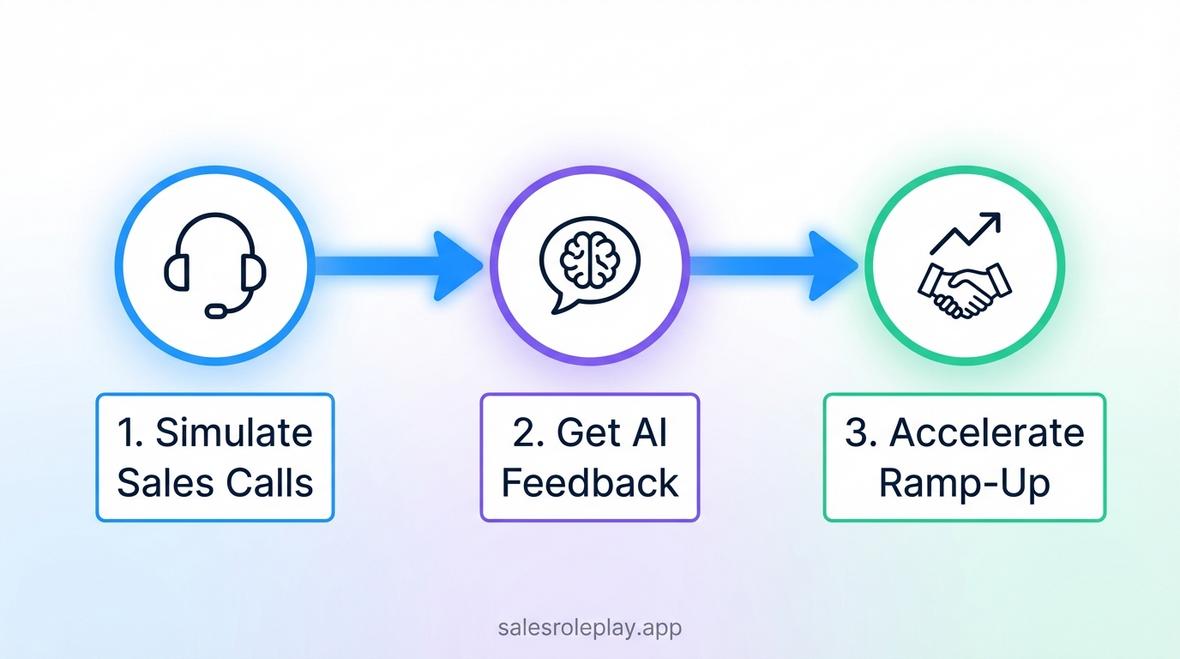
This three-step process simulate, receive AI feedback, and accelerate ramp-up represents the core value proposition of modern sales onboarding software. By providing safe environments for practice and intelligent coaching at scale, these platforms fundamentally change how quickly new representatives develop critical selling skills.
Personalized Learning Paths
Generic, one-size-fits-all training programs fail to account for the diverse backgrounds, experience levels, and learning styles that new sales hires bring to organizations. Effective sales onboarding software incorporates adaptive learning technologies that customize content delivery based on individual performance and knowledge gaps.
For example, a new hire with extensive industry experience but limited consultative selling skills might receive a condensed product training module while spending more time on discovery call methodology. Meanwhile, a representative transitioning from a different industry receives comprehensive market education alongside sales techniques training.
Integrated Performance Analytics
What gets measured gets managed, and modern sales onboarding platforms provide unprecedented visibility into new hire development. Comprehensive analytics dashboards track metrics like practice session completion rates, skill assessment scores, certification achievement, and time-to-first-deal.
These insights enable sales leaders to identify struggling representatives early and provide targeted interventions before performance issues become entrenched. They also highlight which onboarding components drive the strongest outcomes, enabling continuous optimization of the training program itself.
Industry and Role-Specific Scenario Libraries
Effective sales training must reflect the actual situations representatives encounter in their roles. Leading platforms provide extensive libraries of pre-built scenarios tailored to specific industries, sales methodologies, and buyer personas.
A pharmaceutical sales representative needs fundamentally different training than someone selling B2B SaaS solutions. The best sales onboarding software recognizes these distinctions and provides contextually relevant practice opportunities. Organizations can also create custom scenarios that reflect their unique value propositions, competitive positioning, and buyer challenges.
Implementing Sales Onboarding Software Successfully
Purchasing sales onboarding software is only the first step. Realizing its full potential requires thoughtful implementation, stakeholder alignment, and ongoing optimization. Sales leaders who approach deployment strategically see dramatically better results than those who simply purchase licenses and expect transformation.
Building Stakeholder Buy-In
Successful implementation begins with securing commitment from everyone who influences or participates in the onboarding process. This includes not only sales leadership but also enablement teams, frontline managers, and experienced representatives who will serve as mentors.
Present the business case clearly, emphasizing how the platform addresses specific pain points your organization experiences. Share projected impacts on ramp time reduction, retention improvement, and revenue acceleration. When stakeholders understand both the 'why' and the 'what's in it for me,' adoption rates increase substantially.
Integration with Existing Sales Technology
Sales onboarding software delivers maximum value when it integrates seamlessly with your existing technology ecosystem. Look for platforms that connect with your CRM, sales engagement tools, and learning management systems to create unified workflows.
For example, integration with your CRM enables the onboarding platform to automatically track when new representatives log their first activities, schedule their first meetings, and close their initial deals. This data provides valuable context for assessing whether training translates into actual selling behaviors.
Creating Compelling, Relevant Content
Even the most sophisticated platform delivers mediocre results if the training content is outdated, generic, or disconnected from real selling situations. Invest time in developing scenarios, assessments, and learning modules that authentically reflect your market, products, and buyer challenges.
Involve your top performers in content creation. Their insights into what actually works in customer conversations ensure training focuses on high-impact behaviors rather than theoretical best practices. Regularly update content to reflect evolving market conditions, competitive dynamics, and product capabilities.
Measuring Sales Onboarding Software ROI
Demonstrating return on investment is critical for justifying continued investment in sales onboarding software and securing budget for expansion. Sales leaders should establish clear metrics before implementation and track them consistently throughout deployment.
Time-to-Productivity Metrics
The most direct measure of onboarding effectiveness is how quickly new representatives reach productivity benchmarks. Track metrics like days to first meeting scheduled, days to first opportunity created, and days to first deal closed. Compare these figures before and after implementing your onboarding platform to quantify improvement.
According to sales onboarding best practices, organizations using structured onboarding programs can reduce ramp time by 30-50%, translating directly into faster revenue contribution and improved return on new hire investments.
Retention and Long-Term Performance
Effective onboarding impacts not just initial performance but also long-term retention and career trajectory. Track cohort-based retention rates, comparing turnover among representatives who completed your new onboarding program versus those who went through legacy processes.
Additionally, monitor whether representatives who engaged more deeply with onboarding resources (completing more practice scenarios, achieving higher certification scores) demonstrate stronger performance six and twelve months into their tenure. This correlation helps validate which program components drive lasting impact.
Sales Manager Efficiency Gains
One often-overlooked benefit of sales onboarding software is the time it returns to sales managers. When new hires can practice foundational skills independently through AI-powered simulations, managers spend less time on basic coaching and more time on strategic development.
Quantify this impact by surveying managers about time spent on onboarding activities before and after platform implementation. Even modest reductions in manager time investment redirected toward coaching existing team members or engaging in their own selling activities generate significant value.
Choosing the Right Sales Onboarding Software for Your Organization
The sales onboarding software market has expanded rapidly, with dozens of vendors offering varying capabilities, pricing models, and implementation approaches. Selecting the right solution requires careful evaluation aligned with your specific organizational needs and constraints.
Key Evaluation Criteria
When assessing potential platforms, consider these critical dimensions:
- Scalability: Can the platform support your team as it grows? Does pricing scale reasonably with additional users?
- Customization Flexibility: How easily can you tailor content, scenarios, and learning paths to your specific needs?
- AI Capabilities: How sophisticated are the platform's artificial intelligence features for simulation, feedback, and personalization?
- Analytics Depth: What insights does the platform provide about individual and cohort performance?
- Integration Options: Does it connect with your existing CRM, LMS, and sales engagement tools?
- User Experience: Is the interface intuitive enough that new hires will engage willingly rather than viewing it as compliance training?
- Support and Services: What implementation assistance, ongoing support, and content development services does the vendor provide?
Comparing Leading Solutions
Several established players dominate the sales onboarding software category, each with distinct strengths. Platforms like Second Nature and Hyperbound focus heavily on AI-powered conversation simulation, while tools like Mindtickle offer broader enablement capabilities including content management and coaching workflows.
For organizations specifically seeking AI-driven practice environments with deep customization and industry-specific scenarios, SalesRoleplay.app provides a purpose-built solution. The platform enables representatives to practice realistic sales conversations with AI buyers, receive immediate feedback on their performance, and track skill development over time all critical components of effective onboarding.
Piloting Before Full Deployment
Rather than immediately rolling out sales onboarding software across your entire organization, consider starting with a pilot program involving a single team or cohort of new hires. This approach allows you to validate the platform's effectiveness, identify implementation challenges, and refine your deployment strategy before broader expansion.
During the pilot, gather feedback from both new representatives and their managers. Document specific examples of how the platform helped accelerate skill development or where it fell short of expectations. Use these insights to negotiate contract terms, request feature enhancements, or inform your final vendor selection if you're comparing multiple options.
Emerging Trends in Sales Onboarding Technology
The sales onboarding software category continues evolving rapidly as vendors incorporate new technologies and respond to changing organizational needs. Understanding emerging trends helps sales leaders make forward-looking technology investments that remain valuable as the market develops.
Advanced Conversational AI
The next generation of sales onboarding software leverages increasingly sophisticated natural language processing to create practice environments that are virtually indistinguishable from real buyer conversations. These systems understand context, remember previous statements, and adapt their responses based on the representative's approach.
As these AI capabilities mature, practice sessions become more valuable because they authentically replicate the unpredictability and complexity of actual sales interactions. Representatives can't rely on memorized scripts; they must truly understand their value proposition and think critically about buyer needs.
Mobile-First Learning Experiences
Modern sales professionals increasingly expect to access training and development resources from mobile devices. Progressive vendors are redesigning their platforms with mobile-first architectures that enable representatives to complete practice sessions, review feedback, and consume learning content from smartphones and tablets.
This flexibility is particularly valuable for field sales roles where representatives spend limited time at desks. A pharmaceutical sales rep can practice upcoming physician conversations during downtime between appointments, maximizing the efficiency of their development time.
Integration with Conversation Intelligence Platforms
Forward-thinking organizations are connecting their sales onboarding software with conversation intelligence tools that analyze actual customer calls. This integration creates powerful feedback loops where representatives practice specific skills in simulated environments, then see how effectively they apply those skills in real customer interactions.
For example, if conversation intelligence analysis reveals a representative struggles with discovery questioning during actual calls, their onboarding platform can automatically assign targeted practice scenarios focused on that specific competency. This personalized, data-driven approach to ongoing development extends onboarding's value well beyond the first 90 days.
Industry-Specific Onboarding Considerations
While certain onboarding principles apply universally, different industries face unique challenges that influence how sales onboarding software should be configured and deployed.
Technology and SaaS Sales
Organizations selling complex B2B software solutions must ensure new representatives understand both technical product capabilities and the business outcomes those capabilities enable. Effective sales onboarding software for this sector includes detailed product simulations, competitive positioning scenarios, and practice handling technical objections.
The platform should also reflect the consultative, solution-oriented selling approach that succeeds in technology sales, with scenarios emphasizing discovery, stakeholder mapping, and business case development rather than transactional closing techniques.
Healthcare and Medical Device Sales
Representatives selling into healthcare organizations face stringent compliance requirements, complex buying committees, and lengthy sales cycles. Onboarding programs must address regulatory knowledge, clinical evidence communication, and relationship building with diverse stakeholders from physicians to procurement specialists.
Leading platforms for this industry include scenario libraries featuring hospital buying committees, objection handling around clinical evidence and reimbursement, and compliance-focused content that ensures representatives understand regulatory boundaries. For organizations in this space, solutions like medical device sales training provide industry-specific frameworks.
Financial Services
Sales representatives in banking, insurance, and investment services operate within heavily regulated environments where compliance violations carry significant consequences. Onboarding platforms must integrate regulatory training seamlessly with sales skill development, ensuring representatives can effectively communicate value while adhering to all disclosure and documentation requirements.
Scenario-based practice should include common compliance situations handling client objections about fees, explaining complex financial products accurately, and documenting conversations appropriately. The platform should also provide certification tracking to demonstrate regulatory training completion.
Overcoming Common Implementation Challenges
Even well-planned sales onboarding software deployments encounter obstacles. Anticipating these challenges and developing mitigation strategies increases the likelihood of successful adoption and sustained impact.
User Adoption Resistance
Sales representatives, particularly experienced ones, sometimes resist new training technologies, viewing them as administrative burdens rather than development opportunities. Overcoming this resistance requires demonstrating clear value and incorporating the platform into existing workflows rather than treating it as an add-on responsibility.
Position practice sessions as preparation for important meetings rather than compliance requirements. When representatives see direct connections between platform activities and real-world selling situations they face immediately, engagement increases substantially. Highlighting success stories from early adopters also builds credibility and enthusiasm.
Content Development and Maintenance
Creating high-quality, relevant scenarios and learning modules requires significant time investment. Many organizations underestimate this burden during vendor evaluation, then struggle to keep content current after initial deployment.
Address this challenge by establishing clear content governance processes, assigning ownership to specific enablement team members, and scheduling regular content review cycles. Some organizations also leverage white-label solutions that provide pre-built content libraries they can customize rather than creating everything from scratch.
Attribution and ROI Measurement
Isolating the specific impact of sales onboarding software from other factors influencing representative performance can be challenging. New hires are simultaneously receiving manager coaching, shadowing experienced reps, and developing through actual customer interactions making it difficult to attribute improvements solely to the platform.
Mitigate this challenge through controlled comparison where possible. If you're rolling out the platform in phases, compare the performance of cohorts who used it against those who completed legacy onboarding. While not perfectly controlled experiments, these comparisons provide reasonable evidence of impact that satisfies most stakeholders.
The Future of Sales Onboarding
As artificial intelligence, machine learning, and data analytics capabilities continue advancing, sales onboarding software will become even more personalized, predictive, and integrated into the entire sales development lifecycle.
Future platforms will likely incorporate predictive analytics that identify which new hires are at risk of underperformance or attrition based on early engagement patterns, enabling proactive interventions. They'll provide increasingly sophisticated simulations that adapt in real-time to representative skill levels, ensuring practice remains challenging but achievable.
Integration with the broader sales technology ecosystem will deepen, creating seamless experiences where onboarding blends naturally into ongoing development, performance management, and deal execution. Representatives won't distinguish between 'onboarding' and 'doing their jobs'—development will be continuous and contextual.
For sales leaders, these advancements promise to further compress ramp times, improve quality and consistency of customer interactions, and provide unprecedented visibility into team capabilities. Organizations that embrace these technologies strategically will maintain significant competitive advantages in talent development and revenue performance.
Practical Next Steps for Sales Leaders
If you're a Chief Revenue Officer or Sales Manager evaluating sales onboarding software for your organization, consider these actionable steps to move forward effectively:
- Document Current State: Quantify your current onboarding challenges average ramp time, new hire retention rates, manager time investment, and performance consistency. These baselines enable you to measure improvement accurately.
- Define Success Criteria: Establish specific, measurable objectives for what you want onboarding software to accomplish. Is the priority reducing ramp time, improving retention, standardizing training quality, or some combination?
- Engage Stakeholders: Involve sales managers, enablement leaders, and high-performing representatives in vendor evaluation. Their perspectives ensure you select a solution that addresses real needs rather than theoretical requirements.
- Request Customized Demos: Don't settle for generic product demonstrations. Ask vendors to configure scenarios and workflows specific to your industry, sales process, and buyer personas so you can evaluate real-world applicability.
- Pilot Strategically: Start with a focused pilot that includes clear success metrics and feedback mechanisms. Use pilot results to refine your approach before broader deployment.
- Plan for Ongoing Optimization: View onboarding software as a capability that requires continuous refinement rather than a one-time implementation project. Establish processes for regular content updates, scenario additions, and program adjustments based on performance data.
Organizations ready to explore AI-powered onboarding solutions can start with platforms specifically designed for sales development. Solutions like sales onboarding tools at SalesRoleplay.app provide comprehensive capabilities including realistic conversation practice, immediate AI feedback, and detailed performance analytics all critical components for accelerating new representative productivity.
Frequently Asked Questions
How much does sales onboarding software typically cost?
Pricing for sales onboarding software varies significantly based on platform capabilities, user count, and deployment model. Basic learning management systems with limited interactivity might cost $50-100 per user monthly, while sophisticated AI-powered platforms with extensive simulation capabilities typically range from $100-300 per user monthly. Enterprise deployments with custom content development, dedicated support, and advanced analytics often involve annual contracts in the $50,000-500,000 range depending on organization size. When evaluating cost, consider total cost of ownership including implementation services, content development, and ongoing support rather than just license fees.
How long does it take to implement sales onboarding software?
Implementation timelines vary based on platform complexity and organizational readiness. Simple deployments with pre-built content can launch within 2-4 weeks, while comprehensive implementations involving extensive customization, integration with existing systems, and custom scenario development typically require 2-3 months. The critical path usually involves content creation rather than technical configuration. Organizations that invest time upfront developing high-quality, contextually relevant scenarios see much better adoption and results than those rushing to launch with generic content.
When can we expect to see ROI from sales onboarding software?
Most organizations begin seeing measurable improvements within the first onboarding cohort that completes the new program typically 90-120 days after implementation. Early indicators include higher practice session completion rates, improved assessment scores, and faster time-to-first-activity metrics. More substantial ROI evidence, such as reduced overall ramp time and improved quota attainment, becomes apparent after 6-12 months when you can compare full performance cycles of representatives onboarded with the new platform versus legacy approaches. Manager time savings and training consistency improvements are often evident even earlier.
Can sales onboarding software be used for ongoing training beyond initial onboarding?
Absolutely. While these platforms are optimized for new hire onboarding, their core capabilities realistic practice environments, immediate feedback, and skill assessment provide value throughout a representative's career. Many organizations use their onboarding platforms for ongoing skill development, new product launches, sales methodology training, and objection handling practice. This extended usage improves ROI by amortizing platform costs across broader populations and use cases beyond just new hires.
What integrations are most important for sales onboarding software?
The most valuable integrations connect your onboarding platform with systems that capture actual sales activity and performance. CRM integration enables tracking when onboarding translates into real customer-facing behaviors. Sales engagement platform integration allows you to see if representatives apply skills learned in practice to their actual outreach. Learning management system integration creates unified training records. Conversation intelligence integration provides feedback loops between practice and real performance. While not all integrations are essential for every organization, CRM connectivity typically delivers the highest value by enabling comprehensive performance tracking.
Conclusion
Sales onboarding software has evolved into a mission-critical capability for revenue organizations seeking to scale efficiently while maintaining performance quality. By compressing ramp times, standardizing training experiences, and providing objective skill assessments, these platforms deliver measurable improvements in new hire productivity, retention, and long-term success. For sales leaders in Technology, Healthcare, Financial Services, and other B2B sectors, investing in the right onboarding solution represents one of the highest-ROI decisions they can make. As AI capabilities continue advancing and integration with broader sales technology ecosystems deepens, early adopters of sophisticated onboarding platforms will maintain significant competitive advantages in talent development and revenue performance throughout 2026 and beyond.
Ready to Transform Your Sales Training?
See how Salesroleplay can help you transform your sales training.