
Pitch Monster: Master Your Sales Pitch With AI-Powered Practice In 2026

Understanding the Pitch Monster Concept in Modern Sales
In the competitive landscape of B2B sales, the term 'pitch monster' has emerged as a metaphor for the overwhelming challenge of delivering compelling, consistent sales pitches that convert prospects into customers. For sales leaders like Chief Revenue Officers and Sales Managers, taming this pitch monster means equipping their teams with the skills, confidence, and practice necessary to handle any sales conversation with excellence.
The pitch monster represents the sum of all obstacles sales professionals face when presenting their solutions: prospect skepticism, complex objections, varying buyer personas, time constraints, and the constant pressure to perform. According to research from State of Sales Enablement: AI Adoption and Performance Trends, organizations that implement AI-powered sales training see significant improvements in sales cycle acceleration and team productivity, directly addressing the challenges posed by this formidable pitch monster.
Traditional sales training methods often fall short in preparing reps to face real-world pitch scenarios. Static role-plays with colleagues, infrequent manager coaching sessions, and outdated scripts cannot replicate the dynamic nature of actual customer conversations. This gap between training and reality is where the pitch monster thrives, causing even experienced sales professionals to stumble when facing unexpected objections or difficult buyer personalities.
Modern sales teams need a scalable, consistent approach to conquer the pitch monster. AI sales roleplay technology has revolutionized how organizations prepare their teams, offering unlimited practice opportunities against realistic buyer personas in a safe, pressure-free environment. This innovation allows sales professionals to refine their pitches through repetition, instant feedback, and continuous improvement.
Why Pitch Practice Matters for Sales Performance
The correlation between pitch quality and sales outcomes is undeniable. Sales professionals who regularly practice their pitches demonstrate higher close rates, shorter sales cycles, and improved customer satisfaction scores. Yet many organizations underinvest in structured pitch practice, assuming that experience alone will develop the necessary skills.
Research consistently shows that deliberate practice focused, repetitive training with immediate feedback is the most effective method for skill development. When applied to sales pitching, this principle transforms average performers into top producers. The challenge lies in creating opportunities for this type of practice at scale across distributed sales teams.
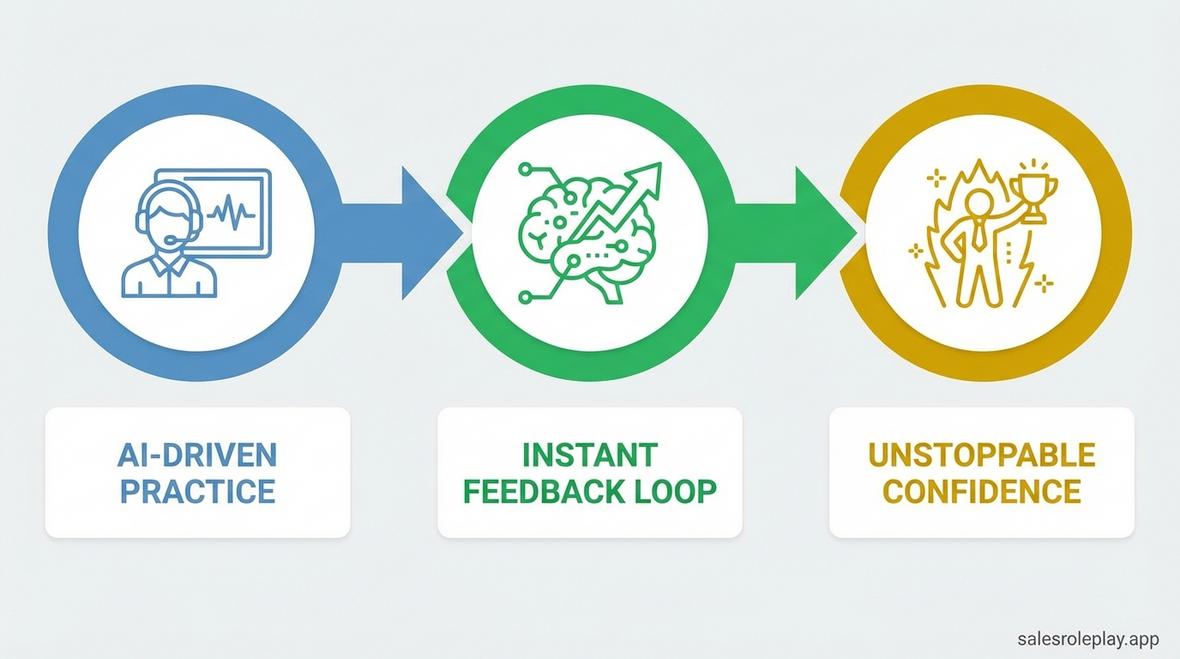
Consider the typical sales onboarding process: new hires receive product training, shadow experienced reps, and eventually begin making calls with minimal preparation. This sink-or-swim approach extends ramp time, increases early attrition, and leaves significant revenue on the table. Effective sales onboarding incorporating AI-powered pitch practice can reduce ramp time by up to 40 percent while building unstoppable confidence in new team members.
Building Confidence Through Repetition
Confidence is the antidote to the pitch monster. Sales professionals who have practiced their pitches dozens or hundreds of times approach conversations with the certainty that comes from preparation. This confidence translates into better tonality, improved listening, and the mental flexibility to adapt when conversations take unexpected turns.
AI-driven practice platforms allow reps to rehearse their pitches against various buyer personas, from the skeptical CFO to the enthusiastic champion. Each interaction provides data-driven feedback on pacing, word choice, objection handling, and value articulation. Over time, this creates neural pathways that make effective pitching automatic rather than anxiety-inducing.
The psychological impact of preparation cannot be overstated. When sales professionals know they have successfully navigated difficult scenarios in practice, they bring that success mindset to real customer interactions. This mental edge often makes the difference between closing deals and losing opportunities to competitors.
Common Pitch Monster Challenges Facing Sales Teams
Every sales organization battles unique variations of the pitch monster, but certain challenges appear consistently across industries. Understanding these common obstacles is the first step toward developing targeted training strategies that address specific weaknesses.
Cold Calling Anxiety and Initial Engagement
For many sales professionals, the pitch monster appears most intimidating during cold calling scenarios. The fear of rejection, combined with uncertainty about how prospects will respond, creates anxiety that undermines performance. This anxiety manifests as rushed speech, failure to pause for responses, and abandoning carefully crafted scripts at the first sign of resistance.
AI-powered cold call simulators allow reps to practice opening statements, permission-based openers, and attention-grabbing value propositions until they become second nature. By experiencing hundreds of simulated cold calls with varying prospect responses, sales professionals develop the resilience and adaptability needed to succeed in real conversations.
The technology industry particularly benefits from structured cold calling practice, as sales cycles involve reaching technical decision-makers who are notoriously difficult to engage. Technology sales teams using AI roleplay platforms report significant improvements in connect rates and meeting conversion percentages.
Objection Handling Struggles
Objections are where the pitch monster shows its teeth. When prospects raise concerns about price, timing, competitor offerings, or implementation complexity, unprepared sales reps often stumble, become defensive, or fail to address the underlying issue. Effective objection handling requires not just memorized responses but the ability to listen, empathize, and reframe concerns as opportunities.
Practicing objection handling with AI allows sales professionals to encounter the full spectrum of possible objections before facing them with real prospects. The AI buyer can be programmed to raise specific objections relevant to your industry, product, or target market, ensuring reps develop tailored responses rather than generic rebuttals.
Healthcare and financial services sales teams face particularly complex objections related to compliance, regulatory requirements, and risk management. By practicing these scenarios repeatedly, reps develop the confidence and competence to navigate sensitive topics without triggering additional concerns.
Discovery Call Effectiveness
The pitch monster often derails sales processes during discovery calls when reps fail to ask insightful questions, listen actively, or uncover genuine pain points. Many sales professionals rush through discovery to get to their pitch, missing critical information that would allow them to tailor their presentation effectively.
AI-powered discovery call training helps reps develop the discipline to follow proven frameworks like SPIN selling or MEDDIC while remaining conversational and authentic. The AI buyer responds realistically to different questioning approaches, rewarding thorough discovery with more detailed information and becoming evasive when reps ask surface-level questions.
This practice environment allows sales professionals to experiment with different discovery techniques, compare outcomes, and refine their approach based on what generates the most useful prospect information. Over time, this builds the instinct to probe deeper rather than accepting initial responses at face value.
AI-Powered Solutions to Tame Your Pitch Monster
Modern sales organizations are turning to artificial intelligence to provide the scalable, personalized practice opportunities their teams need to overcome pitch-related challenges. These solutions go beyond traditional training by offering realistic simulations, immediate feedback, and data-driven insights that accelerate skill development.
Realistic Buyer Personas for Targeted Practice
The effectiveness of pitch practice depends heavily on the realism of the practice environment. AI sales training platforms can simulate dozens of distinct buyer personas, each with unique communication styles, priorities, and objection patterns. This variety ensures that sales reps develop the versatility to adapt their pitches to different audience types.
For example, pitching to a risk-averse CFO requires a fundamentally different approach than engaging an innovation-focused Chief Technology Officer. AI buyer personas can be customized to reflect the specific characteristics of your target market, including industry-specific concerns, regulatory considerations, and organizational dynamics.
This targeted practice approach addresses one of the key weaknesses of traditional role-playing: colleagues cannot authentically embody the diverse range of buyer personalities sales reps will encounter. AI removes this limitation, providing exposure to every conceivable prospect type within a controlled training environment.
Instant Feedback Loops for Rapid Improvement
One of the most powerful features of AI-powered pitch practice is the ability to receive immediate, objective feedback on performance. Traditional coaching requires managers to observe calls, take notes, and schedule follow-up sessions a time-intensive process that limits the frequency of feedback.
AI platforms analyze every aspect of a practice pitch in real-time: word choice, pacing, filler words, question quality, objection handling effectiveness, and value articulation. This comprehensive analysis identifies specific areas for improvement and tracks progress over time, creating a personalized development roadmap for each team member.
The instant nature of this feedback enables rapid iteration. Sales reps can immediately retry scenarios incorporating the suggested improvements, reinforcing correct behaviors and eliminating ineffective habits before they become ingrained. This accelerated learning cycle is particularly valuable for sales managers who need to develop entire teams quickly without sacrificing quality.
Scalable Practice Opportunities Across Teams
Perhaps the most significant advantage of AI-powered pitch training is scalability. A single platform can support unlimited practice sessions across global sales teams, ensuring consistent training standards regardless of geography, time zone, or manager availability.
This scalability is especially critical for organizations with remote or distributed teams. AI-driven sales coaching for remote teams eliminates the logistical challenges of coordinating live practice sessions while providing every team member with equal access to high-quality training resources.
For rapidly growing companies, this scalability ensures that hiring velocity does not compromise training quality. New reps can begin practicing their pitches from day one, building skills in parallel with product knowledge acquisition rather than waiting for manager availability.
Implementing a Pitch Practice Program in Your Organization
Successfully taming the pitch monster requires more than technology it demands a structured approach to skill development integrated into your sales culture. Organizations that achieve the best results combine AI-powered practice tools with clear expectations, manager reinforcement, and recognition systems that reward improvement.
Establishing Practice Benchmarks and Standards
Effective pitch practice programs begin with clear performance standards. What constitutes a successful pitch in your organization? Which skills are most critical for your specific sales process? Defining these benchmarks creates objective criteria for evaluating progress and identifying training gaps.
Many organizations use frameworks like MEDDIC, SPIN, or Challenger to structure their pitch standards. AI training platforms can be configured to assess adherence to these methodologies, ensuring that practice sessions reinforce your chosen sales approach rather than conflicting with it.
Benchmark establishment also involves setting participation expectations. How many practice sessions should new hires complete during onboarding? What ongoing practice cadence do you expect from tenured reps? Clear expectations create accountability and ensure that practice becomes a regular habit rather than an occasional activity.
Integrating Manager Coaching with AI Practice
While AI provides scalable practice and feedback, human coaching remains essential for contextual guidance, motivation, and strategic development. The most effective programs combine AI-generated insights with manager-led coaching conversations that address individual challenges and career development.
Managers can use data from AI practice sessions to identify specific coaching opportunities. Rather than generic development conversations, they can focus on targeted areas where reps struggle: handling specific objections, asking better discovery questions, or articulating value propositions more compellingly.
This data-driven coaching approach maximizes manager productivity by focusing their limited time on high-impact interventions. Instead of spending hours observing calls to identify issues, managers receive detailed analytics highlighting exactly where each team member needs support.
Creating a Culture of Continuous Improvement
Conquering the pitch monster requires shifting organizational mindset from viewing training as an event to embracing it as an ongoing process. High-performing sales teams practice continuously, treating skill development with the same discipline athletes bring to physical training.
Creating this culture involves celebrating improvement, sharing best practices, and normalizing the idea that even top performers benefit from regular practice. When sales leaders publicly engage with AI training platforms and share their own development journeys, it sends a powerful message that continuous learning is valued at all levels.
Gamification elements like leaderboards, achievement badges, and team challenges can accelerate cultural adoption by making practice engaging and socially reinforcing. These elements tap into natural competitive instincts while creating visibility around who is investing in their development.
Measuring ROI from Pitch Training Initiatives
Sales enablement investments must demonstrate measurable business impact. When implementing AI-powered pitch practice, organizations should track specific metrics that connect training activities to revenue outcomes, proving value to executive stakeholders.
Key Performance Indicators to Monitor
Several KPIs directly reflect pitch training effectiveness: conversion rates at each sales stage, average deal size, sales cycle length, and ramp time for new hires. Comparing these metrics before and after training implementation reveals the program's impact on business results.
Activity metrics also matter: practice session completion rates, average scores on simulated pitches, and improvement trajectories over time. These leading indicators predict future sales performance and help identify which team members may need additional support before performance issues appear in real deals.
Customer feedback provides another valuable data point. Are prospects mentioning improved sales experiences? Are customer satisfaction scores rising? These qualitative signals complement quantitative metrics, painting a complete picture of training effectiveness.
Correlating Practice with Sales Outcomes
The most compelling ROI evidence comes from correlating individual practice behaviors with sales results. Organizations that track both training engagement and sales performance often discover strong relationships between practice frequency and quota attainment.
For example, analysis might reveal that reps who complete at least ten practice sessions monthly have 30 percent higher close rates than those who practice sporadically. These insights allow sales leaders to set data-backed practice expectations and predict performance based on training engagement.
This correlation also helps identify which specific practice scenarios drive the greatest performance improvements. If reps who practice objection handling show disproportionate improvement in close rates, that insight justifies investing more heavily in objection-focused training content.
Industry-Specific Pitch Monster Challenges and Solutions
While all sales professionals face pitch-related challenges, the specific manifestation of the pitch monster varies significantly by industry. Understanding these nuances allows for more targeted training approaches that address sector-specific obstacles.
Technology and SaaS Sales
Technology sales professionals often struggle with translating technical features into business value, handling sophisticated technical objections, and navigating complex decision-making units. The pitch monster in this sector appears as analysis paralysis, competitor comparisons, and lengthy evaluation cycles.
Effective pitch training for B2B SaaS teams emphasizes value articulation, ROI storytelling, and multi-threaded engagement strategies. AI practice scenarios should include technical buyers asking detailed integration questions, economic buyers focused on total cost of ownership, and champions seeking ammunition to sell internally.
Financial Services
Financial services sales teams face unique challenges around regulatory compliance, risk communication, and trust building. The pitch monster in this industry often manifests as prospect skepticism, concerns about fiduciary responsibility, and hesitation to change existing financial relationships.
Training for financial services must incorporate compliance requirements while developing skills in consultative selling, active listening, and handling sensitive financial discussions. AI scenarios should reflect the cautious, relationship-oriented nature of financial services buyers.
Healthcare and Pharmaceutical Sales
Healthcare sales professionals navigate complex stakeholder environments, stringent regulations, and evidence-based selling requirements. The pitch monster appears as clinical objections, formulary restrictions, and the need to communicate with diverse audiences from clinicians to administrators.
Pharmaceutical and medical device sales teams benefit from practice scenarios that replicate clinical conversations, require citation of study data, and involve navigating institutional decision-making processes. This specialized preparation ensures reps can confidently discuss clinical efficacy, safety profiles, and economic outcomes.
Advanced Techniques for Mastering Complex Pitches
Beyond foundational skills, elite sales professionals develop advanced techniques that allow them to handle the most challenging pitch scenarios. These capabilities separate top performers from average reps and command premium compensation in competitive markets.
Multi-Threading in Enterprise Deals
Enterprise sales often require pitching to multiple stakeholders with competing priorities. The pitch monster in complex deals appears as misalignment between decision-makers, political dynamics, and the challenge of maintaining momentum across extended sales cycles.
Advanced training should include scenarios where AI simulates entire buying committees, forcing reps to tailor messages for different roles while maintaining consistent positioning. This practice develops the orchestration skills necessary to navigate enterprise complexity successfully.
Storytelling and Emotional Connection
Data and logic alone rarely drive purchasing decisions. Elite sales professionals master storytelling techniques that create emotional connections, making abstract benefits tangible through customer success narratives and relatable analogies.
AI training platforms can evaluate storytelling effectiveness by analyzing narrative structure, emotional language usage, and the integration of customer examples into pitches. This feedback helps reps refine their stories until they consistently resonate with prospects.
The Future of Pitch Training and Sales Development
As AI technology continues advancing, pitch training will become increasingly sophisticated, personalized, and integrated into daily sales workflows. Understanding emerging trends helps organizations stay ahead of the curve in sales capability development.
Voice analysis technology will soon provide real-time feedback on tonality, pacing, and confidence levels during actual customer calls. This capability extends AI coaching beyond practice sessions into live selling situations, creating continuous learning opportunities.
Predictive analytics will identify which specific pitch elements correlate most strongly with deal progression, allowing organizations to focus training on the highest-impact skills. This data-driven approach ensures training investments generate maximum ROI.
Virtual reality integration will create even more immersive practice environments, simulating not just conversation dynamics but also body language, meeting room settings, and the psychological pressure of high-stakes presentations. These advances will further blur the line between practice and reality.
Frequently Asked Questions About Pitch Monster Challenges
What is the pitch monster in sales?
The pitch monster is a metaphor representing the collective challenges sales professionals face when delivering effective sales pitches, including prospect objections, anxiety, lack of preparation, and difficulty articulating value propositions consistently.
How can AI help sales teams overcome pitch challenges?
AI provides unlimited practice opportunities against realistic buyer personas, delivers instant objective feedback, identifies specific improvement areas, and scales training across entire organizations without requiring significant manager time investment.
How many practice sessions are needed to improve pitch performance?
Most sales professionals show measurable improvement after 10-15 structured practice sessions, with continued gains from ongoing practice. The key is consistent, deliberate practice with immediate feedback rather than occasional rehearsal.
Can experienced sales reps benefit from pitch practice?
Absolutely. Even top performers benefit from practicing new scenarios, refining messaging, and maintaining sharp skills. The best athletes practice continuously despite their success the same principle applies to sales professionals.
What metrics indicate successful pitch training?
Key metrics include improved conversion rates at each sales stage, reduced sales cycle length, higher average deal sizes, faster ramp time for new hires, and increased quota attainment percentages across the team.
Conclusion
The pitch monster representing all the challenges sales professionals face in delivering compelling, consistent pitches can be conquered through deliberate practice, AI-powered training, and a commitment to continuous improvement. Modern sales leaders have unprecedented tools to develop their teams' pitch capabilities at scale, from realistic AI buyer simulations to data-driven feedback systems. By implementing structured practice programs, setting clear performance standards, and creating cultures that value ongoing development, organizations can transform pitch performance and drive measurable revenue growth. The combination of technology enablement and human coaching creates unstoppable confidence in sales teams, turning the intimidating pitch monster into a manageable challenge that elite performers consistently overcome.
Ready to Transform Your Sales Training?
See how Salesroleplay can help you transform your sales training.