
How To Practice Sales Calls With AI: Complete 2026 Guide To Mastering Sales Conversations

Transform Your Sales Performance with AI-Powered Call Practice
Mastering sales calls has never been more critical or more challenging. In 2026, top-performing sales teams are leveraging artificial intelligence to practice, refine, and perfect their conversation skills at scale. The traditional approach of sporadic role-plays with managers or peers simply can't match the consistency, availability, and precision that AI sales roleplay platforms now deliver.
Learning how to practice sales calls with AI isn't just about adopting new technology it's about fundamentally transforming how your team develops skills, handles objections, and closes deals. According to Forrester reports, teams using AI for sales practice see 20-30% improvement in objection handling and discovery call conversion rates. This comprehensive guide will walk you through everything you need to know about implementing AI-powered sales call practice in your organization.
Understanding AI-Powered Sales Call Practice
AI-powered sales training represents a paradigm shift from traditional methods. Instead of waiting for scheduled role-play sessions or relying on limited manager availability, sales representatives can now engage in realistic, adaptive conversations with AI buyers anytime they need practice.
What Is AI Sales Call Practice?
AI sales call practice utilizes advanced conversational AI and natural language processing to simulate realistic buyer interactions. These systems analyze your responses in real-time, adapt their behavior based on your approach, and provide detailed feedback on performance metrics including tone, pacing, objection handling, and closing techniques.
Modern AI buyer personas can replicate hundreds of different customer archetypes from skeptical procurement managers to enthusiastic early adopters. This variety ensures sales representatives experience the full spectrum of scenarios they'll encounter in real-world situations.
Why Traditional Role-Play Methods Fall Short
Traditional sales training relies heavily on peer-to-peer role-plays and occasional manager coaching sessions. While these approaches have value, they suffer from several critical limitations:
- Limited Availability: Managers and peers have competing priorities, making consistent practice difficult to schedule
- Inconsistent Quality: The quality of role-play depends entirely on the skill and commitment of your practice partner
- Lack of Objectivity: Human feedback can be subjective and influenced by personal relationships
- No Performance Tracking: Traditional methods provide no quantifiable data on improvement over time
- Embarrassment Factor: Many reps avoid practice due to fear of judgment from colleagues
AI-powered practice eliminates these barriers, creating a judgment-free environment where representatives can fail, learn, and improve without career consequences. The technology provides automated call scoring that tracks progress objectively and identifies specific areas for improvement.
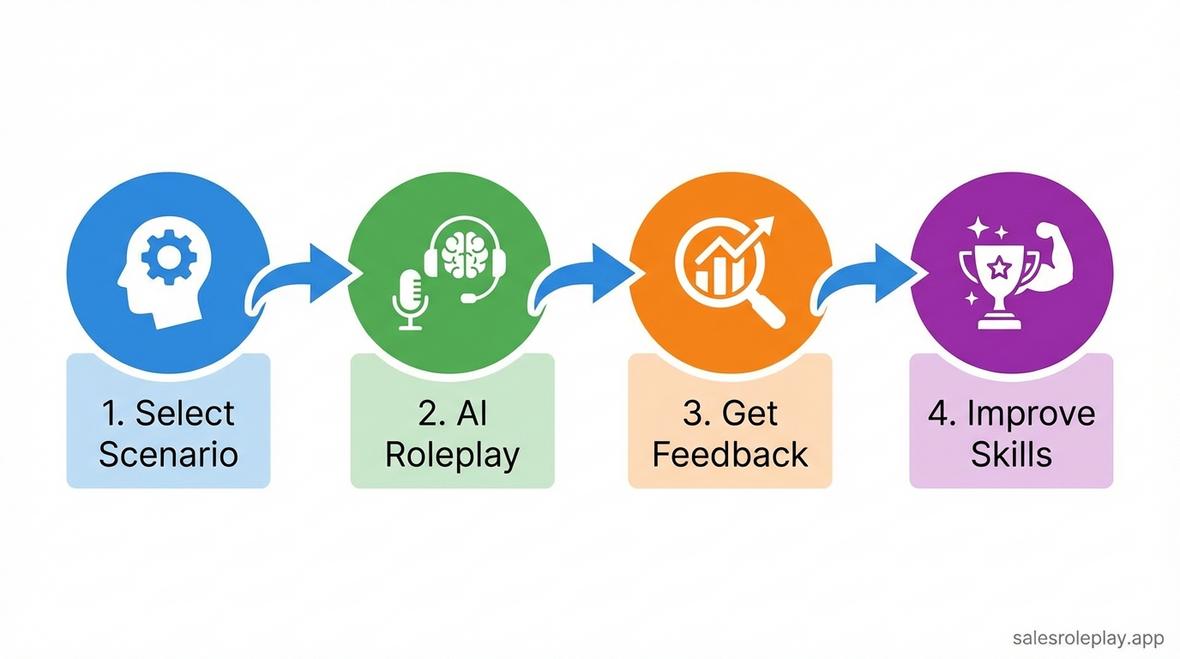
The Four-Step Process for AI Sales Call Practice
Effective AI-powered sales training follows a structured methodology that maximizes learning outcomes and skill development. This process ensures representatives don't just practice randomly they practice with purpose.
Step 1: Select Your Practice Scenario
Begin by identifying the specific skill or situation you want to improve. Modern AI platforms offer extensive sales roleplay scenarios covering:
- Cold calling: Initial outreach to prospects who have never heard of your solution
- Discovery calls: Needs assessment conversations that uncover pain points and priorities
- Product demonstrations: Showcasing features while maintaining focus on value
- Objection handling: Responding to price concerns, competitive comparisons, and timing issues
- Closing conversations: Asking for the business and handling final hesitations
- Negotiation: Discussing terms, pricing, and contract details
The key is choosing scenarios that align with your current development needs or upcoming real-world situations. If you have a major enterprise deal closing next week, practice that specific scenario rather than general cold calling techniques.
Step 2: Engage in AI Roleplay
Once you've selected your scenario, the AI simulation begins. The experience typically involves:
- Voice-based interaction: Speak naturally as you would in a real call
- Adaptive responses: The AI buyer adjusts their reactions based on your approach
- Real-time challenge: Experience authentic objections, questions, and buying signals
- Natural conversation flow: No scripted paths the conversation evolves organically
Advanced platforms like Sales Roleplay create remarkably realistic interactions that feel indistinguishable from actual customer conversations. The AI doesn't follow predetermined scripts it responds dynamically to your specific words, tone, and approach.
Step 3: Get Detailed Performance Feedback
After completing your practice session, the AI analyzes your performance across multiple dimensions. Comprehensive feedback typically includes:
- Talk-to-listen ratio: Did you speak too much or ask enough questions?
- Speaking pace: Were you rushing or speaking too slowly?
- Filler words: How often did you say 'um,' 'like,' or 'you know'?
- Question quality: Did you ask open-ended discovery questions?
- Objection handling: How effectively did you address concerns?
- Value articulation: Did you focus on features or business outcomes?
- Closing effectiveness: Did you clearly ask for next steps?
This granular analysis provides actionable insights you can immediately apply in your next practice session or real call. The feedback isn't vague encouragement it's specific, measurable guidance on exactly what to improve.
Step 4: Track Progress and Improve Skills
Consistent practice with AI creates measurable improvement over time. The best platforms track your performance across sessions, revealing:
- Skill development trends: Which areas are improving fastest?
- Persistent weaknesses: Which skills need additional focus?
- Comparative performance: How do you rank against team benchmarks?
- Scenario mastery: Which situations have you conquered versus those needing work?
This data-driven approach transforms sales development from subjective art into measurable science. Managers gain visibility into individual and team capabilities, enabling targeted coaching interventions. Representatives see tangible evidence of their improvement, which builds confidence and motivation.
How to Implement AI Sales Call Practice in Your Organization
Successfully integrating AI practice into your sales culture requires thoughtful planning and change management. Here's how forward-thinking organizations are making the transition.
Choosing the Right AI Sales Training Platform
Not all AI sales training solutions are created equal. When evaluating platforms, consider:
- Conversation quality: Does the AI create truly realistic interactions or feel robotic?
- Scenario library: Are industry-specific and role-specific scenarios available?
- Customization options: Can you create scenarios reflecting your unique sales process?
- Analytics depth: Does the platform provide actionable insights or just basic scores?
- Integration capabilities: Does it connect with your CRM and existing tech stack?
- Mobile accessibility: Can reps practice on-the-go from any device?
Platforms like Sales Roleplay excel in these areas, offering industry-leading conversation quality and comprehensive analytics that drive measurable performance improvement.
Creating a Culture of Consistent Practice
Technology alone doesn't drive results you need organizational commitment to practice. Successful implementations include:
- Mandatory practice sessions: Require minimum weekly practice completions
- Manager participation: Leaders should practice publicly to normalize the behavior
- Integration with onboarding: New hires complete scenario progressions before making real calls
- Recognition programs: Celebrate improvement and consistent practice habits
- Pre-call preparation: Encourage reps to practice scenarios before important meetings
The goal is making AI practice as routine as checking email not an occasional special activity but an integral part of daily sales operations.
Measuring ROI and Business Impact
To justify investment and sustain executive support, track concrete business outcomes:
- Ramp time reduction: How quickly do new hires reach full productivity?
- Win rate improvement: Are close rates increasing for specific deal types?
- Average deal size: Are reps getting better at selling value versus discounting?
- Objection conversion: What percentage of objections are successfully handled?
- Sales cycle length: Are deals progressing faster through the pipeline?
Organizations implementing comprehensive AI-powered sales training techniques typically see measurable improvements within 60-90 days of consistent usage.
Specific Use Cases for AI Sales Call Practice
Different sales scenarios benefit from AI practice in unique ways. Here's how to apply the technology to specific situations your team encounters.
Mastering Cold Calling
Cold calling remains one of the most challenging and most important sales skills. AI practice helps representatives overcome call reluctance by providing unlimited repetitions without real-world consequences. Practice scenarios should include:
- Getting past gatekeepers with confidence and authenticity
- Delivering compelling value propositions in 30 seconds or less
- Handling immediate objections like 'not interested' or 'send me information'
- Qualifying prospects quickly to avoid wasting time
- Securing meetings rather than providing free consulting
Reps can practice dozens of cold calls daily with AI, building muscle memory and confidence before dialing actual prospects. The private nature of AI practice eliminates the fear factor that paralyzes many representatives.
Perfecting Discovery Calls
Discovery calls determine whether opportunities progress or stall. AI simulations help representatives master the art of asking powerful questions and actively listening. Key practice areas include:
- Building rapport quickly in virtual environments
- Asking open-ended questions that uncover true pain points
- Avoiding premature solution pitching
- Identifying economic buyers and decision criteria
- Establishing clear next steps and mutual commitment
The discovery call training modules can simulate various buyer personalities from forthcoming stakeholders who volunteer information to guarded prospects who answer questions minimally.
Advanced Objection Handling
Every salesperson faces objections, but top performers handle them with confidence and skill. AI practice allows representatives to encounter and overcome objections repeatedly until responses become instinctive. Common objection categories to practice include:
- Price objections: 'This is too expensive' or 'I can get it cheaper elsewhere'
- Timing objections: 'We're not ready' or 'Call me next quarter'
- Authority objections: 'I need to check with my boss'
- Competitive objections: 'We're already using [competitor]'
- Risk objections: 'This seems too complicated' or 'What if it doesn't work?'
The best objection handling training doesn't teach scripted responses it helps representatives understand the underlying concerns and address them authentically.
Industry-Specific Sales Scenarios
Different industries present unique challenges that require specialized practice. AI platforms can create tailored scenarios for:
- Pharmaceutical sales: Navigating healthcare regulations and clinical evidence discussions
- B2B SaaS: Demonstrating complex software and handling technical questions
- Financial services: Building trust while discussing sensitive money matters
- Real estate: Managing emotional decisions and negotiating terms
- Medical devices: Selling to clinical and economic buyers simultaneously
Industry-specific practice ensures representatives don't just learn generic sales skills they master the nuances of their particular market.
Advanced Strategies for Maximizing AI Practice Results
Once your team has adopted basic AI practice habits, these advanced strategies will accelerate skill development even further.
Pre-Call Rehearsal
The most sophisticated sales professionals use AI to rehearse before important calls. If you have a critical demo scheduled with a C-level executive tomorrow, spend 20 minutes practicing that exact scenario with AI today. This preparation:
- Identifies potential objections you haven't considered
- Helps you refine your value proposition for that specific buyer
- Builds confidence by visualizing success
- Reveals gaps in your knowledge that require research
Think of it like professional athletes watching game film and running practice drills before the big game. The actual call becomes much easier when you've already 'performed' it successfully in practice.
Gamification and Team Challenges
Create friendly competition around AI practice to boost engagement:
- Weekly leaderboards showing who completed the most practice sessions
- Team challenges where everyone must master specific scenarios
- Recognition for improvement velocity, not just absolute performance
- Scenario completion badges and achievement systems
Gamification taps into intrinsic motivation, making practice feel less like mandatory training and more like skill development you want to pursue.
Integrating AI Insights into Manager Coaching
AI practice data should inform one-on-one coaching conversations. Managers can:
- Review practice session recordings to identify coaching opportunities
- Compare individual performance against team benchmarks
- Assign specific scenarios targeting individual weaknesses
- Track whether coaching interventions drive measurable improvement
This data-driven approach makes coaching dramatically more effective than generic advice or subjective observations.
Common Mistakes to Avoid
Organizations implementing AI sales practice often stumble in predictable ways. Avoid these pitfalls to maximize your results.
Mistake #1: Inconsistent Usage
Practicing once or twice then abandoning the platform delivers zero value. Skill development requires consistent repetition over weeks and months. Establish minimum practice requirements such as three 20-minute sessions weekly and hold people accountable.
Mistake #2: Ignoring the Feedback
Some representatives complete practice sessions but never review their performance analytics. This is like going to the gym and ignoring your trainer's form corrections. The feedback is where learning happens. Require representatives to identify one specific improvement area after each session.
Mistake #3: Using Only Generic Scenarios
While standard scenarios provide value, the most powerful practice mirrors your actual sales situations. Invest time creating custom scenarios reflecting your specific products, buyer personas, and common objections. The more realistic the practice, the more transferable the skills.
Mistake #4: Treating AI as a Complete Replacement
AI practice is incredibly powerful but shouldn't completely replace human coaching and peer learning. The optimal approach combines AI practice for skill repetition with manager coaching for strategic guidance and peer collaboration for sharing best practices.
The Future of AI-Powered Sales Training
As AI technology evolves, sales practice will become even more sophisticated and valuable. Emerging trends include:
- Emotional intelligence analysis: AI detecting and providing feedback on empathy and rapport-building
- Video-based practice: Analyzing body language and facial expressions during virtual sales calls
- Personalized learning paths: AI recommending specific scenarios based on individual skill gaps
- Integration with real calls: AI analyzing actual customer conversations and suggesting relevant practice scenarios
- Multilingual capabilities: Practicing sales conversations in any language with culturally appropriate nuances
Organizations that embrace these capabilities early will develop significant competitive advantages in sales effectiveness.
Frequently Asked Questions
How much time should sales reps spend practicing with AI weekly?
Most organizations see optimal results with 60-90 minutes of AI practice weekly, typically broken into three 20-30 minute sessions. This frequency builds skills without overwhelming representatives or taking excessive time away from selling activities.
Can AI practice really replace traditional role-playing?
AI practice doesn't necessarily replace traditional methods but dramatically enhances them. AI provides consistent, scalable, judgment-free repetition that traditional role-plays can't match. However, occasional human role-plays and coaching sessions still add value for strategic guidance and interpersonal skill development.
How long before we see measurable improvement?
Most teams observe noticeable improvements in specific metrics within 30-60 days of consistent practice. However, truly transformative results such as significant win rate increases or ramp time reductions typically emerge after 90-120 days of sustained usage.
Is AI sales practice effective for experienced representatives?
Absolutely. Even top performers benefit from AI practice, particularly when preparing for high-stakes calls, learning new products, or entering new markets. The best athletes in the world still practice daily sales professionals should do the same.
What's the typical ROI of implementing AI sales training?
Organizations typically see 3-5x ROI within the first year through faster rep ramp times, higher win rates, and larger average deal sizes. The exact ROI varies based on implementation quality and adoption rates.
Conclusion
Learning how to practice sales calls with AI represents one of the most impactful investments modern sales organizations can make. By providing unlimited, realistic practice opportunities with objective feedback, AI eliminates the traditional barriers that prevented consistent skill development. The four-step process selecting relevant scenarios, engaging in adaptive roleplay, receiving detailed feedback, and tracking improvement creates a systematic path to sales excellence. Whether you're onboarding new representatives, upskilling experienced professionals, or preparing for critical customer conversations, AI-powered practice delivers measurable results that directly impact revenue. The question isn't whether to adopt this technology, but how quickly you can implement it to gain competitive advantage in 2026 and beyond.
Ready to Transform Your Sales Training?
See how Salesroleplay can help you transform your sales training.