
Cold Calling Practice AI: Master Sales Calls With Intelligent Training In 2026
Introduction to Cold Calling Practice AI
Cold calling remains one of the most challenging yet essential skills in sales. Despite digital transformation reshaping the business landscape, the ability to connect with prospects through voice conversations continues to drive revenue across industries. However, traditional cold calling training methods shadowing senior reps, sporadic role-plays, and infrequent coaching sessions often fail to provide the consistent, scalable practice that sales professionals need to excel.
This is where cold calling practice AI emerges as a transformative solution. By leveraging artificial intelligence, sales teams can now access unlimited, realistic practice scenarios that simulate actual buyer conversations. AI-powered platforms analyze performance in real-time, provide instant feedback, and adapt to individual skill levels, creating a personalized learning experience that accelerates skill development far beyond traditional methods.
In 2026, organizations that embrace cold calling practice AI are seeing measurable improvements in connect rates, conversion ratios, and overall sales performance. This comprehensive guide explores how AI-powered cold calling practice works, its benefits, implementation strategies, and why it's becoming the standard for sales training excellence.
Understanding Cold Calling Practice AI Technology
Cold calling practice AI represents a sophisticated convergence of conversational AI, speech recognition, natural language processing, and machine learning algorithms designed specifically for sales training. Unlike simple chatbots or scripted practice tools, these platforms create dynamic, responsive practice environments that mirror real buyer interactions.
How AI-Powered Cold Calling Practice Works
The technology operates through several integrated components. First, speech recognition engines capture and transcribe the sales representative's spoken words in real-time. Advanced natural language understanding then analyzes not just what was said, but how it was delivered including tone, pace, confidence levels, and emotional resonance.
The AI buyer persona responds contextually, adapting its objections, questions, and engagement level based on the rep's performance. If a salesperson delivers a weak value proposition, the AI might express skepticism or disinterest. Conversely, strong opening statements trigger more engaged responses, creating a realistic simulation of buyer behavior.
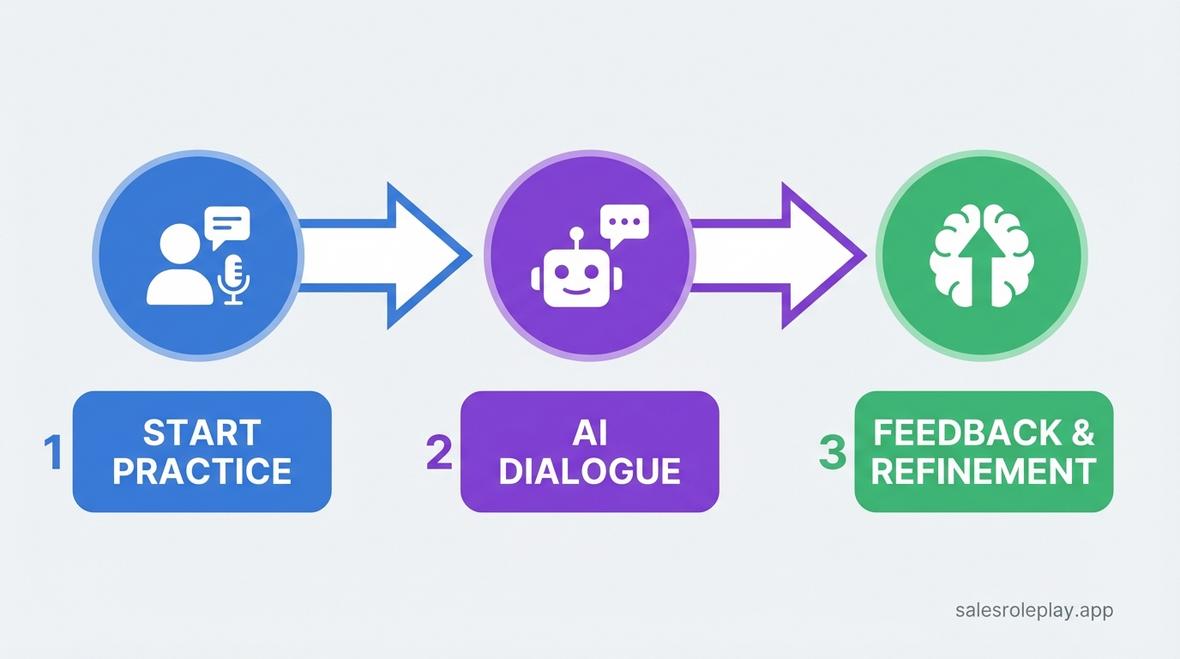
Performance analytics engines continuously evaluate multiple dimensions of the conversation. These include talk-to-listen ratios, filler word frequency, objection handling effectiveness, question quality, and adherence to proven methodologies. After each practice session, reps receive detailed feedback highlighting specific improvement areas with actionable recommendations.
Key Technologies Powering AI Practice Platforms
Modern cold calling practice AI platforms incorporate several cutting-edge technologies. Conversational AI enables natural, flowing dialogues that feel authentic rather than robotic. Machine learning algorithms continuously improve by analyzing thousands of practice sessions, identifying patterns that correlate with successful outcomes.
Sentiment analysis tools detect emotional cues in both the rep's delivery and the AI buyer's responses, helping salespeople develop emotional intelligence. Voice biometrics can identify stress indicators, helping reps learn to manage call anxiety. Integration capabilities allow these platforms to connect with CRM systems, learning management platforms, and sales engagement tools, creating a comprehensive training ecosystem.
Transformative Benefits of AI-Powered Cold Calling Practice
Organizations implementing cold calling practice AI report substantial improvements across multiple performance metrics. These benefits extend beyond individual skill development to impact team dynamics, coaching efficiency, and overall revenue generation.
Unlimited, On-Demand Practice Opportunities
Traditional role-play requires coordinating schedules between sales reps and managers or peers, limiting practice frequency. AI eliminates these constraints, providing 24/7 access to unlimited practice scenarios. Sales professionals can practice before important calls, refine specific techniques during downtime, or work on skill development outside business hours.
This accessibility is particularly valuable for mastering cold calling techniques that require repetition to internalize. Research shows that skill acquisition accelerates dramatically with increased practice frequency. AI platforms enable the high-repetition training that transforms knowledge into instinctive capability.
Instant, Objective, Data-Driven Feedback
Human coaching, while valuable, can be inconsistent and subjective. Managers may focus on different aspects depending on their own experiences and biases. Cold calling practice AI provides standardized, objective feedback based on data analysis rather than opinion.
Every practice session generates detailed performance metrics including talk time percentage, question-to-statement ratio, objection handling success rates, and confidence scores. This quantitative feedback helps reps understand precisely what to improve and track progress over time. The removal of subjective judgment also eliminates the anxiety some reps feel during manager-observed role-plays, creating a psychologically safe practice environment.
Personalized Learning Paths and Adaptive Scenarios
AI platforms analyze individual performance patterns to create customized training recommendations. A rep who struggles with handling price objections receives more scenarios featuring budget concerns. Someone who excels at opening statements but falters during discovery gets targeted practice on questioning techniques.
This personalization extends to difficulty progression. As skills improve, the AI introduces more challenging scenarios tougher objections, more skeptical buyers, complex decision-making environments. This adaptive approach ensures reps are always working at the edge of their capabilities, the optimal zone for skill development.
Scalable Training Infrastructure for Growing Teams
Scaling traditional sales training is resource-intensive, requiring proportional increases in coaching staff. Cold calling practice AI scales effortlessly, supporting teams from ten to ten thousand reps without additional human resources.
This scalability is particularly valuable for organizations experiencing rapid growth, seasonal hiring surges, or distributed teams across multiple time zones. Every rep receives consistent, high-quality training regardless of location or team size. Platforms like AI sales roleplay solutions demonstrate how technology democratizes access to world-class sales training.
Implementing Cold Calling Practice AI: Strategic Approaches
Successfully deploying cold calling practice AI requires more than technology adoption it demands strategic planning, change management, and integration with existing training frameworks.
Assessing Needs and Selecting the Right Platform
Begin by conducting a comprehensive skills gap analysis. Identify specific cold calling challenges your team faces: Are reps struggling with objection handling? Do they talk too much and listen too little? Is call anxiety preventing them from making enough attempts?
Evaluate platforms based on your specific requirements. Consider factors like scenario customization capabilities, integration with your existing tech stack, analytics depth, and user experience. Industry-specific features matter a B2B SaaS sales team has different needs than insurance sales professionals.
Request demonstrations with actual use cases from your industry. Test the AI's conversational quality does it feel natural or robotic? Evaluate the feedback quality is it actionable or generic? Platforms like salesroleplay.app offer industry-specific training modules tailored to various sectors including technology, healthcare, financial services, and home services.
Integrating AI Practice with Existing Training Programs
Cold calling practice AI works best as a complement to, not replacement for, human coaching. Design an integrated approach where AI provides high-volume practice and immediate feedback, while human coaches focus on strategic guidance, motivation, and complex skill development.
Structure your program with clear practice requirements. For example, mandate three AI practice sessions weekly, with human coaching sessions reviewing AI-generated performance data. This hybrid approach leverages the strengths of both modalities AI's scalability and consistency with human judgment and relationship-building.
Incorporate AI practice into your sales onboarding program. New hires can begin practicing immediately, building confidence before making actual prospect calls. Accelerated practice during onboarding significantly reduces time-to-productivity.
Creating Engagement and Driving Adoption
Technology adoption succeeds or fails based on user engagement. Create a culture of practice by celebrating improvement, not just results. Share success stories of reps who improved specific metrics through consistent AI practice.
Gamification elements enhance engagement. Leaderboards showing practice frequency or improvement rates, achievement badges for milestone completions, and team challenges create healthy competition. However, ensure the focus remains on skill development rather than pure competition, which can create counterproductive pressure.
Leadership participation signals importance. When sales managers and directors engage with cold calling practice AI themselves, it demonstrates that continuous improvement applies to everyone, not just struggling reps. This top-down commitment accelerates cultural adoption.
Industry-Specific Applications of Cold Calling Practice AI
Different industries face unique cold calling challenges that require specialized training approaches. Cold calling practice AI platforms increasingly offer industry-specific scenarios and buyer personas.
Technology and SaaS Sales
Tech sales professionals face highly informed, skeptical buyers and complex, multi-stakeholder decision processes. AI practice for technology sales should include scenarios featuring technical objections, competitive comparisons, and requests for detailed product specifications.
Effective AI training for this sector incorporates buyer personas at various organizational levels from technical evaluators focused on integration capabilities to executive buyers concerned with ROI and strategic fit. Reps practice navigating these different conversation styles, learning when to dive into technical details versus maintaining strategic focus.
Financial Services and Insurance
Financial services sales requires building trust quickly while navigating regulatory compliance requirements. Cold calling practice AI for this industry emphasizes compliant language, ethical selling practices, and consultative approaches that prioritize client needs over product pushing.
Insurance-specific scenarios might include prospects with existing coverage, price-sensitive buyers, or individuals who've had negative prior experiences with insurance salespeople. AI practice helps reps develop the patience and consultative skills essential for success in these trust-dependent sectors.
Home Services and Trades
Industries like roofing, HVAC, and solar sales face unique challenges including high homeowner skepticism, emergency service requests versus proactive sales, and seasonal demand fluctuations.
AI practice scenarios for home services should include emergency situations requiring empathy and urgency, homeowners comparison shopping multiple providers, and prospects concerned about contractor reliability. Training emphasizes relationship-building, local market knowledge, and overcoming the negative stereotypes some homeowners hold about service contractors.
Advanced Features in Modern Cold Calling Practice AI
Leading cold calling practice AI platforms continue evolving, incorporating increasingly sophisticated capabilities that enhance training effectiveness.
Real-Time Coaching and Battlecards
Some advanced platforms provide real-time assistance during actual sales calls, not just practice sessions. These systems listen to live conversations and display relevant battlecards, suggested responses to objections, or reminders about key discovery questions.
This real-time support bridges the gap between practice and performance, providing a safety net during actual buyer interactions. It's particularly valuable for new reps still building confidence, effectively extending the practice environment into real-world scenarios.
Emotion and Sentiment Analysis
Advanced cold calling practice AI doesn't just evaluate what you say it assesses how you say it. Emotion detection algorithms identify enthusiasm, confidence, nervousness, or frustration in your voice, providing feedback on emotional delivery.
This capability helps reps develop the emotional intelligence essential for sales success. Learning to project confidence even when feeling nervous, maintaining enthusiasm through rejection, and reading subtle buyer cues separates top performers from average ones.
Multilingual and Cultural Adaptation
Global sales teams require training that accounts for language differences and cultural communication norms. Modern AI platforms offer multilingual practice scenarios with culturally appropriate buyer personas.
A platform might simulate German business buyers who prefer direct, fact-based conversations versus Japanese prospects who value relationship-building and indirect communication. This cultural intelligence training prepares reps for success in diverse global markets.
Measuring ROI and Impact of AI Cold Calling Practice
Demonstrating training ROI remains a persistent challenge in sales enablement. Cold calling practice AI generates extensive data that facilitates rigorous impact measurement.
Key Performance Metrics to Track
Track both activity metrics (practice session frequency, scenario completion rates, time invested) and outcome metrics (connect rates, meeting conversion percentages, pipeline generated). The correlation between practice volume and performance improvement typically becomes evident within 60-90 days.
Monitor skill-specific improvements like objection handling success rates, average call duration, question-to-statement ratios, and talk-time percentages. These granular metrics help identify which training elements drive the greatest impact.
Compare performance between reps who actively engage with AI practice versus those who don't. Control for other variables like territory quality, product knowledge, and experience level. This comparative analysis provides the clearest picture of AI training impact.
Accelerating Time-to-Productivity for New Hires
One of the most significant ROI indicators is reduced ramp time for new sales reps. Organizations implementing AI-powered training report 30-50% reductions in the time required for new hires to reach full productivity.
Calculate the financial impact by multiplying the reduced ramp time by average rep quota and achievement rates. For example, if AI practice reduces ramp time from 6 months to 4 months for a rep with a $500,000 annual quota, the organization gains approximately $83,000 in additional revenue per new hire annually.
Coaching Efficiency and Manager Productivity
Cold calling practice AI doesn't just improve rep performance it transforms coaching efficiency. Managers spend less time on basic skill development and more on strategic coaching, deal strategy, and motivation.
Quantify this by tracking manager time allocation before and after AI implementation. If managers previously spent 10 hours weekly on basic role-play and now spend 3 hours reviewing AI-generated performance data and providing strategic guidance, that's 7 hours redirected to higher-value activities approximately 350 hours annually per manager.
Best Practices for Cold Calling Practice AI Success
Maximizing the value of cold calling practice AI requires thoughtful implementation and ongoing optimization.
Establish Clear Practice Requirements
Set specific, measurable practice expectations. For example, require all reps to complete a minimum of three AI practice sessions weekly, with at least one session focused on their weakest skill area identified by performance data.
Make practice requirements part of performance expectations and compensation structures when appropriate. What gets measured and incentivized gets done. However, balance enforcement with intrinsic motivation help reps see practice as career development, not just compliance.
Customize Scenarios to Match Your Reality
Generic practice scenarios provide some value, but customized scenarios matching your actual buyer personas, common objections, and product specifics deliver significantly greater impact. Invest time in configuring AI scenarios that mirror your sales reality.
Include your actual sales scripts and talk tracks in the training content. This ensures reps practice with the language and frameworks your organization has proven effective, creating consistency across your sales team.
Integrate with Your Sales Methodology
If your organization follows specific sales methodologies like MEDDPICC, Challenger, or SPIN Selling, ensure your cold calling practice AI reinforces these frameworks. AI scenarios should require reps to identify economic buyers (MEDDPICC), teach prospects something new (Challenger), or uncover implications of problems (SPIN).
This integration prevents the confusion that occurs when different training elements teach conflicting approaches. Consistent reinforcement of your chosen methodology across all training modalities accelerates adoption and effectiveness.
Combine AI Practice with Human Coaching
The optimal training approach leverages both AI and human elements. Use cold calling practice AI for high-volume, foundational skill development and immediate feedback. Reserve human coaching for strategic discussions, complex skill development, and motivational support.
Structure coaching conversations around AI-generated performance data. Rather than managers asking 'How do you think that role-play went?' (which yields unreliable self-assessments), they can reference specific metrics: 'Your objection handling success rate improved 15% this month let's discuss what's working and how to maintain that momentum.'
Overcoming Common Implementation Challenges
While cold calling practice AI offers substantial benefits, organizations encounter predictable challenges during implementation.
Addressing Resistance and Skepticism
Some sales professionals initially resist AI practice, viewing it as impersonal or questioning whether AI can truly simulate real buyer interactions. Address this through pilot programs with influential team members who can become internal champions.
Provide transparent communication about how AI complements rather than replaces human interaction. Emphasize that the goal is providing unlimited practice opportunities, not eliminating human coaching or judgment.
Driving Consistent Adoption and Usage
Initial enthusiasm often fades without ongoing engagement strategies. Create routine touchpoints where practice becomes part of weekly rhythms team meetings reviewing aggregate performance trends, monthly challenges focusing on specific skills, or quarterly competitions with meaningful recognition.
Make performance data visible and actionable. Dashboards showing individual progress, team trends, and improvement correlations with business outcomes help reps connect practice with results, reinforcing the value of continued engagement.
Managing Integration and Technical Challenges
Technical integration with existing systems can present obstacles. Work closely with platform providers to ensure smooth connections with your CRM, LMS, and other sales technology. Prioritize platforms with robust APIs and established integration partnerships.
Address technical issues promptly to prevent frustration that damages adoption. Designate internal champions who can troubleshoot common problems and escalate technical issues efficiently.
The Future of Cold Calling Practice AI
The trajectory of cold calling practice AI points toward increasingly sophisticated, personalized, and integrated solutions.
Predictive Performance Analytics
Emerging AI capabilities will predict performance outcomes based on practice patterns. Algorithms might identify that reps who struggle with a specific objection type in practice are likely to face pipeline challenges in 30-60 days, enabling proactive intervention.
This predictive capability transforms training from reactive (addressing problems after they manifest in results) to proactive (preventing problems through early-stage skill development).
Virtual Reality and Immersive Experiences
While current cold calling practice AI focuses on voice interactions, integration with virtual reality will create fully immersive practice environments. Reps might practice not just phone calls but video meetings and in-person presentations with AI-generated buyer avatars displaying realistic body language and facial expressions.
This multisensory training enhances skill transfer to real-world scenarios by engaging more cognitive and emotional systems during practice.
Continuous Learning Ecosystems
The future lies in comprehensive learning ecosystems where cold calling practice AI represents one component of an integrated development platform. These ecosystems will combine AI practice, human coaching, peer learning communities, microlearning content, and real-world performance analytics into seamless development experiences.
Continuous learning becomes embedded in daily work rather than existing as separate training events, fundamentally transforming how sales organizations develop talent.
Frequently Asked Questions
How does cold calling practice AI differ from regular role-play?
Traditional role-play depends on human availability, provides subjective feedback, and offers limited scenario variety. Cold calling practice AI provides unlimited 24/7 access, objective data-driven feedback, adaptive difficulty levels, and extensive scenario libraries. AI eliminates scheduling constraints and performance anxiety associated with manager-observed role-plays while generating detailed analytics impossible with human-only approaches.
Can AI really simulate realistic buyer conversations?
Modern conversational AI has advanced dramatically, creating surprisingly realistic buyer interactions. While not perfectly indistinguishable from humans, quality platforms generate natural dialogue flows, contextually appropriate objections, and adaptive responses based on rep performance. The realism suffices for effective skill development research shows that practice with AI buyers transfers effectively to real-world performance improvements.
How much practice time is needed to see improvements?
Most sales professionals see measurable improvement after 5-10 focused practice sessions. Significant skill transformation typically requires 20-30 sessions over 6-8 weeks. Consistency matters more than volume three 15-minute sessions weekly yields better results than occasional marathon practice days. The exact timeline varies based on current skill levels, practice quality, and application of feedback between sessions.
Does AI practice work for experienced sales professionals or just beginners?
Cold calling practice AI benefits salespeople at all experience levels. Beginners develop foundational skills rapidly. Experienced reps refine specific weaknesses, prepare for high-stakes calls, or explore new approaches risk-free. Top performers use AI practice to maintain sharp skills during slow periods or experiment with advanced techniques. Adaptive difficulty ensures appropriately challenging scenarios regardless of experience level.
What technical requirements are needed for cold calling practice AI?
Most platforms require only a modern web browser, stable internet connection, and microphone. Some offer mobile apps for practice anywhere. No specialized hardware is typically required. Cloud-based architecture means no IT infrastructure investment. However, integration with existing CRM and LMS systems may require API configuration and IT coordination depending on your technology stack complexity.
How do you measure ROI from AI cold calling practice?
Track multiple metrics including connect rates, meeting conversion percentages, pipeline generation, average deal sizes, and win rates before and after implementation. Monitor skill-specific improvements like objection handling success and question quality. Calculate reduced ramp time for new hires and coaching time efficiency gains. Compare performance between reps who actively practice versus those who don't. Comprehensive measurement typically shows positive ROI within 90-180 days for organizations with consistent adoption.
Conclusion
The evolution of cold calling practice AI represents a fundamental transformation in sales training methodology. By providing unlimited, realistic practice opportunities with instant, objective feedback, AI platforms address the core limitations of traditional training approaches scalability, consistency, and practice frequency.
Organizations that embrace this technology are seeing measurable improvements across critical performance metrics, from accelerated new hire productivity to enhanced objection handling success rates. The key to maximizing value lies not in replacing human coaching but in creating integrated training ecosystems where AI handles high-volume skill practice while human coaches focus on strategic development and motivation.
As we move further into 2026, cold calling practice AI will continue evolving with predictive analytics, immersive experiences, and deeper integration with comprehensive sales enablement platforms. Sales leaders who invest in these technologies now position their teams for sustained competitive advantage in increasingly challenging markets. The question is no longer whether to adopt AI-powered practice, but how quickly your organization can implement it effectively.

Ready to Transform Your Sales Training?
See how Salesroleplay can help you transform your sales training.