
Cold Calling Practice AI: Master Sales Calls With Intelligent Training In 2026

The Evolution of Cold Calling Practice with AI Technology
Cold calling remains one of the most challenging yet essential skills in sales, but the way sales professionals practice and master this skill has undergone a revolutionary transformation. Cold calling practice AI has emerged as a game-changing solution that addresses the fundamental limitations of traditional practice methods. In 2026, sales teams are no longer dependent on scarce manager time, static scripts, or awkward role-plays with colleagues. Instead, they're leveraging intelligent AI systems that provide unlimited practice opportunities, instant feedback, and data-driven coaching that accelerates skill development.
The traditional approach to cold calling practice has always been plagued by inconsistency. Sales reps might practice with a manager once a week, rely on outdated scripts, or simply learn on the job by making real calls to prospects an expensive and often painful learning method. Cold calling practice powered by artificial intelligence eliminates these barriers by creating a safe, scalable, and sophisticated training environment where sales professionals can refine their approach without the risk of losing real deals.
What Is Cold Calling Practice AI and Why It Matters
Cold calling practice AI refers to artificial intelligence-powered platforms that simulate realistic sales conversations, allowing sales representatives to practice their cold calling techniques in a controlled environment. These systems use natural language processing, speech recognition, and machine learning to create dynamic conversations that adapt to the rep's responses, much like a real prospect would.
Unlike static scripts or pre-recorded scenarios, cold calling practice AI generates authentic objections, asks challenging questions, and evaluates performance based on multiple criteria including tone, pacing, objection handling, and adherence to sales methodologies. The technology has matured significantly, with platforms like SalesRoleplay.app offering sophisticated AI buyers that mirror real-world prospect behaviors across various industries and roles.
The importance of this technology cannot be overstated. According to recent sales training research, sales professionals who engage in regular, deliberate practice improve their performance by 20-30% compared to those who only learn through live calls. However, traditional practice methods are difficult to scale, time-consuming, and often provide subjective feedback. AI-powered practice solves these challenges while delivering consistent, objective, and immediately actionable insights.
Key Components of Effective Cold Calling Practice AI
- Natural Conversation Flow: The AI must be capable of understanding context, responding appropriately to various opening statements, and generating realistic objections.
- Instant Performance Feedback: Immediate analysis of tone, pace, word choice, filler words, and adherence to best practices.
- Customizable Scenarios: The ability to practice with different buyer personas, industries, and objection types relevant to your specific sales context.
- Data-Driven Insights: Detailed analytics that track improvement over time and identify specific areas needing development.
- Scalability: Unlimited practice sessions available 24/7 without requiring human resources.
Traditional Practice Methods vs. AI-Powered Cold Calling Practice
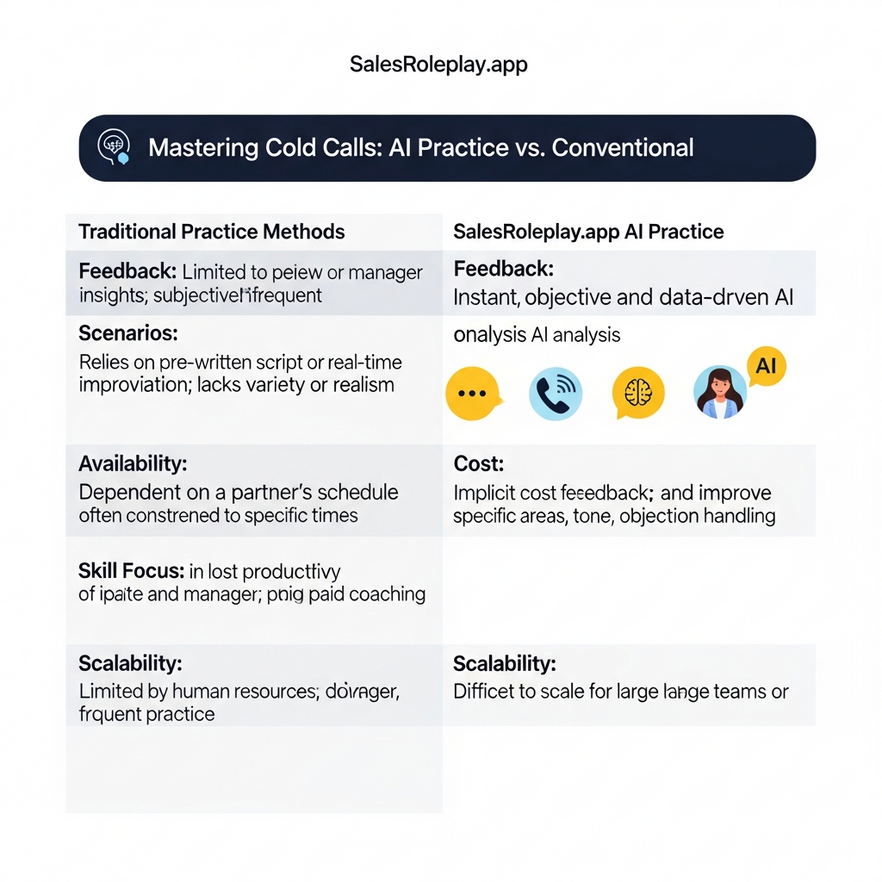
The contrast between conventional cold calling practice and AI-enabled training is stark. Understanding these differences helps sales leaders make informed decisions about their training investments and strategies.
Limitations of Traditional Cold Calling Practice Methods
Traditional approaches to cold calling training have served sales organizations for decades, but they come with significant constraints that limit their effectiveness:
Limited Availability: Practice sessions depend on manager or peer availability, which is often constrained to specific times. Sales managers juggle multiple responsibilities, making consistent practice sessions difficult to schedule. This inconsistency disrupts skill development and prevents reps from practicing when they need it most.
Subjective Feedback: Human evaluators bring personal biases and inconsistent standards to their assessments. One manager might prioritize rapport-building, while another focuses on qualifying questions. This variability makes it difficult for sales reps to understand what truly drives success.
Resource Intensive: Each practice session requires time from both the rep and the manager or coach. For large sales teams, this quickly becomes unsustainable. The opportunity cost of pulling managers away from strategic work to conduct basic role-plays is substantial.
Limited Scenario Variety: Most organizations rely on a handful of pre-written scripts or scenarios that quickly become stale. Real-world sales calls involve infinite variations in prospect responses, making it impossible to prepare for every situation using traditional methods.
No Data Tracking: Traditional practice sessions rarely produce quantifiable data on improvement over time. Feedback is typically qualitative and memory-based, making it difficult to identify specific patterns or measure progress objectively.
Advantages of AI-Powered Cold Calling Practice
Cold calling practice AI transforms the training paradigm by addressing every limitation of traditional methods while introducing capabilities that were previously impossible:
24/7 Availability: Sales reps can practice whenever they want, as often as they want. Whether it's early morning preparation before calls or late-night skill refinement, the AI is always ready. This accessibility dramatically increases practice frequency, which directly correlates with skill improvement.
Objective, Data-Driven Feedback: AI systems analyze calls based on consistent criteria, measuring specific metrics like talk-to-listen ratio, filler word usage, pace, tone variance, and adherence to proven frameworks like MEDDPICC or SPIN Selling. This objectivity removes bias and provides clear, actionable improvement paths.
Unlimited Scenario Variety: Modern AI platforms can generate countless variations of prospect responses, objections, and conversation paths. AI buyers can be configured to represent specific industries, roles, pain points, and personality types, ensuring reps experience diverse scenarios that mirror real-world complexity.
Scalability for Large Teams: Whether you have 10 or 10,000 sales reps, AI-powered practice scales effortlessly. Every team member receives the same quality of training without additional resource investment, making it ideal for sales managers overseeing distributed or rapidly growing teams.
Comprehensive Analytics: Platforms like SalesRoleplay.app's AI call scoring track every practice session, building a detailed profile of each rep's strengths and weaknesses. This data enables personalized coaching and helps identify training needs at both individual and team levels.
How Cold Calling Practice AI Works: The Technology Behind the Training
Understanding the mechanics of cold calling practice AI helps sales leaders and reps maximize its potential. The technology combines several advanced AI capabilities to create realistic, valuable practice experiences.
Natural Language Processing and Conversation Intelligence
At the core of effective cold calling practice AI is natural language processing (NLP), which enables the system to understand what the sales rep is saying, interpret the intent, and generate contextually appropriate responses. Modern NLP models can detect nuances in language, recognize when a rep is attempting to handle an objection versus asking a qualifying question, and respond accordingly.
This technology powers the conversational AI that sales reps interact with during practice sessions. Unlike simple chatbots that follow rigid scripts, sophisticated systems use generative AI to create dynamic conversations that feel authentic. The AI can introduce unexpected objections, ask clarifying questions, and even display emotional responses based on how the sales rep conducts the conversation.
Speech Analysis and Real-Time Feedback
Beyond understanding words, effective cold calling practice AI analyzes how those words are delivered. Voice analysis technology examines:
- Pace and Rhythm: Speaking too fast signals nervousness; too slow may lose the prospect's attention. AI identifies optimal pacing for different conversation phases.
- Tone and Inflection: Monotone delivery kills engagement. The AI detects tone variance and provides feedback on emotional expression.
- Filler Words: 'Um,' 'uh,' 'like,' and 'you know' undermine credibility. AI quantifies their usage and tracks improvement over time.
- Pause Utilization: Strategic pauses create emphasis and give prospects time to think. AI coaching helps reps master this technique.
- Volume and Energy: Appropriate energy levels convey confidence and enthusiasm without being overwhelming.
For sales professionals looking to improve these specific skills, exploring resources on speech and voice for sales alongside AI practice creates a comprehensive development approach.
Adaptive Learning and Personalization
Advanced cold calling practice AI platforms incorporate adaptive learning algorithms that personalize the training experience based on individual performance. The system identifies specific weaknesses perhaps a rep struggles with objection handling but excels at opening statements and adjusts future scenarios to provide more practice in challenging areas.
This personalization extends to scenario selection as well. If you're in solar sales, the AI can simulate conversations with homeowners concerned about installation costs and ROI. If you sell B2B SaaS, the AI becomes a busy IT director skeptical about implementation timelines. This industry-specific customization makes practice highly relevant and immediately applicable.
Implementing Cold Calling Practice AI in Your Sales Organization
Successfully integrating cold calling practice AI into your sales training program requires thoughtful planning and execution. Here's a comprehensive framework for implementation.
Assessment and Platform Selection
Before selecting a platform, assess your organization's specific needs:
- What are your team's primary cold calling challenges?
- What industries and buyer personas do you target?
- What sales methodologies do you follow?
- How will you measure training effectiveness?
- What integration requirements do you have with existing systems?
When evaluating platforms, prioritize those offering robust scenario customization, comprehensive analytics, and proven results. SalesRoleplay.app's AI sales roleplay platform stands out for its versatility across industries and its ability to integrate with existing sales tech stacks.
Onboarding and Driving Adoption
Technology alone doesn't transform performance adoption does. Create a structured onboarding process that includes:
Initial Training: Conduct workshops introducing the platform, demonstrating its value, and addressing concerns. Show before-and-after examples of reps who improved through AI practice.
Structured Practice Requirements: Establish minimum practice expectations for example, three 15-minute sessions weekly for new reps, two sessions for experienced reps. Integrate these requirements into your sales onboarding program.
Gamification and Competition: Leverage leaderboards, achievement badges, and team challenges to make practice engaging. Many platforms include gamification features that drive friendly competition.
Manager Involvement:Sales coaches should review AI-generated reports, identify trends, and incorporate insights into one-on-one coaching sessions. This integration shows reps that AI practice isn't separate from their development it's central to it.
Integration with Existing Workflows
The most effective implementations weave cold calling practice AI seamlessly into daily routines:
- Pre-Call Preparation: Before important calls, reps practice with an AI buyer configured to match the actual prospect's profile and likely objections.
- Post-Call Debriefs: After difficult real calls, reps immediately practice handling similar situations differently with the AI.
- Onboarding Acceleration: New hires spend their first weeks intensively practicing with AI before making real calls, dramatically reducing ramp time.
- Skill Certifications: Create certification programs where reps must achieve certain scores in AI practice scenarios before advancing to new prospect tiers or products.
Best Practices for Maximizing Cold Calling Practice AI Effectiveness
To extract maximum value from AI-powered cold calling practice, follow these proven best practices developed from successful implementations across industries.
Consistent, Deliberate Practice
Frequency matters more than duration. Research on skill acquisition shows that shorter, more frequent practice sessions produce better results than occasional marathon sessions. Encourage reps to practice for 10-15 minutes daily rather than hour-long sessions once a week.
Focus practice on specific skills rather than general run-throughs. For example, dedicate one session to mastering permission-based openers, another to handling price objections, and another to discovery questioning. This deliberate practice approach accelerates skill development.
Review and Apply Feedback Immediately
The power of cold calling practice AI lies in its instant feedback, but that value is lost if reps don't review and apply it. Establish a process where reps:
- Complete a practice session
- Review the AI-generated feedback and scoring
- Identify 1-2 specific improvement areas
- Immediately complete another session focusing on those areas
- Compare scores to confirm improvement
This rapid iteration cycle creates a powerful feedback loop that dramatically accelerates learning compared to traditional methods where feedback comes days or weeks later.
Simulate Real Conditions
Practice should mirror actual calling conditions as closely as possible. Encourage reps to:
- Stand while practicing if they stand during real calls
- Use the same headset or phone they use for prospects
- Practice in their actual workspace with typical background noise
- Follow their standard pre-call routine before AI practice sessions
This environmental consistency helps transfer learned skills more effectively to real-world situations.
Combine AI Practice with Human Coaching
While AI provides scalable, consistent practice opportunities, human coaching remains valuable for strategic guidance, motivation, and complex scenario analysis. The most effective approach combines both:
AI handles high-volume skill practice, basic feedback, and progress tracking, while sales trainers and managers focus on personalized coaching, strategic development, and addressing unique situations. Review AI practice analytics during one-on-one meetings to make coaching sessions more targeted and productive.
Measuring ROI and Impact of Cold Calling Practice AI
Quantifying the return on investment from cold calling practice AI helps justify the technology investment and guides optimization efforts. Track these key metrics:
Performance Metrics
- Connection Rate: Percentage of dials that result in conversations with decision-makers
- Meeting Set Rate: Percentage of conversations that result in scheduled meetings
- Pipeline Generated: Dollar value of opportunities created through cold calling
- Conversion Rates: Percentage of cold-call-generated opportunities that close
- Ramp Time: Days until new reps reach productivity benchmarks
Compare these metrics before and after implementing AI practice to measure impact. Organizations typically see 15-40% improvements in key performance indicators within 90 days of consistent AI practice usage.
Engagement Metrics
- Number of practice sessions per rep per week
- Average practice session duration
- Completion rate of recommended practice scenarios
- Improvement in AI-generated skill scores over time
These metrics indicate adoption levels and help identify reps who may need additional support or encouragement to engage with the platform.
Efficiency Metrics
- Manager time spent on role-play practice (should decrease)
- Manager time spent on data-driven coaching (should increase)
- Training cost per rep (should decrease)
- Time to first deal for new hires (should decrease)
These efficiency gains often represent the most substantial ROI from AI practice platforms, as they free up valuable human resources for higher-leverage activities.
Advanced Applications of Cold Calling Practice AI
Beyond basic practice scenarios, sophisticated implementations of cold calling practice AI unlock additional capabilities that further differentiate high-performing sales organizations.
Industry and Vertical-Specific Training
Generic cold calling practice provides limited value. The objections, language, and priorities differ dramatically between industries. Advanced AI platforms enable deep customization for specific verticals:
- Pharmaceutical sales reps practice navigating complex regulatory conversations with healthcare administrators
- Roofing contractors practice handling storm damage claim objections with homeowners
- Financial services professionals practice discussing investment strategies while maintaining compliance
- Real estate agents practice objection handling with different buyer personality types
This specificity ensures practice time directly translates to improved real-world performance in your actual market.
Role-Specific Scenario Development
Different sales roles require different cold calling approaches. Configure AI practice for:
- SDRs/BDRs: Focus on qualifying conversations and meeting setting with executive-level prospects
- Account Executives: Practice deeper discovery and objection handling for complex deals
- Channel Partners: Develop skills for navigating multi-stakeholder conversations
- Inside Sales: Master high-volume, efficient qualification approaches
This role-based customization ensures every team member practices scenarios directly relevant to their responsibilities.
Sales Methodology Reinforcement
If your organization follows specific sales methodologies, configure your cold calling practice AI to reinforce those frameworks. For example:
- Program the AI to evaluate adherence to MEDDPICC qualification criteria
- Configure scenarios that require proper execution of solution selling principles
- Design practice sessions focused on executing Sandler pain funnel questioning techniques
This integration ensures your methodology isn't just taught in training sessions but becomes ingrained through repeated practice.
The Future of Cold Calling Practice AI
As artificial intelligence technology continues advancing, cold calling practice AI capabilities will expand dramatically. Emerging trends include:
Multimodal Analysis
Next-generation platforms will analyze video in addition to audio, evaluating facial expressions, body language, and visual presentation for video sales calls. This real-time video analysis capability will help reps master virtual selling skills.
Predictive Coaching
AI systems will predict which specific skills each rep should develop next based on their performance data, market conditions, and target accounts. This predictive capability will create truly personalized development paths that maximize improvement efficiency.
Emotional Intelligence Development
Advanced systems will evaluate and coach on emotional intelligence factors empathy demonstration, emotional regulation, and rapport building that are critical to sales success but difficult to practice with traditional methods. AI-powered emotional intelligence coaching represents a significant frontier.
Integration with Real Call Data
Platforms will increasingly integrate with meeting recorders and conversation intelligence tools, automatically generating practice scenarios based on actual challenging calls reps have experienced. This closed-loop system ensures practice addresses real-world situations reps encounter.
Choosing the Right Cold Calling Practice AI Platform
With multiple platforms available, selecting the right solution requires careful evaluation. Consider these critical factors:
Conversation Quality and Realism
The AI must produce natural, contextually appropriate responses that mirror real prospect behavior. Request demo sessions to evaluate conversation quality. Poor AI that responds generically or nonsensically will frustrate reps and limit adoption.
Customization Flexibility
Can you configure buyer personas, industries, objection types, and evaluation criteria to match your specific needs? Generic, one-size-fits-all platforms provide limited value. Look for platforms offering extensive customization options.
Analytics Depth
Superficial scoring (pass/fail or basic percentages) doesn't provide actionable insights. Evaluate the depth and specificity of analytics. The best platforms like SalesRoleplay.app provide detailed breakdowns of multiple performance dimensions with specific improvement recommendations.
Integration Capabilities
The platform should integrate with your existing sales technology stack CRM, sales engagement platforms, learning management systems, and conversation intelligence tools. Standalone systems that don't share data create silos that limit value.
Support and Resources
Strong vendor support, comprehensive documentation, and training resources significantly impact successful implementation. Evaluate what onboarding assistance, ongoing support, and best practice guidance the vendor provides.
Common Challenges and Solutions in Cold Calling Practice AI Adoption
Challenge: Low Initial Adoption
Solution: Make AI practice a requirement, not an option. Integrate it into onboarding, tie practice completion to performance reviews, and publicly recognize top practitioners. Gamification and competition drive engagement when properly implemented.
Challenge: Rep Skepticism
Solution: Demonstrate clear value quickly. Share success stories from early adopters, show before-and-after performance data, and have managers participate in practice sessions to model the behavior. Transparency about how AI practice improves real results overcomes skepticism.
Challenge: Feedback Not Applied
Solution: Create structured review processes where managers discuss AI practice insights during coaching sessions. Don't let AI practice exist in isolation integrate it into your broader sales development framework.
Challenge: Scenario Staleness
Solution: Regularly update scenarios based on market changes, new competitors, and evolving buyer concerns. Assign someone to manage scenario libraries and incorporate input from reps about new objections or situations they're encountering.
Conclusion: Transforming Cold Calling Through Intelligent Practice
The integration of artificial intelligence into cold calling practice represents one of the most significant advances in sales training methodology in decades. Cold calling practice AI solves the fundamental scalability, consistency, and effectiveness challenges that have limited traditional training approaches, while introducing capabilities instant feedback, unlimited scenarios, objective analysis that were previously impossible.
Organizations that embrace this technology and implement it thoughtfully gain substantial competitive advantages. Their reps develop skills faster, ramp more quickly, and perform at higher levels. Managers spend less time on basic role-play and more time on strategic coaching. Training costs decrease while effectiveness increases.
However, technology alone doesn't guarantee success. The organizations seeing the greatest returns from cold calling practice AI combine the technology with strong implementation practices, consistent usage expectations, integration with existing methodologies, and ongoing optimization based on performance data.
As you evaluate cold calling practice AI solutions, prioritize platforms that offer realistic conversations, deep customization, comprehensive analytics, and proven results across similar organizations. Contact SalesRoleplay.app to explore how AI-powered practice can transform your team's cold calling performance and accelerate your revenue growth in 2026 and beyond.
Frequently Asked Questions About Cold Calling Practice AI
Does cold calling practice AI replace sales managers?
No, cold calling practice AI complements rather than replaces sales managers. The technology handles scalable, repetitive skill practice and provides objective performance data. Managers use this data to deliver more targeted, strategic coaching focused on complex situations, motivation, and personalized development planning. AI practice actually makes managers more effective by freeing their time and providing better insights.
How much time should reps spend practicing with AI?
Most successful implementations require 10-15 minutes of daily practice for new reps during their first 90 days, then 2-3 sessions of 10-15 minutes weekly for ongoing skill maintenance and development. The key is consistency frequent, shorter sessions produce better results than occasional lengthy sessions.
How do you measure the effectiveness of cold calling practice AI?
Track both leading indicators (practice frequency, skill score improvements, engagement levels) and lagging indicators (connection rates, meeting set rates, pipeline generated, ramp time reduction). Compare these metrics before and after implementation to quantify impact. Most organizations see measurable improvements within 60-90 days of consistent usage.
Can experienced sales reps benefit from AI practice?
Absolutely. Even experienced reps develop bad habits, face new objections, and need to adapt to market changes. AI practice provides a safe environment to experiment with new approaches, refine specific skills, and maintain sharp cold calling abilities. Many organizations find their top performers are also the most enthusiastic AI practice users because they understand the value of deliberate practice.
Does cold calling practice AI work for different languages?
Yes, advanced platforms support multiple languages, enabling global sales teams to practice in their native languages or the languages of their target markets. SalesRoleplay.app offers practice in over 20 languages, making it suitable for multinational organizations.
What industries benefit most from cold calling practice AI?
Virtually any industry that relies on cold calling can benefit, but particularly high-impact sectors include B2B SaaS, financial services, insurance, medical devices, and professional services. Industries with complex sales cycles, significant objections, or compliance requirements see particularly strong returns from AI-powered practice.
Ready to Transform Your Sales Training?
See how Salesroleplay can help you transform your sales training.