
AI-Guided Selling: The Complete 2026 Guide To Transforming B2B Sales Performance

Introduction to AI-Guided Selling
AI-guided selling represents the convergence of artificial intelligence and modern sales methodology, fundamentally reshaping how B2B organizations approach revenue generation. For sales leaders navigating increasingly complex buying journeys, AI-guided selling provides the intelligent infrastructure needed to scale coaching, accelerate ramp time, and improve close rates across distributed teams.
Unlike traditional sales approaches that rely heavily on intuition and periodic manager intervention, AI-guided selling embeds continuous learning, real-time feedback, and data-driven insights directly into the sales workflow. According to Forrester Sales Enablement Wave 2025, AI-driven sales enablement platforms improve quota attainment by 15-20% through better training and objection handling, making this technology essential for competitive organizations.
This comprehensive guide explores how Chief Revenue Officers, Sales Managers, and enablement leaders can leverage AI-guided selling to build high-performing teams in Technology, Healthcare, Financial Services, and beyond.
What Is AI-Guided Selling?
AI-guided selling is the application of machine learning, natural language processing, and predictive analytics to optimize every stage of the sales process. It encompasses intelligent coaching systems, conversation analysis, automated scoring, and personalized training paths that adapt to individual rep performance.
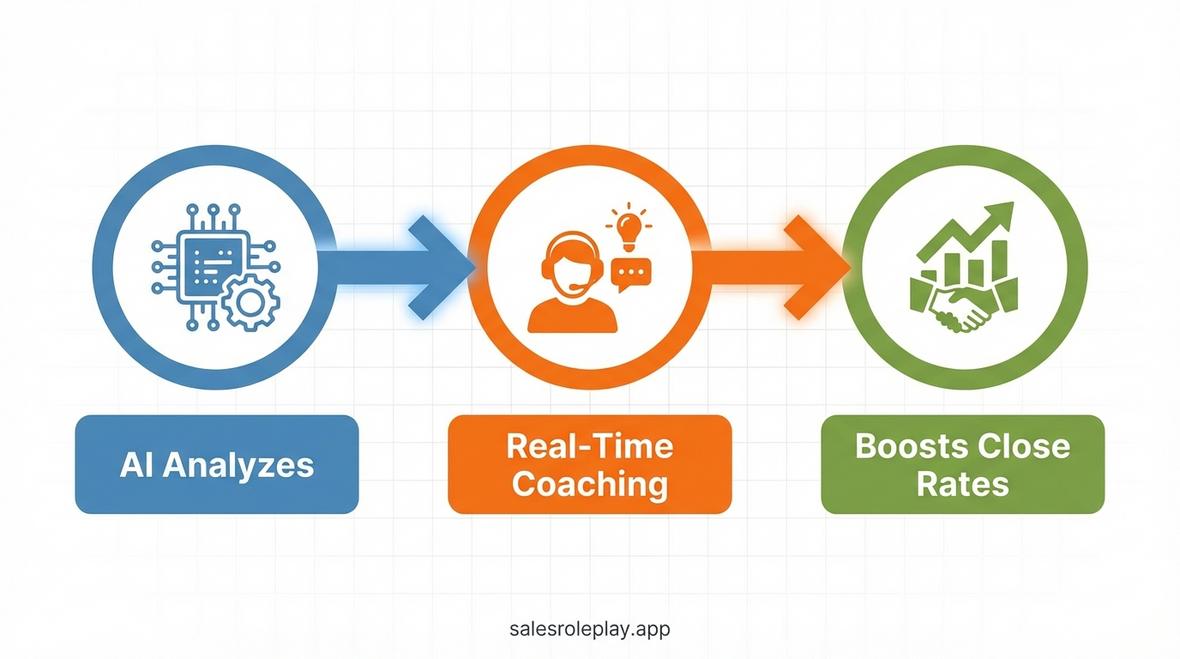
At its core, AI-guided selling transforms sales from an art into a science by:
- Analyzing real conversations: AI systems evaluate tone, pace, objection handling, and question quality during live or recorded calls
- Providing immediate feedback: Reps receive actionable coaching moments directly after interactions rather than waiting for weekly review sessions
- Identifying skill gaps: Machine learning algorithms detect patterns across teams to surface competency weaknesses
- Recommending personalized practice: AI curates roleplay scenarios and training content matched to each seller's development needs
This approach addresses the scalability challenges inherent in traditional coaching models, where manager bandwidth limits the frequency and consistency of skill development interventions.
Core Components of AI-Guided Selling Systems
Conversation Intelligence and Analysis
The foundation of AI-guided selling rests on sophisticated conversation intelligence platforms that transcribe, analyze, and extract insights from customer interactions. These systems evaluate multiple dimensions of sales conversations including talk-to-listen ratios, question frameworks, competitive mentions, and buying signal detection.
Modern AI call scoring technology assesses calls against established frameworks like MEDDIC or Sandler, providing objective performance metrics that eliminate subjective bias from coaching conversations. Sales managers gain visibility into team-wide trends while individual contributors receive specific improvement recommendations.
AI-Powered Roleplay and Simulation
Traditional roleplay exercises suffer from inconsistency, limited availability, and discomfort among participants. AI-guided selling platforms like AI sales roleplay solutions address these challenges by offering unlimited practice opportunities against intelligent buyer personas that adapt responses based on seller behavior.
These simulations replicate challenging scenarios including aggressive price objections, competitive displacements, and multi-stakeholder consensus building. Reps develop muscle memory for critical situations in a safe environment before facing real prospects, dramatically reducing costly mistakes during actual sales cycles.
Predictive Analytics and Deal Scoring
AI-guided selling extends beyond skill development into pipeline management and forecasting accuracy. Machine learning models trained on historical deal data identify leading indicators of win probability, surfacing at-risk opportunities that require intervention and highlighting deals likely to accelerate.
Sales leaders leverage these insights to allocate coaching resources strategically, focusing manager attention on high-value opportunities where targeted support can materially impact outcomes. This data-driven approach to pipeline management improves forecast reliability while optimizing team capacity.
Personalized Learning Paths
Generic training programs fail because they don't account for individual skill levels, learning styles, or role-specific requirements. AI-guided selling platforms create dynamic learning journeys that adapt based on performance data, ensuring each rep receives content and practice scenarios matched to their development stage.
For sales organizations managing complex onboarding processes, this personalization dramatically reduces ramp time. Research from Sales Enablement Society Benchmarks indicates AI training reduces rep ramp time from 9 to 5 months on average, delivering faster time-to-productivity and improved early-tenure performance.
The Business Impact of AI-Guided Selling
Accelerated Ramp Time for New Hires
Time-to-productivity represents one of the most significant hidden costs in sales organizations. Traditional onboarding programs extend over quarters, during which new hires consume manager bandwidth while contributing minimal revenue. AI-guided selling compresses this timeline through on-demand practice, immediate feedback loops, and competency-based progression.
New representatives practice cold calling, discovery calls, and objection handling scenarios hundreds of times before engaging real prospects. This repetition builds confidence and competence simultaneously, enabling sellers to contribute to pipeline generation weeks or months earlier than traditional cohorts.
Improved Close Rates Across the Team
Inconsistent execution remains the primary obstacle to predictable revenue growth. Even in organizations with well-documented methodologies, individual sellers deviate from proven frameworks based on comfort level, situational pressure, or incomplete understanding. AI-guided selling standardizes execution by reinforcing best practices through continuous coaching.
By analyzing thousands of successful and unsuccessful sales interactions, AI systems identify the specific behaviors, question sequences, and value articulations that correlate with closed-won outcomes. These insights inform both individual coaching and broader enablement curriculum, creating a virtuous cycle of performance improvement. According to Forrester TEI Study on AI Sales ROI, organizations implementing AI sales tools achieve 25-50% ROI through productivity gains and cost reductions.
Scalable Coaching Infrastructure
Manager capacity constraints limit coaching frequency in most sales organizations. With ratios often exceeding 10:1, individual contributors receive feedback on a small fraction of their customer interactions. AI-guided selling democratizes coaching by providing every seller with continuous development support regardless of manager availability.
This scalability proves particularly valuable for distributed teams, where geographic separation compounds bandwidth limitations. Remote representatives access the same quality coaching infrastructure as headquarters-based peers, eliminating performance disparities driven by manager proximity. Sales leaders can explore sales coaching use cases to understand implementation approaches.
Data-Driven Sales Strategy Decisions
AI-guided selling transforms sales leadership from reactive management to proactive strategy. Aggregate performance data reveals systemic challenges in messaging, competitive positioning, or qualification criteria that individual deal reviews miss. Leaders identify training gaps, refine ideal customer profiles, and optimize territory assignments based on empirical evidence rather than anecdotal feedback.
This analytical foundation supports more effective resource allocation, focusing enablement investments on high-impact interventions rather than generic programming. Organizations measure training effectiveness through behavior change and revenue impact rather than completion rates or satisfaction scores.
Implementing AI-Guided Selling: A Strategic Framework
Phase 1: Current State Assessment
Successful AI-guided selling implementations begin with honest evaluation of existing sales processes, technology infrastructure, and team capabilities. Sales leaders should audit:
- Current training methodologies: Frequency, format, and effectiveness measurement of existing coaching programs
- Technology stack integration: CRM utilization, communication tools, and data capture mechanisms
- Performance variability: Gap between top and average performers across key metrics
- Onboarding duration: Time required for new hires to reach full productivity
- Manager capacity: Coaching bandwidth and existing responsibilities
This assessment establishes baseline metrics against which AI-guided selling impact can be measured while identifying priority use cases for initial deployment.
Phase 2: Platform Selection and Pilot Design
The AI-guided selling market includes diverse solutions optimizing for different use cases, team sizes, and integration requirements. Evaluation criteria should emphasize:
- Conversation intelligence depth: Sophistication of analysis beyond basic transcription
- Roleplay quality and variety: Realism of AI buyer personas and scenario coverage
- Integration capabilities: Native connectivity with existing CRM and communication platforms
- Customization flexibility: Ability to adapt frameworks, scoring rubrics, and training content
- User experience design: Adoption friction and mobile accessibility
Organizations should pilot AI-guided selling with a representative team segment rather than pursuing immediate full deployment. This approach enables iterative refinement of configurations, identification of change management requirements, and generation of internal success stories that facilitate broader adoption.
Phase 3: Change Management and Adoption
Technology capabilities matter less than user adoption rates in determining AI-guided selling success. Sales representatives accustomed to manager-driven coaching may initially resist AI feedback, perceiving it as surveillance rather than development support. Effective change management strategies include:
- Manager advocacy: Sales leaders model AI tool usage and reference insights during team interactions
- Success celebration: Public recognition of performance improvements linked to AI-guided practice
- Feedback incorporation: Soliciting and acting on rep input regarding tool functionality and coaching quality
- Competency-based incentives: Tying compensation or advancement to skill development metrics
- Continuous communication: Regular updates on platform enhancements and usage best practices
Organizations that treat AI-guided selling as a cultural transformation rather than a software deployment achieve significantly higher utilization rates and performance impact. For teams managing remote sellers, exploring remote team management strategies proves valuable.
Phase 4: Continuous Optimization and Expansion
Initial AI-guided selling implementations focus on foundational skills like cold calling and discovery. As teams mature in platform usage, organizations expand into advanced applications including negotiation simulation, executive presence development, and industry-specific objection handling.
Sales enablement teams should establish regular review cycles examining:
- Correlation analysis: Relationship between AI coaching engagement and revenue outcomes
- Skill progression tracking: Speed of competency development across different training modalities
- Content effectiveness: Performance of various roleplay scenarios and coaching modules
- Manager time allocation: Shifts in how sales leaders spend coaching hours
This data-driven optimization ensures AI-guided selling investments deliver sustained ROI while adapting to evolving sales methodologies and market conditions.
Industry-Specific Applications of AI-Guided Selling
Technology and SaaS Sales
Software sales organizations face complex buyer committees, lengthy evaluation cycles, and intense competitive pressure. AI-guided selling addresses these challenges through multi-threaded conversation coaching, competitive battle card reinforcement, and technical objection handling practice. Teams can leverage B2B SaaS specific training modules to refine approach.
Healthcare and Medical Devices
Regulatory compliance, clinical evidence articulation, and stakeholder consensus building define healthcare sales complexity. AI-guided selling platforms provide compliant communication practice, formulary objection scenarios, and value-based selling reinforcement. Organizations in medical devices benefit from specialized coaching frameworks.
Financial Services
Trust establishment, regulatory navigation, and sophisticated needs analysis characterize financial services selling. AI-guided selling supports fiduciary conversation practice, compliance-approved messaging reinforcement, and complex product explanation scenarios. Financial services teams require specialized training addressing industry-specific challenges.
Measuring AI-Guided Selling Success
Effective measurement frameworks balance leading indicators (behavior change) with lagging indicators (revenue impact). Comprehensive scorecards include:
- Activity metrics: Roleplay completion rates, coaching engagement frequency, and platform utilization
- Skill development: Competency progression across defined frameworks, certification achievement, and peer comparison
- Performance outcomes: Conversion rate improvements, average deal size changes, and sales cycle compression
- Efficiency gains: Ramp time reduction, manager hour reallocation, and training cost per rep
- Predictive accuracy: Forecast reliability improvement and pipeline health indicators
Organizations should establish baseline measurements before AI-guided selling deployment and track trends quarterly, isolating platform impact from broader market or strategy changes through control group comparison where feasible.
The Future of AI-Guided Selling
AI-guided selling continues evolving rapidly as natural language processing, machine learning, and integration capabilities advance. Emerging trends include:
- Real-time conversation guidance: Live coaching during customer interactions rather than post-call analysis
- Emotional intelligence coaching: AI assessment of empathy, active listening, and rapport-building effectiveness
- Buyer persona prediction: Machine learning classification of prospect communication styles with tailored approach recommendations
- Automated content generation: AI-created follow-up emails, proposal sections, and objection responses
- Cross-functional intelligence: Integration of marketing, customer success, and product data into sales coaching
Forward-thinking sales organizations invest in AI-guided selling infrastructure now to build institutional capabilities that compound over time, creating sustainable competitive advantages in talent development and execution consistency.
Frequently Asked Questions About AI-Guided Selling
How does AI-guided selling differ from traditional sales training?
Traditional sales training relies on periodic classroom sessions, occasional manager ride-alongs, and infrequent roleplay exercises. AI-guided selling provides continuous, personalized coaching through every customer interaction, offering immediate feedback and unlimited practice opportunities without consuming manager bandwidth.
What ROI can organizations expect from AI-guided selling?
ROI varies based on implementation scope and existing performance levels, but organizations typically see 15-25% improvements in key metrics including quota attainment, ramp time reduction, and close rate improvement within the first year of deployment.
How long does it take to implement AI-guided selling?
Pilot implementations launch within 2-4 weeks including integration, configuration, and initial training. Full organizational rollout typically completes within 3-6 months depending on team size and change management requirements.
Will AI replace sales managers?
AI-guided selling augments rather than replaces sales management, handling routine coaching tasks and performance analysis so managers can focus on strategic opportunities, complex deal support, and career development conversations that require human judgment.
How do reps respond to AI coaching?
Initial resistance based on surveillance concerns typically dissipates within 30-60 days as representatives experience the development benefits. Organizations with strong change management and manager advocacy achieve 80%+ engagement rates.
Conclusion
AI-guided selling represents the most significant advancement in sales performance technology since CRM adoption. For sales leaders facing pressure to accelerate growth with constrained resources, AI platforms provide the scalable coaching infrastructure necessary to build consistently high-performing teams. By embedding intelligence into every customer interaction, providing unlimited practice opportunities, and delivering personalized development paths, AI-guided selling transforms sales from an inconsistent art into a measurable science. Organizations that invest strategically in these capabilities while managing cultural change effectively will establish sustainable competitive advantages in talent development and revenue execution.
Ready to Transform Your Sales Training?
See how Salesroleplay can help you transform your sales training.