
AI Sales Enablement Tools: The Complete 2026 Guide To Transforming Revenue Performance

Introduction
Sales enablement has evolved from simple content repositories to intelligent, AI-powered ecosystems that fundamentally transform how revenue teams operate. AI sales enablement tools are no longer experimental they've become mission-critical infrastructure for organizations seeking competitive advantage in increasingly complex B2B environments. According to Forrester sales enablement research, typical sales rep ramp time stands at 9.5 months, yet AI enablement tools are cutting that ramp time by 40% in B2B tech firms, with 65% adoption of sales technology in revenue teams. This comprehensive guide explores the landscape of AI sales enablement tools in 2026, revealing how intelligent platforms are delivering measurable business outcomes across training, content management, conversation intelligence, and performance optimization.
What Are AI Sales Enablement Tools?
AI sales enablement tools leverage artificial intelligence, machine learning, and natural language processing to equip sales teams with the right resources, knowledge, and coaching at precisely the right moment. Unlike traditional sales enablement platforms that simply store content, modern AI-powered solutions actively analyze performance data, predict outcomes, and deliver personalized recommendations that accelerate deal velocity and improve win rates.
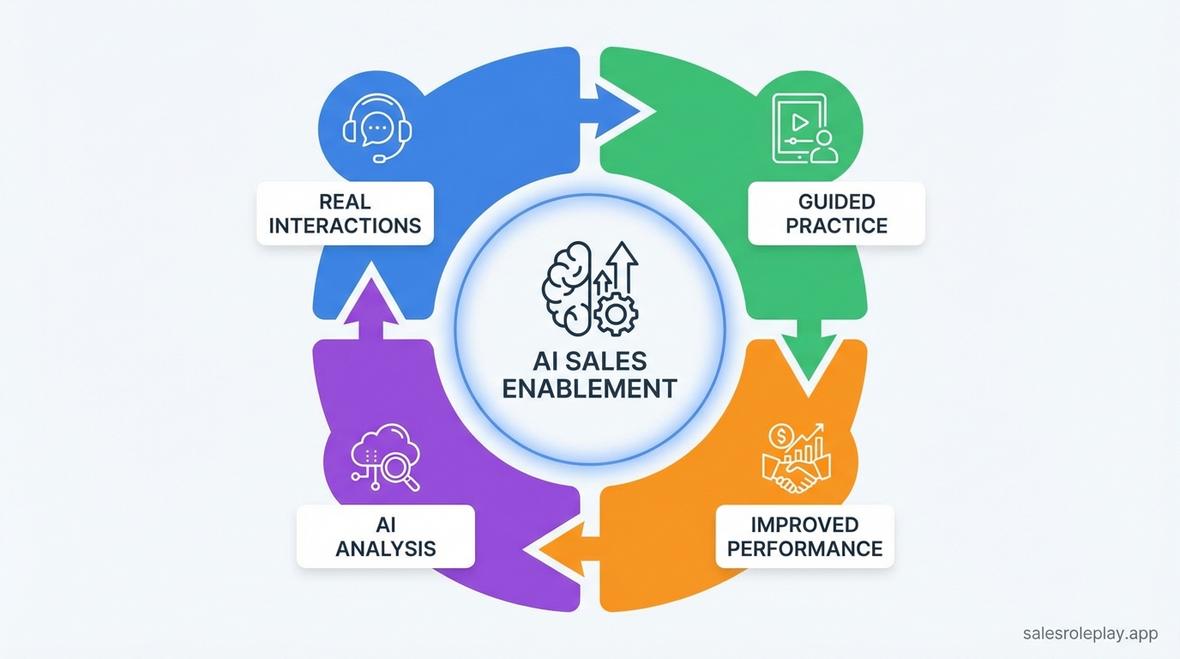
These tools span several categories including intelligent training platforms, conversation intelligence systems, content optimization engines, and predictive analytics dashboards. The integration of AI transforms enablement from a passive resource library into an active coaching system that continuously learns from top performers and scales best practices across entire revenue organizations.
Core Categories of AI Sales Enablement Tools
AI-Powered Training Platforms
Modern AI sales coaching platforms revolutionize how organizations develop selling skills. These systems use AI to simulate realistic customer conversations, analyze rep performance across multiple dimensions, and deliver personalized coaching recommendations. Advanced platforms like AI sales roleplay solutions enable reps to practice discovery calls, objection handling, and negotiation scenarios against intelligent AI buyers that adapt to conversational patterns.
The measurable impact is substantial. Organizations implementing AI sales training techniques report 30-50% reductions in time-to-productivity for new hires and consistent quota attainment improvements of 15-25% among experienced reps. The technology addresses the fundamental challenge of practice providing unlimited, judgment-free opportunities to refine technique without requiring manager bandwidth or peer availability.
Conversation Intelligence Systems
Conversation intelligence platforms record, transcribe, and analyze sales calls using AI to extract actionable insights. These tools identify successful talk patterns, competitive mentions, objection categories, and buying signals that correlate with closed deals. Sales leaders gain visibility into rep performance at scale, moving beyond anecdotal feedback to data-driven sales coaching techniques.
Advanced systems now integrate with CRM platforms to automatically populate fields, suggest next actions, and alert managers to deals requiring intervention. The conversation intelligence software investment delivers ROI through improved forecast accuracy, accelerated onboarding, and systematic replication of top performer behaviors across the entire team.
Content Intelligence Platforms
AI-powered content enablement tools analyze how sales collateral performs across different deal stages, industries, and buyer personas. These platforms recommend the most effective case studies, product sheets, and presentations based on contextual factors like deal size, competitive landscape, and stakeholder roles. Machine learning algorithms continuously refine recommendations based on content engagement metrics and win/loss outcomes.
The business impact addresses a critical inefficiency: research shows that sales reps spend up to 30% of their time searching for or recreating content. Intelligent content systems reduce search time by 60-70% while simultaneously improving content relevance and utilization rates.
Predictive Analytics and Coaching
AI sales enablement platforms increasingly incorporate predictive analytics that forecast deal outcomes, identify at-risk opportunities, and prescribe specific actions to increase win probability. These systems analyze hundreds of data points across communication patterns, stakeholder engagement, competitive dynamics, and buying signals to generate risk scores and recommended interventions.
According to the Forrester enablement tech survey, 61% of CROs report AI tools cut customer acquisition cost by 22%, with 20% pipeline conversion uplift. Predictive coaching combines forecast intelligence with specific skill development recommendations, directing reps toward training modules, practice scenarios, or mentor conversations that address their individual performance gaps.
Key Features of Effective AI Sales Enablement Tools
Personalized Learning Paths
The most effective AI enablement platforms create individualized development journeys based on role, experience level, performance data, and learning preferences. Rather than one-size-fits-all training programs, these systems identify specific skill gaps through call analysis, assessment results, and manager feedback, then construct customized learning sequences that address each rep's unique development needs.
Personalization extends to practice scenarios as well. Personalized coaching paths adapt difficulty levels, industry contexts, and buyer personas to match where each seller needs the most development, ensuring practice time delivers maximum improvement per hour invested.
Real-Time Performance Feedback
Modern AI enablement tools provide immediate feedback rather than delayed coaching sessions. During practice scenarios, reps receive instant analysis of talk-to-listen ratios, filler word usage, competitor handling effectiveness, and value articulation quality. This immediate feedback loop accelerates learning by reinforcing positive behaviors and correcting ineffective patterns before they become habits.
Advanced systems now offer real-time assistance during live customer calls, surfacing relevant battlecards, objection responses, and talk tracks based on conversation context. This 'in-the-moment' enablement transforms AI from training tool to active selling assistant.
Integration Ecosystem
Enterprise-grade AI sales enablement platforms integrate seamlessly with existing revenue technology stacks including CRM systems, sales engagement platforms, learning management systems, and communication tools. This integration creates a unified data environment where insights flow bidirectionally call recordings sync to CRM records, training completions update skill profiles, and content engagement informs opportunity stages.
The value of integration extends beyond convenience. Unified data enables AI models to make more accurate predictions and recommendations by analyzing the complete context of each deal and seller performance pattern.
Analytics and Reporting Capabilities
Comprehensive analytics dashboards provide visibility into enablement program effectiveness at individual, team, and organizational levels. Revenue leaders track metrics including training completion rates, skill proficiency scores, certification attainment, content utilization, and most importantly, correlation between enablement activities and revenue outcomes.
Advanced platforms offer cohort analysis comparing performance trajectories of reps who completed specific training modules versus those who didn't, attribution models linking enablement investments to pipeline generation, and predictive models forecasting future performance based on current engagement patterns.
Implementing AI Sales Enablement Tools Successfully
Defining Clear Objectives
Successful implementations begin with explicit, measurable objectives tied to business outcomes. Rather than vague goals like 'improve training,' effective enablement leaders define specific targets such as 'reduce new hire time-to-first-deal from 120 to 75 days' or 'increase average deal size by 18% within six months.' These concrete objectives guide platform selection, implementation priorities, and success measurement.
Organizations should align enablement objectives with broader revenue goals, ensuring that AI tool investments directly support strategic priorities like market expansion, product launch success, or competitive displacement initiatives.
Change Management and Adoption
Technology alone doesn't drive results adoption does. Successful enablement transformations invest significantly in change management, clearly communicating the 'why' behind new tools, involving sales leadership as visible champions, and creating early wins that build momentum. Organizations should identify early adopters among respected reps who can serve as peer advocates demonstrating value to skeptical colleagues.
Effective adoption strategies include gamification elements that make engagement intrinsically rewarding, manager accountability for team utilization metrics, and integration of enablement activities into existing workflows rather than creating separate, additional tasks.
Continuous Optimization
AI enablement platforms improve through continuous refinement based on usage data and outcome analysis. Organizations should establish regular review cycles examining which content gets used and drives results, which training modules correlate with performance improvement, and which AI recommendations prove accurate versus misleading.
This optimization extends to the AI models themselves. Platforms should be regularly retrained on fresh data reflecting current buyer behaviors, competitive dynamics, and successful selling patterns. Organizations that treat enablement as a living system rather than a one-time implementation realize substantially greater long-term value.
Industry-Specific Applications of AI Sales Enablement
B2B SaaS and Technology Sales
Technology sales organizations leverage AI enablement tools to navigate complex, consultative sales cycles involving multiple stakeholders and technical evaluations. B2B SaaS teams use conversation intelligence to identify which technical capabilities resonate with different buyer personas, content intelligence to deliver relevant case studies based on prospect technology stack, and predictive analytics to prioritize accounts showing highest propensity to buy.
AI-powered training platforms help technology sellers practice product demonstrations, handle technical objections, and articulate ROI in language that resonates with both technical evaluators and executive decision-makers. The ability to simulate diverse buyer scenarios from IT security concerns to CFO budget negotiations accelerates rep readiness across the complete sales cycle.
Financial Services
The financial services industry faces unique enablement challenges including complex regulatory requirements, sophisticated products, and risk-averse buyers. AI enablement platforms help financial advisors and institutional sales teams navigate compliance constraints while delivering personalized recommendations.
Conversation intelligence ensures adherence to required disclosures and prohibited language, while AI coaching platforms provide compliant practice environments where reps can refine advisory conversations without regulatory risk. Content intelligence ensures that only approved, current materials are recommended based on product type, customer segment, and regulatory jurisdiction.
Healthcare and Pharmaceutical Sales
Medical and pharmaceutical sales representatives operate in highly regulated environments with expert buyers and evidence-based decision processes. AI enablement tools support these teams through clinical data accessibility, regulatory-compliant messaging frameworks, and simulation of physician interactions across specialties.
Advanced platforms help pharma reps practice value articulation grounded in clinical trial data, navigate formulary discussions with payers, and address safety questions with appropriate technical depth. The combination of content intelligence and conversation analytics ensures consistent, compliant messaging while enabling personalization to individual healthcare provider preferences.
Manufacturing and Industrial Sales
Complex manufacturing sales involving technical specifications, long sales cycles, and engineering evaluations benefit from AI enablement that surfaces relevant technical documentation, previous similar project experiences, and configuration options based on customer requirements.
AI training platforms help industrial sales engineers practice technical presentations, ROI justifications involving total cost of ownership calculations, and negotiation scenarios addressing price, terms, and service level agreements. Predictive analytics identify which deals require application engineering support versus standard configurations, optimizing resource allocation.
Measuring ROI of AI Sales Enablement Tools
Efficiency Metrics
Organizations measure enablement efficiency through time-to-productivity for new hires, average time spent searching for content, training completion rates, and certification attainment timelines. Leading implementations track how AI enablement compresses the traditional sales ramp curve, measuring time-to-first-meeting, time-to-first-opportunity, and time-to-first-closed-deal.
Content utilization metrics reveal which assets actually support deal progression versus those consuming creation resources without delivering value. This data informs content investment decisions, focusing resources on high-impact materials.
Effectiveness Metrics
Beyond efficiency, effectiveness metrics connect enablement activities to revenue outcomes. Organizations track win rate improvements among trained versus untrained cohorts, average deal size changes following specific training interventions, and quota attainment distributions across teams with varying enablement engagement levels.
Advanced attribution models quantify pipeline and revenue contribution from enablement programs, measuring the incremental deals influenced by specific content assets, training modules, or coaching interventions. These models provide defensible ROI calculations justifying continued and expanded enablement investments.
Leading Indicators
Sophisticated enablement organizations monitor leading indicators predicting future performance including practice volume and quality scores, content engagement patterns, skill assessment results, and manager coaching frequency. These forward-looking metrics enable proactive interventions before performance gaps manifest in missed quotas.
Predictive models identify reps at risk of underperformance based on declining engagement with enablement resources, allowing targeted coaching before deals are lost or tenure becomes a retention risk.
Future Trends in AI Sales Enablement
Conversational AI Evolution
The next generation of AI sales enablement features increasingly sophisticated conversational AI that understands context, emotion, and subtle buying signals. These systems will move beyond keyword detection to genuine comprehension of intent, objection severity, and relationship dynamics. Practice environments will feature AI buyers exhibiting realistic behavioral patterns including ambiguity, changing priorities, and political dynamics within buying committees.
Predictive Skill Development
Emerging platforms will predict future skill requirements based on market evolution, competitive moves, and product roadmaps, proactively developing capabilities before they become critical. Rather than reactive training addressing current gaps, AI will forecast which competencies will differentiate high performers in six to twelve months and construct preparatory learning paths.
Automated Content Generation
AI will increasingly generate customized sales content including personalized proposals, industry-specific case studies, and stakeholder-tailored presentations. These systems will analyze successful historical content, customer data, and competitive intelligence to automatically produce relevant, compliant materials requiring minimal human editing. This automation will free enablement teams to focus on strategy and coaching rather than content production.
Augmented Reality Training
Virtual and augmented reality technologies will create immersive training environments replicating high-stakes sales scenarios including boardroom presentations, trade show booth interactions, and facility tours. These experiential learning environments will combine the psychological realism of in-person practice with the scalability, measurement, and AI feedback of digital platforms.
Selecting the Right AI Enablement Platform
Assessment Criteria
Organizations evaluating AI sales enablement tools should assess platforms across several dimensions including AI sophistication and accuracy, integration capabilities with existing systems, user experience and adoption likelihood, analytics depth and customization, security and compliance features, and vendor roadmap alignment with organizational priorities.
Proof-of-concept pilots should test platforms with representative use cases and diverse user groups, measuring actual adoption rates and early performance impact rather than relying solely on vendor demonstrations and reference calls.
Build Versus Buy Considerations
While some large enterprises contemplate building proprietary enablement systems, most organizations realize greater value from purpose-built platforms that aggregate best practices across thousands of implementations. The pace of AI innovation makes internal development challenging to sustain, with commercial platforms offering continuous enhancement cycles that internal IT teams struggle to match.
The decision ultimately depends on unique requirements, available technical resources, and strategic importance of differentiated enablement capabilities versus focusing internal development resources on core product innovation.
Vendor Evaluation
Beyond product capabilities, organizations should evaluate vendor financial stability, customer success organization maturity, implementation methodology rigor, user community strength, and commitment to ongoing innovation. Reference calls should probe actual adoption rates achieved, time-to-value realized, and candid assessment of vendor responsiveness to issues and enhancement requests.
Contract negotiations should address data ownership, model training rights, integration support levels, and roadmap influence to ensure the relationship supports long-term success rather than just initial deployment.
Best Practices for Maximizing Value
Organizations extracting maximum value from AI sales enablement investments follow several consistent practices. They establish executive sponsorship ensuring enablement aligns with revenue strategy and receives necessary resources. They create cross-functional governance including sales leadership, enablement, IT, and revenue operations to coordinate implementation and optimize integration.
Leading organizations instrument everything, capturing comprehensive data on enablement activities and outcomes to fuel continuous improvement. They celebrate wins publicly, sharing success stories that build momentum and demonstrate value. They invest in enablement team development, ensuring internal teams develop the skills to leverage AI platforms effectively rather than simply administering systems.
Most importantly, successful organizations maintain focus on outcomes rather than activities. The goal isn't training completion or content creation volume it's measurable revenue impact through faster ramps, higher win rates, larger deals, and improved retention. This outcome orientation ensures AI enablement investments deliver business results rather than just technological sophistication.
Frequently Asked Questions
What is the difference between sales enablement and sales training?
Sales enablement encompasses the broader ecosystem of tools, content, and processes that equip sellers to engage buyers effectively throughout the entire sales cycle. Training is one component of enablement, focused specifically on skill development. Modern AI sales enablement platforms integrate training with content management, conversation intelligence, analytics, and workflow automation to support sellers comprehensively.
How much do AI sales enablement tools cost?
Pricing varies significantly based on platform capabilities, user count, and deployment model. Entry-level platforms start around $50-100 per user monthly for basic training and content functionality. Enterprise conversation intelligence and comprehensive enablement suites typically range from $150-300+ per user monthly. Organizations should evaluate total cost of ownership including implementation services, integration development, content creation, and ongoing administration when comparing options.
How long does implementation take?
Implementation timelines depend on organizational complexity and integration requirements. Basic deployments with limited customization can launch in 4-6 weeks. Comprehensive implementations involving CRM integration, custom content development, conversation intelligence deployment, and change management typically require 12-16 weeks to reach full adoption. Organizations should plan for ongoing optimization beyond initial launch.
What integrations are most important?
CRM integration is foundational, enabling bidirectional data flow between enablement activities and opportunity records. Sales engagement platform integration streamlines workflows by embedding enablement resources within existing rep processes. Learning management system integration provides comprehensive development tracking. Communication tool integration (video conferencing, email) enables automated capture and analysis of customer interactions.
How do we measure success?
Success measurement should span efficiency metrics (time-to-productivity, content search time), effectiveness metrics (win rates, deal size, quota attainment), and leading indicators (practice volume, skill scores, content engagement). The most compelling metrics connect enablement activities directly to revenue outcomes through cohort analysis, attribution modeling, and predictive analytics demonstrating ROI.
Conclusion
AI sales enablement tools have evolved from experimental technologies to mission-critical revenue infrastructure, delivering measurable improvements in rep productivity, deal velocity, and win rates. The convergence of conversation intelligence, predictive analytics, personalized coaching, and intelligent content management creates enablement ecosystems that scale best practices, accelerate development, and optimize every customer interaction. Organizations that strategically implement these platforms with clear objectives, strong change management, continuous optimization, and outcome-focused measurement realize substantial competitive advantages through faster ramps, higher performance consistency, and data-driven sales excellence. As AI capabilities continue advancing, the gap between organizations leveraging intelligent enablement and those relying on traditional approaches will only widen, making strategic platform selection and implementation increasingly critical to revenue success.
Ready to Transform Your Sales Training?
See how Salesroleplay can help you transform your sales training.