
AI Digital Human: The Future Of Sales Training & Customer Engagement In 2026

Introduction to AI Digital Humans
The sales landscape is undergoing a dramatic transformation, driven by the emergence of AI digital human technology. These sophisticated virtual entities combine artificial intelligence, natural language processing, and realistic avatars to create interactive experiences that are revolutionizing how sales teams train, engage with prospects, and refine their skills. For sales leaders managing B2B organizations, understanding and leveraging AI digital humans has become essential to maintaining competitive advantage and improving key performance metrics.
An AI digital human represents more than just a chatbot or automated response system. These advanced solutions provide lifelike interactions that simulate real conversations, complete with emotional intelligence, contextual awareness, and adaptive learning capabilities. As sales organizations face mounting pressure to reduce ramp time, improve close rates, and deliver consistent training experiences, AI digital humans offer a scalable solution that addresses these challenges head-on.
What is an AI Digital Human?
An AI digital human is a computer-generated character powered by artificial intelligence that can interact with people in remarkably human-like ways. Unlike traditional chatbots that follow rigid scripts, AI digital humans leverage advanced machine learning algorithms to understand context, recognize speech patterns, and respond with appropriate emotional cues and body language.
These virtual representatives combine several cutting-edge technologies including natural language understanding, computer vision, speech synthesis, and conversational AI. The result is an interactive experience that feels authentic and engaging, making them particularly valuable for sales training scenarios where realistic practice is essential for skill development.
Core Components of AI Digital Humans
The technology behind an AI digital human includes multiple integrated systems working in harmony:
- Natural Language Processing (NLP): Enables the AI to understand spoken and written communication, interpreting intent and context beyond literal word meanings
- Machine Learning Models: Allow the system to improve responses over time based on interactions and feedback
- Speech Synthesis: Generates natural-sounding voice output with appropriate tone, pacing, and inflection
- Facial Animation: Creates realistic expressions and micro-expressions that enhance communication authenticity
- Behavioral Intelligence: Responds appropriately to conversational cues, objections, and emotional signals
According to research from Stanford's Human-Centered AI Institute, AI as a collaborative tool with humans enhances growth, education, and agency, improving productivity when designed to augment rather than replace human roles. This principle is foundational to effective AI digital human implementation in sales environments.
AI Digital Humans in Sales Training
For Chief Revenue Officers and Sales Managers, the application of AI digital human technology in training programs represents a game-changing opportunity. Traditional sales training often suffers from inconsistency, limited practice opportunities, and inability to scale personalized coaching. AI digital humans address each of these limitations effectively.
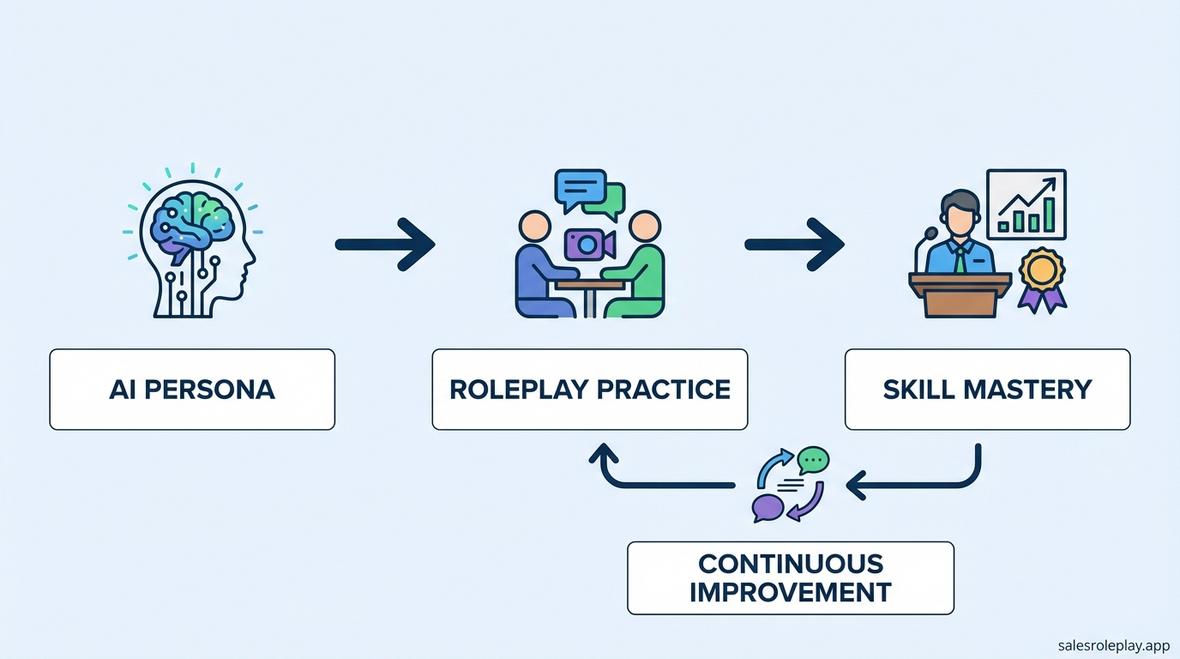
Unlimited Roleplay Practice Sessions
One of the most powerful applications of an AI digital human is providing unlimited, on-demand roleplay scenarios. Sales representatives can practice cold calling techniques, objection handling, and discovery calls as many times as needed without requiring manager availability or peer participation.
These practice sessions can be customized to reflect specific industries, buyer personas, and sales scenarios relevant to your organization. Whether your team sells to healthcare administrators, technology executives, or financial services professionals, the AI digital human can be programmed to accurately represent these distinct audiences.
The platform SalesRoleplay.app leverages this technology to create immersive training experiences where sales professionals engage with AI-powered personas that respond realistically to different approaches, questions, and techniques. This creates a safe environment for experimentation and skill development without the risk of losing actual deals.
Standardized Training at Scale
Maintaining training consistency across distributed sales teams presents significant challenges for sales leaders. An AI digital human ensures that every team member receives identical training scenarios, evaluation criteria, and feedback mechanisms regardless of location or time zone.
This standardization is particularly valuable for organizations experiencing rapid growth or high turnover. New sales representatives can access comprehensive onboarding programs immediately, practicing essential skills with AI digital humans before engaging with actual prospects. This accelerated ramp time directly impacts revenue generation capacity.
Objective Performance Measurement
Unlike human role-play partners who may provide subjective or inconsistent feedback, AI digital human systems deliver objective performance analytics. Every interaction can be recorded, transcribed, and analyzed for key performance indicators including:
- Talk-to-listen ratio
- Question quality and frequency
- Objection handling effectiveness
- Discovery thoroughness
- Closing technique execution
- Adherence to sales methodology frameworks
These data-driven insights enable sales managers to identify specific skill gaps and provide targeted coaching interventions. The performance metrics generated by AI digital human interactions create an evidence-based foundation for continuous improvement initiatives.
Strategic Benefits for Sales Organizations
Implementing AI digital human technology delivers measurable benefits across multiple dimensions of sales performance. Sales leaders evaluating these solutions should consider both immediate operational improvements and long-term strategic advantages.
Dramatically Reduced Ramp Time
New sales representatives typically require several months to reach full productivity. AI digital humans accelerate this timeline by providing intensive, focused practice opportunities that compress learning curves. Instead of waiting for scheduled training sessions or manager availability, new hires can engage in dozens of realistic conversations daily.
Organizations implementing comprehensive AI sales training programs report significant reductions in time-to-first-deal and time-to-quota attainment. This acceleration directly impacts revenue capacity and hiring ROI.
Improved Close Rates and Win Rates
Consistent practice with AI digital human sparring partners enables sales professionals to refine their techniques, test different approaches, and develop confidence before engaging with real prospects. This preparation translates directly to improved performance in actual sales conversations.
Skills particularly well-suited to AI digital human practice include objection handling, value proposition articulation, and discovery question frameworks. Mastering these fundamental capabilities through repetitive practice creates measurable improvements in conversion rates across the sales funnel.
Scalable Coaching Infrastructure
Sales managers face constant tension between providing individualized coaching and managing their own responsibilities. AI digital human technology extends coaching capacity by handling routine practice and feedback, allowing managers to focus on strategic guidance and complex situations.
This leverage effect is particularly valuable for organizations with high sales-to-manager ratios. Even teams with limited management resources can provide extensive practice opportunities and immediate feedback through AI-powered systems. The coaching infrastructure becomes effectively unlimited, supporting as many practice sessions as representatives desire.
Industry-Specific Applications
The versatility of AI digital human technology makes it valuable across diverse B2B sales environments. Different industries face unique challenges that these systems can address through customized implementation.
Technology and SaaS Sales
Technology sales cycles typically involve complex products, technical objections, and sophisticated buyer committees. AI digital humans can be programmed to represent various stakeholder personas from technical evaluators to executive decision-makers each with distinct concerns and priorities.
Sales representatives can practice navigating these complex dynamics, learning to adjust their communication style and value proposition based on audience. This preparation is invaluable for enterprise sales strategies where stakeholder management determines success.
Healthcare and Medical Device Sales
Healthcare sales professionals must master regulatory knowledge, clinical terminology, and evidence-based selling approaches. AI digital human personas can represent physicians, hospital administrators, and procurement committees, each requiring different engagement strategies.
The ability to practice complex clinical conversations without imposing on busy healthcare professionals provides significant value. Sales representatives can refine their approach to discussing clinical outcomes, reimbursement considerations, and implementation logistics in a risk-free environment.
Financial Services Sales
Financial services sales demand exceptional trust-building, regulatory compliance, and technical product knowledge. AI digital humans can simulate skeptical prospects, compliance scenarios, and challenging financial situations that representatives must navigate with precision.
Practice sessions can incorporate industry-specific objections, regulatory constraints, and competitive positioning scenarios unique to financial services. This targeted preparation improves both confidence and competence when engaging with actual clients.
AI Governance and Human-Centered Design
As organizations increasingly adopt AI digital human technology, thoughtful governance and human-centered design principles become essential. Experts are split on whether smart machines and AI systems will allow people to retain control over essential decision-making by 2035, with many predicting expanded AI roles in daily life but concerns over diminishing human agency.
For sales organizations, this means implementing AI digital humans as augmentation tools rather than replacement systems. The goal should be enhancing human capability, not eliminating human judgment. Sales leaders should ensure that AI-powered training complements rather than replaces human coaching, mentorship, and relationship development.
Research involving over 500 experts surveyed predicts AI will amplify human capabilities but raises concerns about outsourcing decision-making. In sales training contexts, this suggests using AI digital humans for skill development and practice while reserving strategic decision-making and relationship management for human professionals.
Implementation Roadmap for Sales Leaders
Successfully deploying AI digital human technology requires strategic planning and phased implementation. Sales leaders should consider the following roadmap for maximum impact and adoption.
Phase 1: Assessment and Planning
Begin by identifying specific skill gaps and training challenges within your sales organization. Which competencies would benefit most from unlimited practice opportunities? Common priorities include:
- Cold calling confidence and technique
- Discovery call structure and questioning
- Objection handling for common competitive situations
- Closing techniques and negotiation skills
- Industry-specific knowledge demonstration
Evaluate existing sales training programs to identify gaps that AI digital human technology could address. Consider both new hire onboarding and ongoing skill development needs.
Phase 2: Pilot Program
Launch a limited pilot with a subset of your sales team to validate effectiveness and gather feedback. Select representatives across different experience levels to assess impact on both new hires and veteran sellers.
Establish clear success metrics including practice session frequency, skill assessment scores, and ultimately business outcomes like conversion rates and deal velocity. This data-driven approach ensures objective evaluation of the AI digital human implementation.
Phase 3: Scaling and Optimization
Based on pilot results, expand access across the broader sales organization. Incorporate feedback to refine scenarios, personas, and evaluation criteria. Develop a library of industry-specific and role-specific practice scenarios that address your unique sales environment.
Integrate AI digital human practice into formal training curricula and ongoing development expectations. Consider establishing minimum practice requirements or incorporating performance scores into team performance reviews.
Future Trends in AI Digital Human Technology
The AI digital human landscape continues evolving rapidly, with several emerging trends that will shape future applications in sales training and customer engagement.
Enhanced Emotional Intelligence
Next-generation AI digital humans will demonstrate increasingly sophisticated emotional intelligence, recognizing subtle cues in voice tone, facial expressions (in video interactions), and word choice. This advancement will enable even more realistic practice scenarios where sales representatives must navigate complex emotional dynamics.
Multi-Modal Interaction Capabilities
Future AI digital human systems will seamlessly integrate text, voice, video, and even virtual reality environments. Sales professionals might conduct practice calls in immersive VR boardrooms, presenting to multiple AI personas simultaneously while managing group dynamics and competing priorities.
Predictive Coaching Insights
Advanced analytics will enable AI systems to predict skill development trajectories and proactively recommend targeted practice scenarios. Rather than generic training, each sales representative will receive personalized development plans based on their unique skill profile and performance patterns.
Selecting the Right AI Digital Human Platform
Sales leaders evaluating AI digital human solutions should consider several critical factors to ensure successful implementation and adoption.
Customization and Industry Specificity
The platform should support deep customization to reflect your specific products, industries, and buyer personas. Generic scenarios provide limited value compared to tailored experiences that mirror your actual sales environment.
Platforms like SalesRoleplay.app offer extensive customization capabilities, allowing sales leaders to create scenarios specific to their market, competitors, and sales methodology.
Integration with Existing Systems
Effective AI digital human platforms integrate with your existing sales technology stack including CRM systems, learning management platforms, and performance analytics tools. This integration ensures practice data informs broader coaching efforts and skill development tracking.
User Experience and Adoption
Technology adoption ultimately depends on user experience. The AI digital human interface should be intuitive, accessible, and engaging. Sales representatives are more likely to practice regularly when the experience is seamless and valuable.
Consider platforms that offer mobile access, allowing representatives to practice during downtime or while traveling. This flexibility maximizes practice frequency and skill development momentum.
Measuring ROI and Success Metrics
Implementing AI digital human technology requires investment, making clear ROI measurement essential for justifying and optimizing the initiative.
Leading Indicators
Track practice frequency, session completion rates, and skill assessment scores as early indicators of engagement and capability development. These metrics provide immediate feedback on program adoption and effectiveness.
Lagging Business Outcomes
Ultimately, success should be measured through business impact including:
- Reduced time-to-first-deal for new hires
- Improved win rates and conversion percentages
- Increased average deal size
- Shortened sales cycles
- Enhanced customer satisfaction scores
Compare cohorts of representatives with and without access to AI digital human training to isolate impact. This controlled comparison provides the clearest evidence of effectiveness and return on investment.
Overcoming Common Implementation Challenges
While AI digital human technology offers substantial benefits, sales leaders should anticipate and address common implementation challenges.
Sales Team Resistance
Some sales professionals may initially resist AI-powered training, viewing it as impersonal or preferring traditional approaches. Address this resistance by clearly communicating benefits, demonstrating immediate value, and incorporating feedback into platform refinement.
Position AI digital humans as tools that enhance rather than replace human coaching. Emphasize how unlimited practice opportunities accelerate skill development and ultimately make sales professionals more successful.
Technical Integration Complexity
Integrating new technology with existing systems can present challenges. Work closely with platform vendors to ensure smooth implementation and data flow between systems. Prioritize platforms with robust APIs and proven integration experience.
Content Development Requirements
Creating effective AI digital human scenarios requires investment in content development. Sales leaders must define realistic personas, common objections, and appropriate difficulty progressions.
Consider starting with a core library of essential scenarios and expanding based on team feedback and identified needs. Many platforms offer templates and best practices to accelerate content creation.
Frequently Asked Questions
How realistic are AI digital human interactions?
Modern AI digital human technology creates remarkably realistic interactions using advanced natural language processing and conversational AI. While users recognize they are practicing with AI, the conversations feel authentic enough to provide genuine skill development and confidence building.
Can AI digital humans replace human sales managers?
No. AI digital humans augment rather than replace human coaching and management. They excel at providing unlimited practice opportunities and objective feedback, but human managers remain essential for strategic guidance, motivation, and relationship development.
What industries benefit most from AI digital human training?
Organizations across industries benefit from this technology, but particularly those with complex sales processes, technical products, or high-stakes conversations. Technology, healthcare, and financial services sales teams often see exceptional results from AI digital human implementation.
How long does implementation typically take?
Implementation timelines vary based on customization requirements and organizational complexity. Basic deployments can launch within weeks, while fully customized solutions with extensive scenario libraries may require several months of development and refinement.
What is the typical ROI for AI digital human training platforms?
ROI varies by organization, but companies typically see returns through reduced ramp time, improved win rates, and enhanced coaching capacity. Organizations often report that even modest improvements in these metrics justify the investment within the first year.
Conclusion
The AI digital human represents a transformative advancement in sales training and development. For sales leaders seeking to improve team performance, reduce ramp time, and scale coaching infrastructure, this technology offers compelling benefits backed by measurable results. By providing unlimited, realistic practice opportunities with objective feedback, AI digital humans address fundamental challenges that have limited sales training effectiveness for decades. As the technology continues advancing with enhanced emotional intelligence and predictive capabilities, early adopters will establish competitive advantages that become increasingly difficult for competitors to overcome. Sales organizations that strategically implement AI digital human technology position themselves for sustained performance improvements and market leadership in an increasingly competitive landscape.
Ready to Transform Your Sales Training?
See how Salesroleplay can help you transform your sales training.