
AI Customer Service Training: Complete Guide To Transforming Your Support Team In 2026

The Evolution of Customer Service Training in 2026
The landscape of customer service has fundamentally transformed. Traditional training methods characterized by inconsistent feedback, limited practice opportunities, and high resource costs no longer meet the demands of modern support teams. As businesses scale and customer expectations rise, AI customer service training has emerged as the definitive solution for organizations seeking to build world-class support operations.
Forward-thinking companies are now leveraging artificial intelligence to deliver continuous, personalized, and scalable training experiences. This shift isn't just about adopting new technology; it's about reimagining how customer service professionals develop skills, handle objections, and deliver exceptional experiences across every touchpoint.
In this comprehensive guide, we'll explore how AI customer service training is revolutionizing support team development, the proven methodologies that drive results, and the specific strategies you can implement to transform your customer service operations in 2026.
The Critical Limitations of Traditional Customer Service Training
Before diving into AI-powered solutions, it's essential to understand why conventional training approaches fall short in today's demanding environment.
Limited Practice Opportunities
Traditional role-playing exercises depend entirely on human availability and trainer frequency. New hires might practice handling difficult customer scenarios only once or twice during onboarding, leaving them unprepared for the complex situations they'll face daily. This scarcity of practice creates confidence gaps that directly impact customer satisfaction scores and resolution times.
The reality is that mastery requires repetition. Olympic athletes don't practice their routines twice and compete; they rehearse thousands of times. Yet traditional customer service training often expects representatives to excel after minimal exposure to realistic scenarios.
Inconsistent and Delayed Feedback
When training depends on human evaluators, feedback quality varies dramatically between trainers. One coach might focus on empathy and tone, while another emphasizes efficiency and resolution speed. This inconsistency leaves trainees confused about priorities and best practices.
Moreover, feedback often arrives days after a training session, when the specific context and emotions have faded. This delay significantly reduces the learning impact, as immediate correction is far more effective than retrospective analysis.
Prohibitive Resource Costs
Delivering quality training at scale requires significant investment in trainer time, physical facilities, and curriculum development. For organizations with distributed teams or rapid growth trajectories, these costs become unsustainable.
Consider a company onboarding 50 new customer service representatives quarterly. Traditional training demands weeks of classroom time, dedicated trainers, role-play partners, and continuous curriculum updates. The financial and operational burden quickly compounds, forcing companies to choose between training quality and budget constraints.
Scalability Challenges
Perhaps the most significant limitation is the inability to scale training effectively for large teams or during rapid onboarding periods. When your business doubles its support team, can your training infrastructure keep pace? Traditional methods struggle with this fundamental challenge, creating bottlenecks that slow growth and compromise service quality.
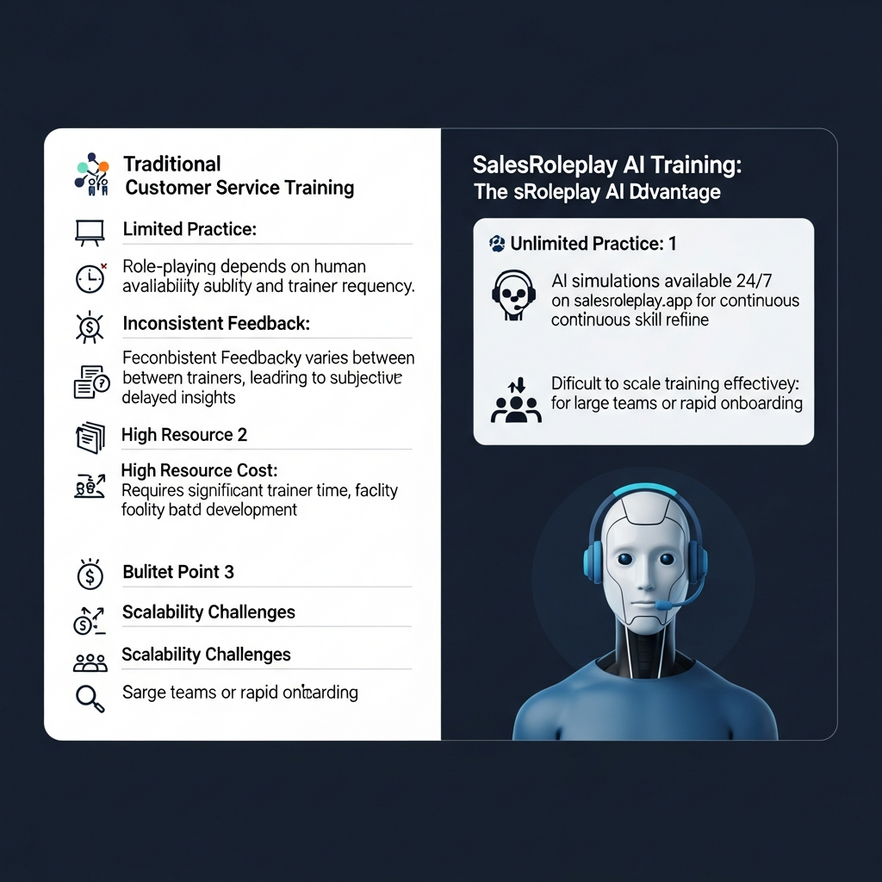
The SalesRoleplay AI Advantage: Transforming Customer Service Training
Enter AI customer service training—a paradigm shift that addresses every limitation of traditional approaches while unlocking capabilities previously impossible.
Unlimited Practice: 24/7 Skill Refinement
AI-powered platforms like SalesRoleplay.app provide unlimited access to realistic customer scenarios. Representatives can practice handling angry customers, processing complex returns, or explaining technical products whenever their schedule permits at 2 AM or during lunch breaks.
This continuous availability transforms skill development from an occasional event into an ongoing habit. New hires can run through dozens of scenarios before their first live customer interaction, building confidence and competence simultaneously.
The psychological impact is profound. When representatives know they can practice any scenario at any time, anxiety decreases and performance improves. They're no longer paralyzed by fear of making mistakes because they've already made and corrected those mistakes in safe, simulated environments.
Consistent, Immediate, Data-Driven Feedback
AI evaluators apply identical criteria across every interaction, eliminating subjective variance. Whether it's the first conversation of the day or the hundredth, the feedback quality remains consistent.
More importantly, this feedback arrives instantly. Representatives receive specific, actionable insights immediately after each practice session, highlighting strengths and identifying improvement opportunities while the experience is fresh. This immediate loop accelerates learning exponentially compared to delayed human feedback.
AI call scoring technology analyzes multiple dimensions simultaneously tone, empathy, resolution effectiveness, compliance adherence, and more providing comprehensive evaluations that would require teams of human observers.
Dramatic Cost Reduction
While traditional training scales linearly with team size, AI customer service training scales logarithmically. The marginal cost of training your 100th representative is virtually identical to training your 10th.
Organizations implementing AI training solutions typically report 60-80% reductions in training costs while simultaneously improving outcomes. The savings come from reduced trainer hours, eliminated facility costs, and dramatically shortened time-to-productivity for new hires.
These resources can then be redirected toward strategic initiatives, advanced coaching for top performers, or customer experience enhancements that directly impact revenue.
Infinite Scalability for Growing Teams
Whether you're onboarding 5 representatives or 500, AI training platforms handle the load effortlessly. There are no scheduling conflicts, no trainer shortages, no facility constraints.
This scalability proves particularly valuable for seasonal businesses, rapid growth scenarios, or global operations spanning multiple time zones. Your training infrastructure becomes an enabler of growth rather than a constraint.
Implementing AI Customer Service Training: Proven Strategies
Understanding the benefits is only the first step. Successful implementation requires thoughtful strategy and execution.
Step 1: Assess Current State and Establish Baselines
Begin by documenting your current training processes, costs, and outcomes. Measure key metrics including:
- Average time to productivity for new hires
- First-call resolution rates
- Customer satisfaction scores (CSAT/NPS)
- Training cost per representative
- Knowledge retention rates at 30, 60, and 90 days
These baselines provide the foundation for measuring ROI and identifying improvement opportunities. Without clear starting points, you cannot demonstrate the value AI training delivers to stakeholders.
Step 2: Develop Realistic, High-Impact Scenarios
The effectiveness of AI customer service training depends entirely on scenario quality. Invest time in creating realistic situations that mirror your actual customer interactions.
Start by analyzing your most common customer issues, your most challenging scenarios, and the situations where representatives typically struggle. Incorporate actual language patterns, emotional dynamics, and resolution pathways from real interactions.
Platforms like AI sales roleplay allow you to customize scenarios extensively, ensuring alignment with your specific industry, products, and customer demographics.
Step 3: Integrate Training Into Daily Workflows
For AI training to deliver maximum impact, it must become part of daily routines rather than an occasional event. Implement strategies like:
- Mandatory daily practice sessions (even just 10-15 minutes)
- Pre-shift warm-ups where representatives practice likely scenarios
- Post-incident debriefs where challenging customer interactions are recreated and practiced
- Gamified competitions that reward consistent practice and improvement
The sales onboarding framework can be adapted for customer service teams, creating structured learning paths that guide representatives from foundational skills to advanced techniques.
Step 4: Amplify Human Coaching with AI Insights
AI doesn't replace human coaches it amplifies their effectiveness. Use AI-generated performance data to identify specific improvement opportunities, then have coaches provide targeted guidance on those exact skills.
For example, if AI analysis reveals a representative struggles with emotional de-escalation, their coach can focus exclusively on that competency rather than spending time on diagnostic conversations. This precision transforms coaching from general guidance to targeted skill development.
Explore sales coaching methodologies that combine AI analytics with human expertise for optimal results.
Step 5: Establish Continuous Improvement Cycles
AI training platforms generate vast amounts of performance data. Leverage this intelligence to continuously refine scenarios, update best practices, and identify emerging training needs.
Schedule quarterly reviews where you analyze trends across your team, identify common challenges, and develop new scenarios addressing those gaps. This iterative approach ensures your training evolves alongside your business, customer expectations, and market dynamics.
Industry-Specific Applications of AI Customer Service Training
While the core principles remain consistent, AI customer service training delivers unique value across different industries.
Financial Services and Banking
Financial institutions face complex regulatory requirements, sensitive customer situations, and high-stakes interactions. AI training allows representatives to practice compliance scenarios, fraud discussions, and difficult financial conversations in risk-free environments.
Representatives can rehearse explaining loan denials, handling account discrepancies, or navigating customer frustration about fees all while receiving feedback on regulatory compliance and empathy simultaneously. This dual focus proves impossible with traditional training methods.
Learn more about financial services training strategies that combine compliance with customer experience excellence.
Healthcare and Medical Services
Healthcare customer service representatives must balance empathy with efficiency, HIPAA compliance with helpfulness, and medical complexity with accessibility. AI training creates safe spaces to practice these delicate balancing acts.
Scenarios can simulate emotionally charged situations like appointment scheduling for urgent symptoms, insurance explanation for denied claims, or billing questions from stressed patients all while monitoring compliance with privacy regulations.
Technology and SaaS
Technology companies deal with sophisticated products, technically diverse customers, and rapidly evolving features. B2B SaaS customer service teams particularly benefit from AI training that can instantly incorporate new product updates into practice scenarios.
Representatives can practice troubleshooting complex technical issues, explaining feature limitations diplomatically, or upselling premium features all calibrated to different customer technical proficiency levels.
Retail and E-commerce
The retail and ecommerce sector handles enormous interaction volumes with diverse customer emotions from delighted gift recipients to frustrated return seekers. AI training scales to prepare teams for this variability.
Practice scenarios range from processing straightforward returns to handling damaged product complaints, managing out-of-stock frustrations, or converting browsers into buyers during live chat interactions.
Telecommunications
Telecom customer service faces unique challenges: technical complexity, long-term contracts, competitive markets, and high customer frustration when services fail. Telecommunications training through AI allows representatives to practice service restoration conversations, plan explanation, retention scenarios, and technical troubleshooting.
These high-stakes conversations directly impact churn rates and customer lifetime value, making effective training a revenue driver rather than a cost center.
Measuring AI Customer Service Training Success
Implementing AI customer service training is only valuable if you can demonstrate tangible results. Focus on these key performance indicators:
Operational Efficiency Metrics
- Time to Productivity: How quickly do new hires reach acceptable performance levels?
- Average Handle Time: Are representatives resolving issues more efficiently?
- First-Call Resolution Rate: What percentage of issues are resolved in the initial interaction?
- Transfer Rate: How often must representatives escalate to supervisors?
Quality and Customer Experience Metrics
- Customer Satisfaction (CSAT): Post-interaction survey scores
- Net Promoter Score (NPS): Likelihood to recommend based on service quality
- Quality Assurance Scores: Internal evaluation of interaction quality
- Customer Effort Score: How easy was it for customers to resolve their issues?
Financial Impact Metrics
- Training Cost per Representative: Total training investment divided by team size
- Revenue Impact: Increased upsell/cross-sell from better-trained representatives
- Retention Improvement: Reduced customer churn attributable to service quality
- Employee Retention: Reduced agent turnover due to better preparation and confidence
Organizations implementing comprehensive AI training typically see 25-40% improvements across these metrics within the first six months, with continued gains as the training culture matures.
Advanced AI Customer Service Training Applications
Beyond foundational training, AI opens possibilities for advanced skill development previously accessible only to elite performers.
Emotional Intelligence Development
Modern AI can analyze vocal tone, word choice, and conversation flow to assess and develop emotional intelligence. Representatives receive feedback on empathy expression, emotional recognition, and adaptive communication skills that separate good service from exceptional service.
This capability addresses one of customer service's most critical yet challenging-to-teach competencies. Traditional training might discuss empathy conceptually; AI training provides specific, behavioral feedback on empathetic communication.
Multilingual and Cultural Training
Global support teams require cultural competency alongside language skills. AI training platforms can simulate customer interactions across languages and cultural contexts, preparing representatives for diverse customer bases.
Explore Spanish language training, French training, or other language-specific scenarios that incorporate cultural nuances alongside linguistic accuracy.
Crisis and High-Stakes Scenario Training
Some customer service situations carry enormous consequences product safety issues, data breaches, service outages affecting critical operations. These scenarios occur rarely but demand flawless execution.
AI training allows representatives to practice these high-stakes situations repeatedly, building muscle memory for crisis protocols without exposing the organization to real-world risks during the learning process.
Advanced Objection Handling
Customer objections whether about price, policy, or product limitations represent critical moments in the service journey. Objection handling training through AI allows representatives to encounter dozens of objection variations and practice response strategies until they become second nature.
This repetition builds the confidence necessary to handle objections diplomatically rather than defensively, transforming potential conflicts into relationship-building opportunities.
Your 90-Day AI Customer Service Training Implementation Roadmap
Ready to transform your customer service training? Follow this proven implementation timeline:
Days 1-30: Foundation and Planning
- Conduct current state assessment and establish baseline metrics
- Identify 10-15 highest-priority training scenarios based on actual customer interactions
- Select your AI training platform (consider pricing and features)
- Assemble your implementation team including training leads, technology specialists, and frontline representatives
- Develop your change management and communication strategy
Days 31-60: Pilot and Refinement
- Launch pilot program with 10-20 representatives across different skill levels
- Gather detailed feedback on scenario realism, platform usability, and learning effectiveness
- Refine scenarios based on pilot insights
- Develop integration strategies for existing workflows and systems
- Create internal champions who will advocate for the platform across teams
Days 61-90: Full Deployment and Optimization
- Roll out AI training to entire customer service organization
- Implement daily practice requirements and gamification elements
- Establish coaching protocols that leverage AI-generated insights
- Begin measuring impact against baseline metrics
- Create continuous improvement processes for scenario updates and expansion
Throughout this journey, maintain clear communication about goals, celebrate early wins, and address concerns transparently. Change management often determines success or failure more than the technology itself.
The Future of AI Customer Service Training: What's Next?
As we look toward 2026 and beyond, several emerging trends will further enhance AI customer service training capabilities:
Predictive Training Needs Analysis
AI will increasingly predict individual training needs before performance gaps emerge, analyzing conversation patterns to identify skill degradation or emerging challenges. Imagine receiving a notification: 'Your empathy scores have declined 15% over the past week here are three practice scenarios to address this trend.'
Augmented and Virtual Reality Integration
While current AI training operates through voice and text, emerging platforms will incorporate visual elements through AR/VR, creating even more immersive practice environments. Representatives might practice handling in-store customer interactions or navigate virtual product demonstrations.
Real-Time Conversation Assistance
Beyond training, AI will provide real-time guidance during actual customer interactions, suggesting optimal responses, flagging compliance risks, or identifying upsell opportunities essentially serving as a copilot during live conversations.
Hyper-Personalized Learning Paths
Training will become increasingly individualized, with AI creating unique learning journeys based on each representative's strengths, weaknesses, learning style, and career aspirations. No two representatives will follow identical training paths.
Getting Started with AI Customer Service Training
The transformation of your customer service training begins with a single decision: commit to excellence through AI-powered development.
Whether you're a sales manager seeking to improve team performance, a sales trainer looking for scalable solutions, or a Chief Revenue Officer focused on customer experience as a competitive advantage, AI customer service training offers measurable, sustainable results.
Start by exploring platforms designed specifically for your needs. SalesRoleplay.app offers comprehensive AI training solutions with industry-specific scenarios, unlimited practice opportunities, and intelligent feedback systems that accelerate skill development across your entire organization.
For organizations requiring customized branding and dedicated environments, investigate whitelabel solutions that maintain your brand identity while leveraging best-in-class AI training technology.
Real-World Results: AI Customer Service Training Success Stories
The theoretical benefits of AI customer service training become tangible when examining organizations that have successfully implemented these solutions:
Case Study: Financial Services Transformation
A mid-sized banking institution implemented AI training for its 200-person customer service team, focusing on compliance scenarios and emotional de-escalation. Within six months, they achieved:
- 43% reduction in compliance violations during quality assurance reviews
- 31% improvement in customer satisfaction scores
- 22% decrease in average handle time while maintaining quality
- 68% reduction in training costs compared to previous methods
Read the full financial services transformation case study for detailed insights.
Case Study: Retail Customer Service Excellence
A national retail chain deployed AI training across 150 locations, emphasizing product knowledge and objection handling. Results included:
- 56% faster time-to-productivity for seasonal hires
- 38% increase in upsell attachment rates
- 29% improvement in employee retention (reduced turnover from 47% to 33% annually)
- Customer NPS increase from 42 to 61
Explore additional examples in the retail sales transformation case study.
Case Study: Technology Support Scaling
A rapidly growing SaaS company needed to scale its support team from 25 to 100 representatives in six months. AI training enabled this aggressive growth while maintaining quality:
- Onboarding time reduced from 6 weeks to 3.5 weeks
- First-call resolution rates maintained above 75% despite rapid team expansion
- Training cost per new hire decreased by 71%
- Customer satisfaction remained stable throughout scaling period
Frequently Asked Questions About AI Customer Service Training
Does AI training replace human coaches entirely?
No. AI training amplifies human coaching effectiveness rather than replacing it. AI handles repetitive practice, consistent evaluation, and immediate feedback, freeing human coaches to focus on strategic guidance, emotional support, and complex skill development that requires human judgment and experience.
What industries benefit most from AI customer service training?
While virtually every industry with customer service operations can benefit, organizations with high interaction volumes, complex products, strict compliance requirements, or seasonal staffing fluctuations see particularly dramatic results. This includes financial services, healthcare, technology, retail, and telecommunications.
How quickly can we expect to see results?
Most organizations observe measurable improvements within 30-45 days of implementation, with substantial results evident by 90 days. The timeline depends on implementation thoroughness, team engagement, and baseline performance levels.
Can AI training integrate with our existing systems?
Modern AI training platforms offer extensive integration capabilities with CRM systems, learning management systems, quality assurance tools, and workforce management platforms. Discuss specific integration requirements with your chosen platform provider many offer API access for custom integrations.
What if our team resists AI training?
Change resistance is natural and manageable through proper change management. Focus on demonstrating value through pilot programs, celebrating early wins, involving representatives in scenario development, and emphasizing how AI training helps them succeed rather than evaluates them negatively. Most resistance dissolves once teams experience the benefits firsthand.
What's the typical ROI of AI customer service training?
Organizations typically achieve 300-500% ROI within the first year through reduced training costs, improved customer retention, increased efficiency, and decreased employee turnover. The exact ROI depends on your organization's size, current training costs, and performance improvement potential.
Conclusion: The Competitive Imperative of AI Customer Service Training
Customer service excellence has evolved from a nice-to-have differentiator to a competitive imperative. In markets where products become increasingly commoditized, the quality of customer interactions often determines long-term success or failure.
Traditional training methods limited by human availability, inconsistent feedback, prohibitive costs, and scalability challenges cannot deliver the preparation modern customer service teams require. AI customer service training addresses these limitations while unlocking capabilities previously impossible: unlimited practice, instant feedback, infinite scalability, and continuous improvement.
The question isn't whether to adopt AI training, but how quickly you can implement it relative to competitors. Organizations that embrace this transformation will develop superior teams, deliver exceptional customer experiences, and build sustainable competitive advantages. Those that delay will find themselves struggling to match the service quality, efficiency, and innovation of AI-enabled competitors.
Your customer service training transformation begins today. Explore how AI post-sales training and comprehensive training solutions can elevate your team from competent to exceptional.
The future of customer service belongs to organizations that invest in their teams through intelligent, scalable, effective training. Make that investment today, and watch your customer satisfaction, team confidence, and business results transform in ways traditional training never could achieve.
Ready to revolutionize your customer service training? Contact us to schedule a demonstration and discover how AI-powered training can transform your support operations.
Ready to Transform Your Sales Training?
See how Salesroleplay can help you transform your sales training.