
AI And Sales Enablement: The Complete 2026 Guide To Transforming Revenue Performance

Understanding AI and Sales Enablement in 2026
The intersection of AI and sales enablement represents one of the most transformative shifts in revenue operations today. Sales enablement has evolved from simple training documentation and static resources to a dynamic, technology-powered discipline that leverages artificial intelligence to drive measurable performance improvements across the entire sales organization.
Sales enablement encompasses all the tools, content, processes, and training that empower sales teams to sell more effectively. When combined with AI, this discipline becomes exponentially more powerful enabling personalized coaching at scale, predictive analytics, and real-time guidance that adapts to each seller's unique development needs.
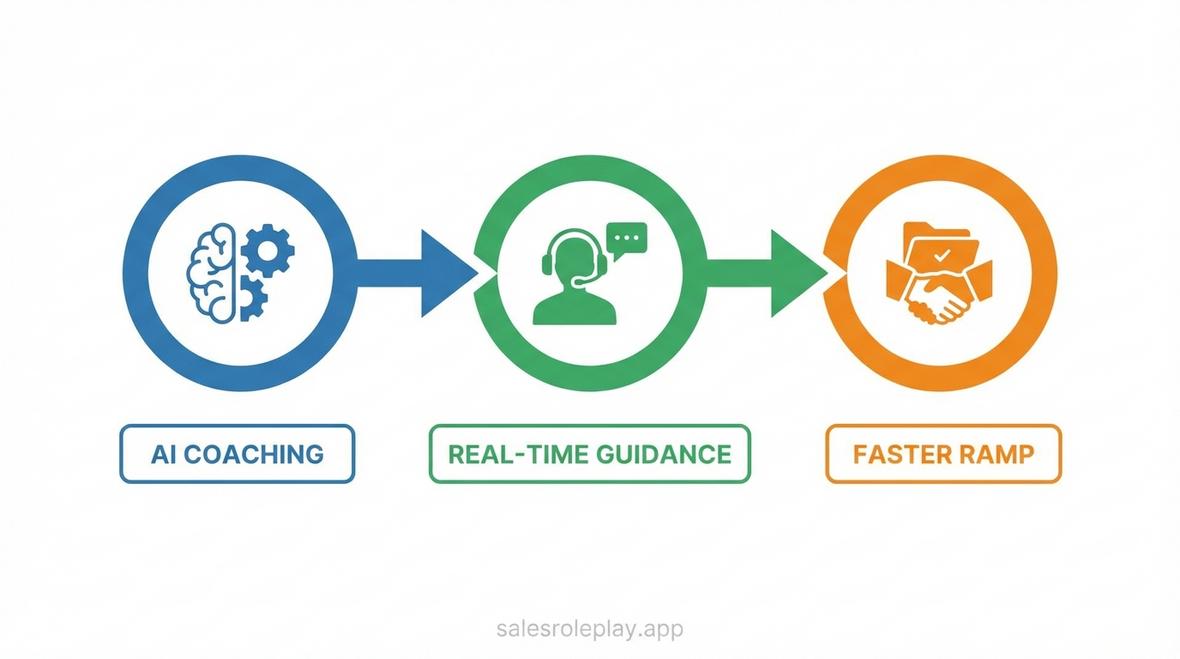
According to research from Salesforce, organizations with mature sales enablement functions see 49% win rates on forecasted deals, compared to 42.5% for companies without such programs. When AI is integrated into these programs, the performance gap widens even further, with leaders reporting up to 30% faster ramp times and significantly higher quota attainment.
Modern AI and sales enablement platforms deliver capabilities that were impossible just a few years ago: intelligent role-play simulations that adapt to seller responses, automated call scoring that provides instant feedback, and predictive analytics that identify which sellers need intervention before they miss quota. This technological evolution is reshaping how sales leaders approach sales enablement strategy and implementation.
Key Components of AI-Powered Sales Enablement
The foundation of effective AI and sales enablement rests on several integrated components that work together to create a comprehensive development ecosystem for sales professionals. Understanding these elements helps sales leaders build programs that deliver sustained performance improvement.
Intelligent Training and Content Delivery
AI-powered platforms analyze individual seller behavior, performance data, and learning patterns to deliver personalized training content at the exact moment it's needed. Rather than overwhelming new hires with generic onboarding materials, intelligent systems identify knowledge gaps and serve targeted microlearning modules that address specific skill deficiencies.
This approach transforms traditional sales training best practices by moving from calendar-based learning to competency-based development. Sellers receive coaching on objection handling immediately after struggling with pricing conversations, or get discovery question frameworks right before conducting needs analysis calls.
AI Role-Play and Simulation Technology
One of the most impactful applications of AI and sales enablement is intelligent role-play technology. Platforms like AI sales roleplay create realistic buyer personas that respond dynamically to seller inputs, providing unlimited practice opportunities without requiring manager time or peer availability.
These simulations go far beyond scripted scenarios. Advanced AI buyers adapt their objections, ask follow-up questions, and exhibit realistic buying behaviors that mirror actual prospect interactions. This creates a safe environment where sellers can experiment with different approaches, make mistakes, and receive immediate feedback all without risking real revenue opportunities.
Automated Call Scoring and Analysis
AI-powered call scoring systems analyze thousands of sales conversations to identify patterns that correlate with successful outcomes. These systems evaluate talk-to-listen ratios, question quality, objection handling effectiveness, and adherence to proven methodologies providing objective feedback that eliminates subjective bias.
Rather than managers manually reviewing a handful of calls per week, AI enables analysis of every customer interaction. This comprehensive approach surfaces coaching opportunities across the entire team and helps sales leaders allocate their limited coaching time to the highest-impact interventions.
Predictive Analytics and Proactive Coaching
Advanced AI and sales enablement platforms use machine learning to predict which sellers are at risk of missing quota, which deals are likely to stall, and which skills gaps will most significantly impact future performance. This predictive capability enables proactive coaching interventions rather than reactive firefighting.
By analyzing historical performance data, activity metrics, and engagement patterns, these systems can alert sales managers weeks before performance problems become visible in pipeline metrics. This early warning system dramatically improves coaching effectiveness and helps prevent costly performance issues.
Implementing an AI and Sales Enablement Strategy
Successfully integrating AI and sales enablement requires a strategic approach that considers technology selection, change management, and continuous optimization. Organizations that treat AI as a tactical tool rather than a strategic capability typically see limited results and poor adoption.
Assess Your Current Enablement Maturity
Before implementing AI-powered solutions, sales leaders must honestly evaluate their current enablement capabilities. This assessment should examine content organization, training effectiveness, coaching consistency, and technology infrastructure. Organizations with immature enablement foundations will struggle to leverage AI effectively the technology amplifies existing processes, both good and bad.
Key questions include: Do sellers have easy access to current content? Are coaching conversations documented and tracked? Do you measure the impact of training on revenue outcomes? Can you identify which specific skills correlate with quota attainment? Answering these questions helps identify the highest-leverage areas for AI investment.
Select the Right AI Enablement Platform
The market for AI and sales enablement technology has expanded rapidly, with dozens of vendors offering varying capabilities. Evaluation criteria should include integration with existing systems (CRM, conversation intelligence, LMS), customization flexibility, user experience, and vendor support quality.
Leading platforms offer comprehensive capabilities across training, coaching, and analytics. SalesRoleplay.app provides an integrated approach that combines AI role-play, automated scoring, and performance analytics in a single platform eliminating the complexity of managing multiple point solutions.
When evaluating vendors, request demos with your actual content and scenarios. Generic demonstrations rarely reveal how the platform will perform with your specific use cases, industry terminology, and sales methodologies.
Design a Phased Implementation Roadmap
Successful AI and sales enablement implementations follow a phased approach that builds capability gradually rather than attempting comprehensive transformation overnight. A typical roadmap includes:
- Phase 1 (Months 1-2): Platform configuration, content migration, and pilot group selection. Start with a small cohort of early adopters who can provide feedback and become internal champions.
- Phase 2 (Months 3-4): Expanded rollout to additional teams, refinement based on pilot learnings, and initial coaching training for managers on using AI insights.
- Phase 3 (Months 5-6): Full organizational deployment, advanced feature activation (predictive analytics, custom scenarios), and integration with performance management processes.
- Phase 4 (Months 7+): Continuous optimization, content expansion, and capability enhancement based on usage data and performance outcomes.
This phased approach reduces risk, allows for course correction, and builds organizational change management momentum that drives sustained adoption.
Train Managers and Coaches on AI-Augmented Coaching
The most sophisticated AI and sales enablement platform delivers limited value if managers don't know how to leverage the insights it provides. Sales leaders must receive training on interpreting AI-generated recommendations, conducting coaching conversations based on objective data, and balancing automated feedback with human connection.
Effective sales coaches use AI to identify what to coach while applying their experience and relationship skills to determine how to coach. This human-AI partnership creates coaching experiences that are both data-driven and emotionally intelligent addressing skill gaps while maintaining seller motivation and confidence.
Measuring ROI and Impact of AI and Sales Enablement
Demonstrating the business value of AI and sales enablement investments requires establishing clear metrics and measurement frameworks before implementation begins. Leading organizations track both leading indicators (activity and engagement metrics) and lagging indicators (revenue and performance outcomes).
Leading Indicators of Program Success
Early signals that your AI enablement program is gaining traction include platform adoption rates, content engagement metrics, and coaching activity levels. Specific metrics to monitor:
- Active user percentage: What portion of your sales organization regularly uses the platform? Healthy programs see 80%+ weekly active usage.
- Practice session completion: Are sellers engaging with AI role-play scenarios? Top performers often complete 2-3x more practice sessions than average performers.
- Content consumption patterns: Which resources are sellers accessing? When are they accessing them? This reveals whether just-in-time learning is occurring.
- Manager coaching frequency: Has the platform increased coaching touchpoints? AI should enable more frequent, focused coaching conversations.
Lagging Performance and Revenue Metrics
The ultimate measure of AI and sales enablement success is impact on revenue outcomes. Organizations should establish baseline metrics before implementation and track changes over time:
- Ramp time reduction: How quickly do new hires reach full productivity? AI-powered programs typically reduce ramp time by 20-40%.
- Quota attainment improvement: What percentage of sellers hit quota? Has the distribution shifted with more sellers in the high-performer category?
- Win rate enhancement: Are sellers closing a higher percentage of qualified opportunities? Even modest win rate improvements generate substantial revenue impact.
- Average deal size growth: Are sellers having more effective discovery conversations that uncover larger opportunities?
- Sales cycle compression: Are deals moving through pipeline stages faster due to improved seller effectiveness?
Research from the Sales Management Association shows that organizations with formalized enablement programs see 15% higher win rates and 18% higher quota attainment than those without such programs. When AI capabilities are added, these performance gaps widen further.
Industry-Specific AI and Sales Enablement Applications
Different industries face unique sales challenges that AI and sales enablement can address with tailored approaches. Understanding industry-specific applications helps sales leaders design programs that reflect the realities of their market.
B2B SaaS and Technology Sales
Technology sales organizations face complex product portfolios, rapidly evolving feature sets, and sophisticated buyer committees. B2B SaaS companies use AI enablement to help sellers master product positioning, navigate multi-stakeholder sales processes, and articulate value in business outcome terms rather than technical features.
AI role-play scenarios can simulate technical evaluations, procurement negotiations, and executive business reviews giving sellers practice with the full range of conversations they'll encounter in enterprise sales cycles.
Financial Services and Insurance
Highly regulated industries require enablement programs that emphasize compliance while building consultative selling skills. Financial services organizations leverage AI to ensure sellers can navigate regulatory requirements while asking powerful discovery questions and building trust-based client relationships.
AI platforms can incorporate compliance checkpoints into role-play scenarios, helping sellers practice required disclosures and documentation while maintaining natural conversation flow.
Healthcare and Medical Device Sales
Medical sales professionals must master clinical knowledge, navigate complex healthcare buying processes, and communicate with diverse stakeholders from clinicians to procurement professionals. Medical device companies use AI enablement to help sellers develop the consultative expertise required in value-based healthcare environments.
AI simulations can recreate interactions with different buyer personas from surgeons focused on clinical outcomes to CFOs concerned with total cost of ownership helping sellers adapt their approach to each stakeholder's priorities.
Professional Services and Consulting
Services firms sell intangible solutions based on expertise and relationships. AI and sales enablement helps consulting organizations standardize their discovery methodologies, improve scoping conversations, and develop sellers who can articulate complex value propositions clearly.
AI role-play scenarios focused on situation assessment, problem identification, and solution design help services sellers sharpen the consultative skills that differentiate top performers.
Overcoming Common Implementation Challenges
While the benefits of AI and sales enablement are substantial, organizations frequently encounter obstacles during implementation. Anticipating these challenges and developing mitigation strategies improves success rates.
Seller Resistance and Adoption Barriers
Sales professionals are often skeptical of new technology, particularly if previous initiatives failed to deliver promised benefits. Overcoming this resistance requires demonstrating clear value, making adoption easy, and celebrating early wins.
Strategies that drive adoption include: involving top performers in pilot programs so they become advocates; showing how AI saves time rather than creating extra work; gamifying practice with leaderboards and challenges; and sharing specific examples of how AI insights led to won deals.
Content Quality and Relevance Issues
AI platforms amplify the impact of your content if that content is outdated, generic, or poorly organized, AI won't magically fix these problems. Successful implementations include a content audit and refresh process that ensures sellers receive relevant, current, and actionable resources.
Leading organizations establish content governance processes with clear ownership, regular review cycles, and feedback mechanisms that capture seller input on usefulness and accuracy.
Integration and Technical Complexity
Many sales organizations use 10+ different tools, creating integration challenges when adding AI enablement platforms. Successful implementations prioritize seamless data flow between systems particularly CRM, conversation intelligence, and learning management platforms.
When evaluating vendors, assess their integration capabilities, API documentation, and implementation support. Platforms with pre-built connectors to major systems significantly reduce deployment complexity and time-to-value.
The Future Evolution of AI and Sales Enablement
The capabilities of AI and sales enablement technology continue to advance rapidly. Understanding emerging trends helps sales leaders prepare for the next wave of innovation and maintain competitive advantage.
Hyper-Personalization at Scale
Future AI platforms will create completely individualized learning paths based on each seller's background, learning style, skill gaps, and performance trajectory. Rather than one-size-fits-all training programs, every seller will receive a customized development plan that adapts in real-time based on their progress.
Real-Time Conversation Guidance
Emerging AI capabilities will provide real-time coaching during actual customer conversations suggesting questions, surfacing relevant content, and alerting sellers to risk signals. This evolution from post-call analysis to in-call guidance represents a fundamental shift in how AI augments seller performance.
Emotional Intelligence and Soft Skills Development
Next-generation AI will analyze not just what sellers say, but how they say it evaluating tone, empathy, and emotional intelligence. This enables coaching on soft skills that have historically been difficult to develop systematically.
Predictive Deal Coaching
AI systems will analyze deal characteristics, buyer engagement patterns, and seller behaviors to predict outcome probability and prescribe specific actions to improve close rates. This evolution from descriptive analytics ('what happened') to prescriptive recommendations ('what to do next') dramatically increases coaching impact.
Building the Business Case for AI and Sales Enablement
Securing executive support and budget for AI and sales enablement initiatives requires a compelling business case that quantifies expected returns and addresses implementation risks. Successful business cases include several key elements.
Quantify the Cost of the Status Quo
Many organizations underestimate the hidden costs of inadequate enablement: extended ramp times that delay revenue contribution, low win rates that require larger pipelines, inconsistent execution that damages brand reputation, and manager time consumed by reactive coaching.
Calculate these costs explicitly. For example, if your average seller takes 6 months to ramp and generates $500K annually, each month of ramp time costs approximately $42K in delayed revenue. If AI reduces ramp by 2 months, that creates $84K of accelerated revenue per new hire.
Project Realistic Performance Improvements
Conservative business cases should assume modest performance gains validated by industry benchmarks. Typical improvements from mature AI and sales enablement programs include: 20-30% reduction in ramp time, 5-10% improvement in win rates, 10-15% increase in quota attainment, and 25-40% improvement in manager coaching efficiency.
Even these conservative assumptions generate substantial ROI. A 50-person sales organization with $30M in annual revenue could see $3-5M in incremental revenue from a 10% quota attainment improvement alone.
Address Implementation Risks and Mitigation
Strong business cases acknowledge potential risks adoption challenges, integration complexity, content development requirements and outline specific mitigation strategies. This balanced perspective builds credibility and demonstrates thoughtful planning.
Selecting the Right AI and Sales Enablement Partner
The vendor you choose significantly impacts implementation success and long-term value realization. Key selection criteria should include platform capabilities, implementation methodology, customer success support, and strategic vision.
Evaluate whether vendors offer comprehensive capabilities across training, coaching, and analytics, or if you'll need to integrate multiple point solutions. Platforms like SalesRoleplay.app provide end-to-end functionality that simplifies deployment and creates a more cohesive user experience.
Assess the vendor's implementation approach and customer success philosophy. Do they provide strategic guidance or just technical implementation? Will they help you develop content and scenarios, or simply provide access to technology? The most successful partnerships combine powerful technology with expert guidance on enablement strategy and best practices.
Frequently Asked Questions
What is the difference between sales enablement and sales training?
Sales training is a subset of sales enablement. Training focuses specifically on skill development through formal learning programs, while enablement encompasses all the resources, tools, content, and processes that help sellers perform effectively including training, content management, technology platforms, and performance analytics.
How long does it take to see ROI from AI and sales enablement investments?
Leading indicators like adoption rates and engagement metrics typically appear within 30-60 days. Lagging performance metrics like improved win rates and quota attainment generally become evident within 90-180 days, depending on your sales cycle length. Most organizations achieve positive ROI within 6-9 months of implementation.
Can AI replace sales managers and coaches?
No. AI augments and amplifies human coaching but doesn't replace the relationship, judgment, and emotional intelligence that effective managers provide. AI handles scalable, repetitive tasks like call analysis and skill assessment, freeing managers to focus on strategic coaching conversations and relationship building.
What size organization benefits most from AI and sales enablement?
Organizations of all sizes can benefit, but the specific use cases vary. Smaller teams (10-50 sellers) often prioritize AI role-play for practice efficiency, while larger enterprises (100+ sellers) focus on coaching scalability and analytics. Mid-market companies typically seek comprehensive platforms that address multiple use cases.
How do I measure the success of our AI enablement program?
Successful measurement frameworks include both leading indicators (platform adoption, practice completion, content engagement) and lagging indicators (ramp time, quota attainment, win rate, average deal size). Establish baseline metrics before implementation and track changes quarterly to assess impact and identify optimization opportunities.
Conclusion
The convergence of AI and sales enablement represents a fundamental transformation in how organizations develop and support their revenue teams. By combining intelligent technology with strategic enablement principles, sales leaders can deliver personalized coaching at scale, accelerate new hire productivity, and drive measurable performance improvements across their entire organization.
Success requires more than technology adoption it demands strategic planning, thoughtful implementation, and ongoing optimization. Organizations that approach AI enablement as a strategic capability rather than a tactical tool consistently achieve superior results, creating sustainable competitive advantages in their markets.
The future of sales performance belongs to organizations that embrace this technology evolution while maintaining the human elements that drive authentic customer relationships and consultative selling excellence.
Ready to Transform Your Sales Training?
See how Salesroleplay can help you transform your sales training.