
Achieve Sales Goals: 17 Proven Strategies To Drive Revenue In 2026

Sales leaders face mounting pressure to consistently achieve sales goals while managing teams across distributed environments, adapting to buyer behavior shifts, and justifying training investments. The gap between setting ambitious revenue targets and actually hitting them continues to widen for many B2B organizations, particularly as economic uncertainty forces buyers to scrutinize every purchase decision more carefully.
Research reveals that B2B win rates average 15-25%, with qualified opportunity close rates hovering around 29%. These sobering statistics underscore why sales leaders must adopt systematic, data-driven approaches to performance improvement rather than relying on intuition or outdated playbooks.
This comprehensive guide explores 17 actionable strategies that sales managers, Chief Revenue Officers, and sales directors can implement immediately to help their teams consistently achieve sales goals. From AI-powered training methods to strategic pipeline management, these tactics address the full spectrum of challenges facing modern B2B sales organizations.
Understanding Why Sales Teams Miss Their Goals
Before implementing solutions, sales leaders must diagnose the root causes preventing teams from hitting targets. The most common obstacles include inadequate training, poor qualification processes, weak discovery skills, and ineffective objection handling.
A revealing statistic shows that only 28% of leaders say AI actually improves revenue-driving sales performance, according to a Highspot survey of 463 leaders. This gap between technology adoption and actual results highlights a critical implementation challenge: many organizations invest in tools without the supporting infrastructure to drive behavioral change.
Another significant factor is misalignment between buyers and sellers. Studies demonstrate a 38% higher win rate when buyers and sellers agree on the core problem, based on 2024 research from Emblaze via Corporate Visions. This alignment rarely happens by accident it requires deliberate discovery frameworks and consistent skill development across the entire sales organization.
Strategy 1: Implement Systematic Skills Practice
The foundation for achieving sales goals rests on continuous skill development. Traditional one-time training sessions produce minimal lasting impact, with research showing that reps forget up to 87% of training content within 30 days without reinforcement.
Progressive sales organizations now use AI sales roleplay platforms to create scalable practice environments where reps can refine cold calling, discovery, objection handling, and closing techniques without risking real opportunities. These platforms provide on-demand practice scenarios that simulate actual buyer conversations, complete with intelligent feedback on talk-to-listen ratios, filler word usage, and strategic questioning techniques.
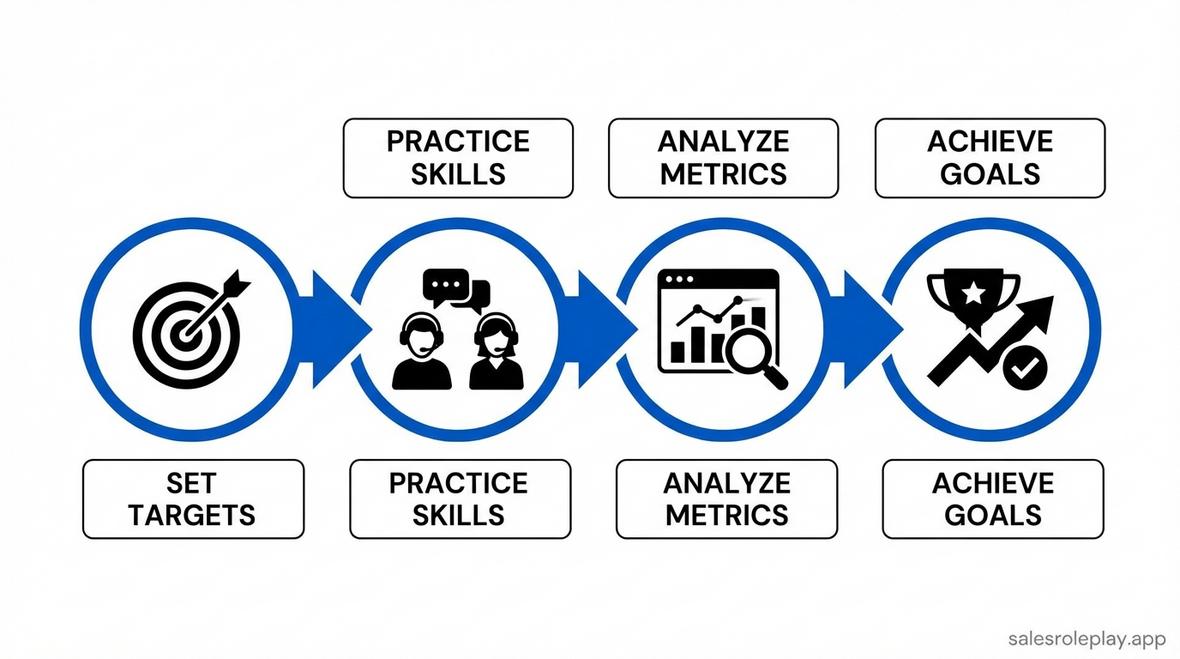
The four-step cycle of setting targets, practicing skills, analyzing metrics, and achieving goals creates a sustainable performance improvement framework. Sales managers should establish weekly practice requirements tied to specific skill gaps identified through call analysis, ensuring that training directly addresses the behaviors preventing quota attainment.
Strategy 2: Standardize Discovery Frameworks
Inconsistent discovery processes represent one of the most common reasons sales teams fail to achieve sales goals. When each rep conducts discovery differently, qualification accuracy suffers, pipeline quality deteriorates, and win rates decline.
Implementing a standardized discovery framework whether MEDDPICC, SPIN Selling, or a custom methodology ensures every team member uncovers the same critical information needed to advance opportunities effectively. The key is not which framework you choose, but rather that your entire team applies it consistently across every qualified opportunity.
Sales leaders should create comprehensive discovery question libraries aligned to their specific methodology, then use roleplay training to ensure reps can execute these conversations naturally rather than mechanically reading from scripts. Regular call reviews should assess discovery execution quality, with coaching focused on refining questioning techniques and active listening skills.
Strategy 3: Optimize Cold Calling Effectiveness
Despite predictions of its demise, cold calling remains a critical channel for B2B sales development. However, most teams approach cold calling with insufficient preparation and inconsistent execution, resulting in low connection rates and even lower conversion rates.
To improve cold calling outcomes, sales leaders should focus on three key areas: opener effectiveness, permission-based progression, and objection handling preparedness. The first 10 seconds of any cold call determine whether the prospect engages or disconnects, making opener refinement essential.
Progressive teams use AI-powered cold calling practice to test different approaches, analyze tonality and pacing, and build confidence before dialing prospects. This preparation dramatically improves connection quality and conversion rates, helping teams book more qualified meetings that advance pipeline development.
Strategy 4: Master Objection Handling
Every sales conversation encounters objections from timing concerns to budget constraints to competitive comparisons. The difference between teams that consistently achieve sales goals and those that fall short often comes down to objection handling effectiveness.
Rather than treating objections as obstacles, top-performing reps view them as buying signals that indicate genuine interest paired with specific concerns. The key is preparing for common objections in advance, developing proven response frameworks, and practicing delivery until responses feel natural and conversational.
Sales managers should catalog the most frequent objections their teams encounter, then create objection handling scripts that address each concern directly while redirecting conversations toward value and differentiation. Regular practice using realistic scenarios ensures reps can deliver these responses confidently under pressure.
Strategy 5: Leverage Data-Driven Coaching
Gut-feel coaching produces inconsistent results because it relies on subjective assessments rather than objective performance data. Modern sales leaders use conversation intelligence platforms and call scoring systems to identify specific skill gaps, then tailor coaching interventions to address individual development needs.
Effective AI call scoring analyzes dozens of variables across sales conversations from question quality to talk-to-listen ratios to tonality patterns providing coaches with precise insights about where each rep needs improvement. This data-driven approach ensures coaching time focuses on high-impact behaviors rather than generic feedback.
Sales managers should establish regular coaching cadences that combine call reviews, skill practice sessions, and deal strategy discussions. The most effective coaching relationships balance support with accountability, celebrating progress while maintaining clear expectations around skill development and quota attainment.
Strategy 6: Accelerate New Rep Onboarding
The time required to ramp new sales reps directly impacts team capacity and revenue predictability. Organizations with 6-month ramp periods essentially operate at 50% capacity for half the year, creating significant opportunity costs and putting additional pressure on tenured reps to overperform.
Progressive sales leaders compress ramp times by implementing structured onboarding programs that combine product knowledge, sales methodology training, competitive positioning, and extensive skills practice. Rather than throwing new hires into live conversations prematurely, they use AI-powered onboarding simulations to build confidence and competence in low-risk environments.
The most effective onboarding programs establish clear milestones for the first 30, 60, and 90 days, with specific skill certifications required before progressing to full quota responsibility. This systematic approach ensures new reps develop the capabilities needed to contribute meaningfully to team goals rather than simply filling headcount.
Strategy 7: Improve Pipeline Qualification
Bloated pipelines filled with low-probability opportunities create false confidence while obscuring actual forecast accuracy. Sales teams that fail to rigorously qualify opportunities waste time on deals they cannot win, diverting attention from winnable business that could help them achieve sales goals.
Implementing strict qualification criteria aligned to proven frameworks like MEDDPICC or BANT ensures pipeline quality improves dramatically. Sales managers should conduct regular pipeline reviews that challenge opportunity validity, pushing reps to either advance deals through concrete next steps or disqualify prospects that lack genuine buying intent.
The key is establishing clear stage-entry criteria that require specific evidence before opportunities progress. For example, moving from discovery to proposal might require documented agreement on business problems, quantified impact, identified decision-makers, and confirmed budget allocation. These gates prevent wishful thinking from contaminating forecast accuracy.
Strategy 8: Optimize Territory Design
Unbalanced territory assignments create unequal opportunity distribution, making it nearly impossible for some reps to achieve sales goals regardless of effort or skill level. Sales leaders must regularly analyze territory performance data to identify imbalances, then redistribute accounts to ensure fair quota allocation.
Effective territory design considers multiple variables: account potential, geographic concentration, industry vertical alignment, and rep experience levels. The goal is creating territories where quota attainment is possible through consistent execution rather than requiring extraordinary circumstances or luck.
Annual territory reviews should incorporate account segmentation analysis, rep capacity planning, and market opportunity assessment. When territories prove consistently unproductive despite multiple rep assignments, the issue is likely structural rather than individual performance-related, requiring territory redesign rather than personnel changes.
Strategy 9: Refine Sales Forecasting Accuracy
Inaccurate forecasts create planning challenges across the entire organization, from product development to customer success staffing. Sales leaders must implement rigorous forecasting disciplines that balance optimism with realism, ensuring executive teams can make informed decisions based on reliable revenue projections.
The foundation of accurate forecasting is pipeline hygiene maintaining clean data about opportunity stage, close probability, and timeline. Sales managers should establish weekly forecast review rhythms that examine deal progression evidence, challenge assumptions, and adjust projections based on actual buyer behavior rather than hopeful thinking.
Advanced organizations use AI-powered forecasting tools that analyze historical win patterns, deal velocity metrics, and engagement signals to generate probabilistic revenue predictions. These systems often outperform human forecasts because they identify subtle patterns that indicate deal risk or acceleration.
Strategy 10: Develop Industry Vertical Expertise
Generic sales approaches increasingly fail as buyers demand vendor partners who understand their specific industry challenges, regulatory environments, and operational constraints. Sales teams that develop deep vertical expertise differentiate themselves from competitors relying on product-centric pitches.
Building vertical expertise requires intentional investment in industry education, customer immersion experiences, and specialized content development. Sales leaders should create industry-specific training programs that cover common pain points, regulatory considerations, buying processes, and competitive dynamics unique to each target vertical.
Reps armed with vertical expertise can conduct more meaningful discovery conversations, position solutions in industry-relevant contexts, and build credibility with senior executives. This consultative approach dramatically improves win rates while shortening sales cycles, helping teams consistently achieve sales goals.
Strategy 11: Implement Account-Based Selling Strategies
Traditional high-volume prospecting approaches often prove inefficient when targeting enterprise accounts with complex buying committees and extended sales cycles. Account-based selling strategies concentrate resources on high-value targets, coordinating marketing and sales efforts to penetrate key accounts systematically.
Effective account-based approaches require deep account research, stakeholder mapping, personalized engagement strategies, and multi-threaded relationship development. Sales leaders should identify target account lists based on ideal customer profiles, then orchestrate coordinated campaigns that engage multiple decision-makers simultaneously.
The key to account-based success is patience and persistence recognizing that enterprise deals require 6-18 month cultivation periods. Teams must maintain consistent engagement without expecting immediate conversions, building relationships and credibility that eventually translate into significant contract values.
Strategy 12: Strengthen Competitive Positioning
Sales reps who cannot articulate clear differentiation from competitors struggle to create urgency or justify premium pricing. Every competitive evaluation ultimately comes down to perceived value differences, making competitive positioning a critical skill for teams aiming to achieve sales goals.
Sales leaders should develop comprehensive competitive intelligence resources that document competitor strengths, weaknesses, positioning strategies, and common objections. More importantly, they must train reps to position against competitors without disparaging them focusing instead on unique value propositions and differentiated capabilities.
Regular competitive roleplay scenarios help reps practice responding to 'We're already talking to [Competitor]' situations with confidence and strategic insight. The goal is not winning every competitive evaluation but rather ensuring your solution receives fair consideration based on genuine differentiation.
Strategy 13: Optimize Pricing and Discount Strategies
Excessive discounting erodes margins while training buyers to negotiate aggressively on every deal. Sales teams that rely on price concessions to close business rarely achieve sales goals profitably, creating revenue that fails to support organizational growth and investment.
Effective pricing strategies establish clear discount authorization levels, require justification for concessions, and train reps to defend value rather than defaulting to price reductions. The key is helping reps understand that price objections usually mask underlying concerns about value perception, implementation risk, or competitive alternatives.
Sales managers should analyze discount patterns across their teams, identifying reps who consistently discount heavily and providing coaching on value articulation and negotiation techniques. Organizations that maintain pricing discipline typically achieve higher win rates at better margins than those competing primarily on price.
Strategy 14: Enhance Sales Technology Stack Utilization
Many sales organizations invest heavily in CRM systems, sales engagement platforms, and conversation intelligence tools, yet realize minimal ROI because reps fail to adopt these technologies consistently. Technology only creates value when integrated into daily workflows and supported by proper training.
Sales leaders must approach technology implementation strategically selecting tools that address specific capability gaps rather than collecting point solutions that create complexity without corresponding value. The focus should be on platforms that automate administrative work, provide actionable insights, or enable practice and skill development.
For example, AI meeting recorders automatically capture conversation details and extract action items, freeing reps from manual note-taking while ensuring CRM data accuracy. Similarly, AI coaching platforms scale personalized feedback beyond what managers can provide manually, accelerating skill development across entire teams.
Strategy 15: Create a Culture of Accountability
High-performing sales teams balance supportive coaching environments with clear accountability for results and behaviors. Sales leaders must establish transparent performance expectations, track leading indicators that predict success, and address underperformance directly rather than hoping it resolves organically.
Effective accountability systems focus on controllable activities call volume, meeting bookings, proposal submissions rather than solely on outcomes influenced by factors beyond rep control. This approach ensures reps understand exactly what behaviors drive success, while managers can identify skill gaps or effort deficiencies early.
Regular one-on-one meetings should review both activity metrics and outcome results, celebrating wins while diagnosing losses for learning opportunities. The goal is creating psychological safety where reps feel comfortable discussing challenges while understanding that consistent underperformance requires intervention.
Strategy 16: Develop Sales Leadership Capabilities
Frontline sales managers represent the most critical factor in team performance, yet many organizations promote top performers into management roles without providing leadership training. This approach creates teams led by strong individual contributors who lack coaching, forecasting, and team development skills.
Investing in sales manager coaching programs pays significant dividends by improving the effectiveness of the people directly responsible for rep performance. These programs should cover coaching methodologies, performance management frameworks, pipeline reviews, and strategic account planning.
The best sales leaders balance strategic thinking with tactical execution support they establish clear vision and expectations while providing the hands-on coaching that helps individual reps overcome obstacles. Organizations that develop strong frontline leadership consistently outperform those with weak management layers.
Strategy 17: Measure What Matters and Optimize Continuously
Sales organizations generate enormous data volumes, yet many leaders struggle to identify which metrics actually predict success. The key is establishing a balanced scorecard that tracks both leading indicators (activities) and lagging indicators (outcomes), then using these insights to drive continuous improvement.
Critical metrics include pipeline generation rates, conversion percentages at each stage, average deal sizes, sales cycle lengths, and win rates against specific competitors. By analyzing these metrics across top performers versus struggling reps, sales leaders can identify the specific behaviors and skills that separate quota achievers from those who consistently fall short.
Monthly business reviews should examine trend data rather than point-in-time snapshots, identifying patterns that suggest emerging problems or opportunities. This analytical approach transforms sales management from reactive firefighting into proactive performance optimization.
Frequently Asked Questions About Achieving Sales Goals
How long does it typically take to see improvement after implementing new sales strategies?
Most organizations begin seeing early indicators within 30-45 days as reps adopt new behaviors, with measurable revenue impact typically appearing in 60-90 days as these practices translate into closed deals. Sustained transformation requires 6-12 months of consistent execution and reinforcement.
What percentage of sales reps typically achieve quota?
Industry benchmarks suggest that 40-60% of sales reps achieve quota in well-managed organizations, though this varies significantly by industry, average deal size, and quota-setting methodologies. Organizations with rigorous training programs and strong coaching cultures typically see higher attainment percentages.
How much should companies invest in sales training?
Leading sales organizations typically invest 3-5% of total sales budget in training and enablement, though ROI matters more than absolute spend. A U.S. B2B digital revenue share forecasted to reach 56% in 2025 underscores the importance of equipping teams for modern selling environments through strategic training investments.
What is the most important skill for sales reps to develop?
While product knowledge and presentation skills matter, discovery and questioning capabilities consistently rank as the highest-value skills. Reps who master consultative discovery uncover deeper pain points, build stronger business cases, and differentiate themselves from product-pushing competitors.
How can remote sales teams maintain performance?
Remote teams require intentional communication rhythms, robust technology infrastructure, and self-directed learning resources. Virtual roleplay platforms, video-based coaching, and frequent team collaboration sessions help distributed teams maintain cohesion and performance standards despite physical separation.
Conclusion
Helping sales teams consistently achieve sales goals requires systematic approaches that address skill development, process optimization, and performance management simultaneously. The 17 strategies outlined in this guide provide a comprehensive framework for sales leaders committed to transforming team performance and driving predictable revenue growth. Success depends not on implementing every tactic immediately, but rather on selecting the highest-impact opportunities for your specific organization and executing them with discipline and consistency. By combining modern training technologies like AI-powered sales roleplay with proven methodologies and strong leadership, B2B sales organizations can build the capabilities needed to exceed targets quarter after quarter.
Ready to Transform Your Sales Training?
See how Salesroleplay can help you transform your sales training.