
Account Manager Strategy: 15 Proven Frameworks To Drive Revenue Growth In 2026

Account management has evolved from transactional relationship maintenance to a strategic revenue function that directly impacts long-term business growth. In 2026, successful account managers leverage data-driven frameworks, AI-powered insights, and structured methodologies to maximize customer lifetime value and drive predictable expansion revenue. This comprehensive guide explores proven account manager strategy frameworks that transform client relationships into sustainable revenue engines.
According to Forrester's research on B2B account expansion, teams using advanced planning tools achieve 28% account expansion rates compared to just 12% for traditional methods. This performance gap underscores the critical importance of implementing structured account management strategies that align relationship health with revenue outcomes.
Understanding Strategic Account Management in Modern B2B
Strategic account management represents a fundamental shift from reactive service delivery to proactive growth orchestration. Rather than simply responding to client needs, modern account managers anticipate challenges, identify expansion opportunities, and position solutions that align with client business objectives.
The most effective account manager strategy integrates three core pillars: relationship health, revenue growth, and solution adoption. These interconnected elements create a strategic framework where customer satisfaction directly drives financial performance while successful implementation reinforces partnership value.
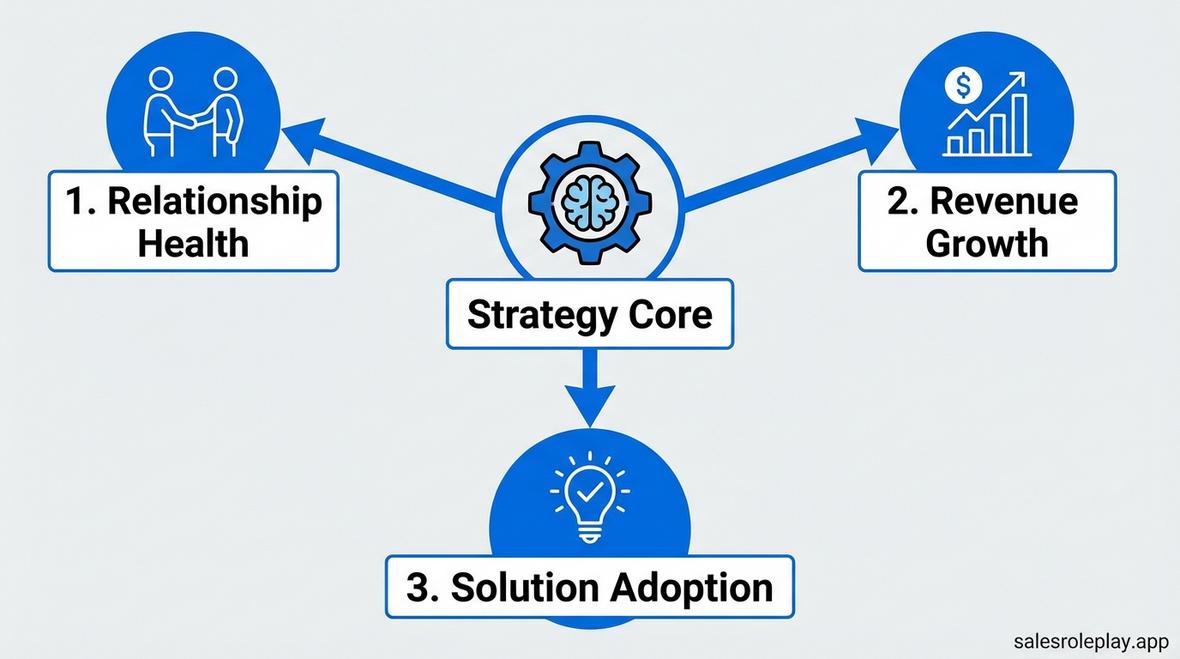
This strategic framework illustrates how intelligent planning connects relationship management with measurable business outcomes. The bidirectional arrows between strategy core and key objectives demonstrate that effective account management requires continuous feedback loops and adaptive planning.
Essential Components of Effective Account Manager Strategy
Building a comprehensive account manager strategy requires integrating multiple tactical and strategic elements that work together to maximize account value and longevity.
Account Segmentation and Prioritization
Not all accounts deserve equal attention. Research from Forrester on account manager productivity indicates that top-performing account managers effectively handle 15-20 key accounts using structured enablement tools, allowing them to focus resources where they generate the greatest impact.
Effective segmentation considers multiple factors including current revenue contribution, expansion potential, strategic alignment, and relationship health. Tier-one accounts receive personalized strategic planning and executive engagement, while tier-two and tier-three accounts benefit from scalable, technology-enabled management approaches.
Quarterly Business Reviews That Drive Action
Strategic quarterly business reviews (QBRs) transform standard check-ins into growth catalysts. Rather than presenting usage statistics and feature updates, effective QBRs demonstrate measurable business impact, identify unrealized value, and collaboratively develop expansion roadmaps.
The most impactful QBRs follow a structured framework: reviewing agreed-upon success metrics, celebrating achievements, addressing challenges transparently, and mapping future opportunities. This approach positions account managers as strategic partners rather than vendor representatives.
Data-Driven Account Health Scoring
Implementing objective health scoring systems enables proactive risk management and opportunity identification. Effective scoring models incorporate product usage patterns, engagement frequency, support ticket trends, payment history, and stakeholder sentiment to generate comprehensive health assessments.
Leading organizations establish clear thresholds that trigger specific interventions. When scores indicate declining health, account managers execute structured recovery playbooks. Conversely, high health scores combined with certain usage patterns signal expansion readiness.
Building an Expansion Revenue Engine
The most successful account manager strategy treats every existing customer as a growth opportunity. Forrester data demonstrates that high-performing teams using strategic frameworks achieve 15-20% year-over-year account growth rates from existing B2B clients.
Identifying White Space Opportunities
White space analysis reveals untapped potential within existing accounts by mapping current product adoption against total available opportunity. This systematic approach identifies departments, use cases, or product lines where clients could derive additional value.
Effective white space mapping requires deep understanding of client organizational structure, business objectives, and decision-making processes. Account managers collaborate with client stakeholders to uncover challenges that existing or adjacent solutions could address.
Multi-Threading Stakeholder Engagement
Single-threaded relationships create vulnerability and limit expansion potential. Strategic account managers deliberately cultivate relationships across multiple organizational levels and functional areas, creating resilient partnerships that withstand individual stakeholder changes.
This approach involves mapping the complete stakeholder ecosystem, understanding each individual's priorities and influence, and developing tailored engagement strategies. Executive sponsors, day-to-day users, technical evaluators, and financial decision-makers each require different value propositions and communication approaches.
Value Realization Frameworks
Clients renew and expand based on perceived value delivery. Implementing structured value realization frameworks ensures clients recognize and internalize the business impact your solutions generate.
Document baseline metrics before implementation, establish clear success criteria, track progress against objectives, and regularly communicate results in business terms rather than product features. This evidence-based approach transforms abstract software capabilities into concrete business outcomes.
Leveraging Technology and AI in Account Management
Modern account manager strategy incorporates intelligent technologies that augment human judgment, automate routine tasks, and surface actionable insights from complex data patterns.
AI-Powered Coaching and Skill Development
Sales leaders seeking to elevate account management capabilities can implement AI-powered sales roleplay platforms that provide account managers with realistic practice scenarios. These tools simulate challenging client conversations, objection handling situations, and negotiation dynamics in risk-free environments.
Unlike traditional role-playing that depends on manager availability, AI-enabled practice tools offer on-demand skill development. Account managers can rehearse upcoming renewal conversations, practice expansion pitches, or refine discovery questioning techniques whenever convenient.
Predictive Analytics for Churn Prevention
Advanced analytics platforms analyze hundreds of behavioral signals to predict churn risk weeks or months before clients explicitly express dissatisfaction. These early warning systems enable proactive intervention while retention remains achievable.
Leading indicators include declining product engagement, reduced stakeholder responsiveness, support ticket escalation, competitive product research, and organizational changes. When algorithms detect concerning patterns, they alert account managers and recommend specific intervention strategies.
Automated Account Planning
AI-assisted planning tools analyze account data, industry trends, and historical patterns to generate preliminary account plans that human account managers refine. This technology-human partnership accelerates planning cycles while incorporating data-driven insights that individuals might overlook.
These platforms suggest expansion opportunities based on similar account patterns, recommend optimal engagement cadences, identify at-risk relationships requiring attention, and forecast revenue trajectories under various scenarios.
Training and Development for Strategic Account Managers
Transforming transactional account managers into strategic growth drivers requires deliberate skill development across multiple competencies.
Consultative Selling Methodologies
Strategic account management demands consultative rather than transactional selling approaches. Organizations can implement MEDDPICC training frameworks that teach account managers to understand client metrics, economic buyers, decision processes, and champion development.
These structured methodologies provide consistent frameworks that account managers apply across different client situations, ensuring comprehensive discovery and stakeholder alignment before proposing expansions.
Financial Acumen Development
Executive-level account management requires understanding client financial statements, business models, and economic drivers. Account managers who speak the language of CFOs and business unit leaders position themselves as strategic advisors rather than product specialists.
Training programs should cover financial statement analysis, ROI calculation methodologies, total cost of ownership frameworks, and business case development. This financial literacy enables account managers to quantify value propositions in terms that resonate with economic buyers.
Industry and Vertical Expertise
Deep vertical knowledge differentiates strategic account managers from generalist relationship managers. Understanding industry-specific challenges, regulatory environments, competitive dynamics, and business models enables account managers to provide genuinely strategic guidance.
Organizations serving multiple verticals can develop industry-specific training programs covering sectors like healthcare, financial services, manufacturing, and technology. This specialized knowledge allows account managers to speak credibly with industry executives and identify vertical-specific expansion opportunities.
Measuring Account Management Performance
Effective account manager strategy requires clear metrics that balance activity, relationship health, and financial outcomes.
Essential Key Performance Indicators
Comprehensive account management measurement incorporates multiple KPI categories. Revenue metrics include net revenue retention, gross revenue retention, expansion revenue, average contract value growth, and customer lifetime value. These financial indicators demonstrate the economic impact of account management investments.
Relationship health metrics encompass net promoter scores, customer satisfaction ratings, executive engagement levels, product adoption rates, and support ticket trends. These leading indicators predict future financial performance and identify intervention opportunities.
Activity metrics track QBR completion rates, stakeholder engagement breadth, strategic plan documentation, and proactive outreach frequency. While less directly tied to outcomes, these measures ensure account managers execute fundamental relationship-building activities.
Attribution and Impact Modeling
Sophisticated organizations implement attribution models that connect specific account management activities to measurable outcomes. These frameworks might track how QBR frequency correlates with renewal rates, how executive engagement depth influences expansion revenue, or how early health score interventions improve retention.
Statistical analysis of these relationships enables evidence-based optimization of account management strategies, resource allocation, and training priorities.
Scaling Account Management Operations
As customer bases grow, organizations must balance personalized high-touch engagement with scalable efficiency.
Digital Account Management Models
Not every account justifies dedicated human account management. Digital account management programs use technology, automation, and self-service resources to serve lower-tier accounts efficiently while reserving human attention for strategic relationships.
Effective digital programs incorporate automated health monitoring, triggered communication sequences, self-service knowledge bases, community forums, and periodic human touchpoints. This hybrid approach maintains relationship continuity at sustainable cost structures.
Account Management Playbooks
Codifying best practices into repeatable playbooks ensures consistent execution across account management teams. These structured guides document proven approaches for common scenarios including onboarding sequences, renewal conversations, expansion discovery, risk mitigation, and executive engagement.
Organizations can develop playbooks for different account segments, industries, product lines, or lifecycle stages. New account managers benefit from documented institutional knowledge while experienced practitioners contribute refinements based on field experience.
Enablement and Continuous Learning
Market dynamics, product capabilities, and competitive landscapes constantly evolve. Sustaining account management excellence requires ongoing enablement that keeps teams current with relevant knowledge and skills.
Modern enablement programs leverage AI-powered coaching platforms that provide personalized skill development, automated call scoring and feedback, and data-driven performance insights. These tools enable scalable coaching that complements manager-led development.
Account Management Leadership and Culture
Building high-performing account management organizations extends beyond individual skill development to creating cultures that prioritize customer success and strategic partnership.
Aligning Incentives with Desired Outcomes
Compensation structures powerfully shape behavior. Account manager compensation should balance retention, expansion, customer satisfaction, and strategic relationship depth rather than focusing exclusively on revenue metrics.
Leading organizations implement multi-component compensation including base salary, retention bonuses, expansion commissions, customer health score modifiers, and team performance incentives. This balanced approach encourages behaviors that drive long-term account value rather than short-term revenue extraction.
Cross-Functional Collaboration Models
Strategic account management requires orchestrating resources across sales, customer success, product, engineering, and executive teams. Account managers function as internal advocates and project managers who coordinate these diverse stakeholders around customer objectives.
Effective collaboration requires clear role definitions, established escalation paths, shared success metrics, and regular coordination rituals. Account managers need organizational authority and executive support to mobilize internal resources when client situations demand.
Data Transparency and Insight Sharing
When account managers access comprehensive client data including usage patterns, support interactions, financial transactions, and stakeholder engagement history, they make more informed strategic decisions. Centralizing this information in accessible systems eliminates information silos that create blind spots.
Similarly, capturing and sharing account manager insights enriches organizational knowledge. When account managers document client conversations, strategic priorities, competitive intelligence, and relationship dynamics, these insights inform product development, marketing positioning, and competitive strategy.
Advanced Account Management Strategies
Executive Sponsorship Programs
Pairing client executives with vendor executives creates peer-level relationships that transcend traditional vendor-customer dynamics. These executive sponsors provide strategic guidance, facilitate internal navigation, and demonstrate organizational commitment to client success.
Effective sponsorship programs include structured engagement cadences, clear communication protocols, escalation procedures, and mutual accountability. Executive sponsors receive briefings from account managers before client interactions and follow up on commitments made during executive discussions.
Customer Advisory Boards
Inviting strategic clients to participate in advisory boards creates collaborative partnerships that inform product direction while strengthening relationships. These forums provide clients with influence over vendor strategy while giving vendors direct access to customer perspectives and priorities.
Successful advisory boards meet regularly, address substantive strategic topics, demonstrate responsiveness to client input, and create networking opportunities among participating organizations. Membership in advisory boards signals to clients that vendors value their partnership beyond transactional revenue.
Strategic Account Planning Workshops
Annual or semi-annual planning workshops bring together extended account teams to comprehensively analyze account dynamics, refresh strategic plans, and align internal stakeholders around account objectives.
These structured sessions review account history and performance, assess current relationship health, identify expansion opportunities, evaluate competitive positioning, define success metrics, and assign action items with clear ownership. The collaborative nature ensures shared understanding and coordinated execution.
Industry-Specific Account Manager Strategy Considerations
While fundamental account management principles apply across industries, certain sectors present unique challenges and opportunities that require tailored approaches.
Technology and SaaS Accounts
Managing B2B SaaS accounts requires emphasis on product adoption, feature utilization, and value realization. Account managers must balance expansion opportunities with ensuring clients extract value from existing capabilities before introducing additional complexity.
The subscription model creates annual renewal moments where clients explicitly evaluate value delivery. Strategic account managers proactively demonstrate ROI throughout the subscription period rather than scrambling to justify value during renewal negotiations.
Financial Services Accounts
Account management in financial services demands deep regulatory knowledge, rigorous security protocols, and understanding of complex approval processes. Long sales cycles and conservative decision-making cultures require patient relationship development and meticulous compliance documentation.
Financial services account managers must navigate hierarchical organizations, demonstrate regulatory expertise, and provide extensive security and compliance documentation. Success requires building trust across risk management, compliance, and business stakeholder groups.
Healthcare Accounts
Managing healthcare and medical device accounts involves clinical stakeholders, evidence-based decision-making, and patient outcome considerations. Account managers must understand clinical workflows, speak credibly about medical evidence, and navigate complex healthcare organizational structures.
Healthcare account management often requires coordinating with clinical champions, demonstrating patient outcomes, providing peer-reviewed research, and addressing diverse stakeholder concerns from clinicians to administrators to patient advocates.
Future Trends in Account Manager Strategy
The account management profession continues evolving as technology capabilities expand, buyer expectations shift, and business models transform.
AI-Augmented Relationship Management
Artificial intelligence will increasingly augment human account managers by automating routine tasks, surfacing predictive insights, and recommending optimal engagement strategies. Rather than replacing human judgment, AI will enhance account manager effectiveness by processing vast data volumes and identifying patterns humans might miss.
Future account managers will collaborate with AI assistants that suggest conversation topics based on recent client activities, predict expansion readiness using behavioral signals, draft personalized communication based on stakeholder preferences, and recommend intervention strategies for at-risk accounts.
Outcome-Based Partnership Models
Traditional software licensing increasingly gives way to outcome-based commercial models where vendors share risk and reward tied to client business results. This shift transforms account managers from product sellers to genuine business partners invested in client success.
Managing outcome-based relationships requires deeper business understanding, more sophisticated value measurement, and tighter operational integration between vendor and client organizations. Account managers must track client business metrics as closely as product usage statistics.
Community-Led Growth Strategies
Forward-thinking organizations complement individual account management with community-building strategies that create peer networks among clients. These communities facilitate knowledge sharing, provide mutual support, and strengthen collective loyalty to vendor platforms.
Account managers who cultivate community connections multiply their impact by enabling clients to learn from peers, recognizing community contributors, and facilitating valuable introductions. Community engagement becomes both a retention mechanism and an expansion catalyst.
Frequently Asked Questions About Account Manager Strategy
What is the optimal account load for strategic account managers?
Research indicates that top account managers effectively manage 15-20 strategic accounts with proper enablement tools and support systems. This capacity varies based on account complexity, deal sizes, and organizational support infrastructure. Higher account loads require digital assistance and automation to maintain relationship quality.
How do you measure account management success?
Comprehensive measurement balances financial metrics like net revenue retention and expansion revenue with relationship health indicators such as customer satisfaction scores and product adoption rates. Leading indicators predict future outcomes while lagging indicators confirm results. Effective frameworks track both activity metrics and outcome metrics across multiple dimensions.
What skills differentiate top-performing account managers?
Elite account managers demonstrate consultative selling capabilities, business acumen, strategic thinking, financial literacy, emotional intelligence, and industry expertise. They balance relationship-building skills with analytical rigor, combining genuine empathy with commercial discipline. Continuous learning orientation allows them to stay current with evolving client needs and market dynamics.
How can AI improve account management effectiveness?
AI enhances account management through predictive analytics that identify risk and opportunity, automated health monitoring that surfaces concerning patterns, personalized engagement recommendations based on stakeholder preferences, and scalable coaching through AI-powered sales training platforms. These technologies augment rather than replace human judgment, allowing account managers to focus on high-value strategic activities.
What frameworks support strategic account planning?
Effective account planning frameworks incorporate stakeholder mapping, relationship health assessment, white space analysis, competitive positioning evaluation, success metric definition, and action planning with clear ownership. Tools like SWOT analysis, value chain mapping, and organizational network analysis provide structured approaches to comprehensive account understanding.
Conclusion
Strategic account management transforms customer relationships from transactional interactions into sustainable revenue engines that drive predictable business growth. The frameworks outlined in this guide from relationship health monitoring to AI-augmented insights to industry-specific approaches provide comprehensive blueprints for building high-performing account management organizations.
Success requires balancing relationship depth with commercial discipline, leveraging technology to augment human judgment, and continuously developing account manager capabilities through structured training and coaching. Organizations that implement these account manager strategy principles position themselves to maximize customer lifetime value, achieve superior retention rates, and generate consistent expansion revenue that compounds over time. The future belongs to organizations that recognize account management as a strategic growth function rather than an administrative maintenance role.
Ready to Transform Your Sales Training?
See how Salesroleplay can help you transform your sales training.