
Account Manager Best Practices: 15 Proven Strategies To Drive Customer Growth In 2026

Understanding Account Management Excellence in 2026
Account management has evolved from a transactional role into a strategic function that drives sustainable revenue growth and customer lifetime value. In today's competitive landscape, mastering account manager best practices is no longer optional it's essential for business survival and expansion. The modern account manager serves as a trusted advisor, growth architect, and relationship orchestrator, balancing customer needs with business objectives.
Research from Forrester data shows B2B financial services achieve 25% average customer expansion revenue via proactive account manager engagement. This statistic underscores the critical impact that effective account management has on bottom-line results. Organizations that invest in developing their account management capabilities consistently outperform competitors in retention, expansion, and customer satisfaction metrics.
The role demands a unique blend of strategic thinking, relationship-building, problem-solving, and commercial acumen. Whether you're managing enterprise accounts or mid-market clients, implementing proven account manager best practices creates a foundation for predictable growth and long-term customer partnerships.
Proactive Engagement: The Foundation of Account Success
Proactive engagement represents the cornerstone of exceptional account management. Rather than waiting for customers to reach out with problems, elite account managers anticipate needs, identify opportunities, and initiate valuable conversations before issues escalate.
Implementing Structured Check-Ins
Establish a cadenced communication rhythm tailored to each account's size and complexity. Enterprise accounts may require weekly touchpoints, while smaller accounts benefit from bi-weekly or monthly check-ins. The key is consistency and value delivery in every interaction.
Create a structured agenda for each check-in that includes: account health assessment, progress toward agreed objectives, upcoming initiatives or challenges, opportunities for expansion, and collection of feedback on your performance. This framework ensures conversations remain strategic rather than purely operational.
Leveraging Data for Proactive Insights
Modern account managers utilize analytics platforms to monitor customer engagement patterns, product usage trends, and potential risk indicators. By identifying behavioral changes early such as declining login frequency or reduced feature adoption you can intervene before dissatisfaction develops.
Tools like AI meeting recorders help capture critical customer insights during every interaction, ensuring nothing falls through the cracks. These platforms analyze conversation patterns, identify action items, and track commitments, enabling more informed and proactive account management.
Deep Listening: Uncovering Hidden Needs and Opportunities
Deep listening goes far beyond hearing words it involves understanding context, recognizing unspoken concerns, and identifying opportunities that customers may not articulate explicitly. This practice forms a critical component of account manager best practices that separates exceptional performers from average ones.
Active Listening Techniques
Effective account managers employ multiple listening strategies: asking open-ended questions that encourage elaboration, paraphrasing customer statements to confirm understanding, observing non-verbal cues during video or in-person meetings, taking detailed notes without allowing technology to create barriers, and allowing comfortable silence for customers to think and expand on their thoughts.
When customers describe challenges, resist the urge to immediately propose solutions. Instead, dig deeper with follow-up questions that explore root causes, business impact, stakeholder perspectives, and previous attempts to address the issue. This approach demonstrates genuine interest while uncovering valuable context that informs better recommendations.
Discovery Questions Framework
Develop a comprehensive question bank organized by business area: strategic objectives, operational challenges, technology infrastructure, team dynamics, competitive pressures, and growth initiatives. Customize these questions for each account based on their industry, size, and maturity stage.
Resources like sales discovery questions guides provide frameworks that can be adapted for account management contexts. The goal is uncovering not just what customers need today, but where they're headed and how you can accelerate their journey.
Continuous Value Delivery Throughout the Customer Lifecycle
Account retention and expansion depend on delivering consistent, measurable value that justifies and exceeds the customer's investment. This requires moving beyond reactive support to become a proactive source of business improvement.
Quarterly Business Reviews (QBRs)
QBRs represent structured opportunities to demonstrate value, align on objectives, and plan future initiatives. Effective QBRs include: quantified results achieved since the last review, progress against mutually defined success metrics, case studies or best practices from similar customers, strategic recommendations based on account analysis, and a collaborative roadmap for the next quarter.
Prepare comprehensive QBR materials in advance, sharing them with key stakeholders to gather input and ensure the meeting addresses their priorities. This collaborative approach transforms QBRs from vendor presentations into strategic planning sessions.
Value Realization Tracking
Establish clear metrics that quantify the business impact of your solution. These might include: cost savings or avoidance, revenue growth attributed to your product, time savings or efficiency gains, quality improvements or error reduction, and customer satisfaction or NPS improvements.
Document these outcomes systematically in a value tracker shared with customer stakeholders. This creates a compelling narrative during renewal discussions and builds the business case for expansion. When customers can clearly see the ROI they're achieving, renewals become straightforward conversations.
Tailored Solutions: Customization at Scale
While standardization drives operational efficiency, exceptional account management requires customizing your approach to each customer's unique context. The challenge lies in delivering personalization without sacrificing scalability.
Account Segmentation Strategies
Develop a tiered account structure based on revenue potential, strategic importance, complexity, and growth trajectory. This segmentation determines resource allocation, engagement frequency, and service level commitments. High-value enterprise accounts receive white-glove treatment with dedicated resources, while smaller accounts benefit from efficient, technology-enabled engagement models.
Create standardized playbooks for each segment that define: communication cadence and channel preferences, types of value-add activities and resources, escalation paths and response time commitments, expansion opportunity identification criteria, and success metrics and review frequency.
Personalization Techniques
Even within standardized frameworks, incorporate personalization elements that demonstrate deep account knowledge. Reference specific customer initiatives in your communications, share industry news or insights relevant to their business, connect them with peers facing similar challenges, customize product demonstrations to their use cases, and celebrate their wins and milestones.
Technology platforms like AI buyer tools enable account managers to simulate customer perspectives and practice personalized engagement strategies before critical conversations, ensuring messages land effectively.
Strategic Relationship Building and Multi-Threading
Sustainable account relationships extend beyond a single point of contact. Elite account managers build multi-threaded relationships across customer organizations, creating resilience against personnel changes and broader organizational influence.
Stakeholder Mapping
Create a comprehensive stakeholder map for each key account that identifies: decision-makers with budget authority, influencers who shape purchasing decisions, champions who actively advocate for your solution, users who interact with your product daily, and economic buyers who evaluate ROI and business outcomes.
For each stakeholder, document their priorities, pain points, communication preferences, and relationship strength. This intelligence guides targeted engagement strategies and ensures you're nurturing relationships across the organization.
Executive Sponsorship Programs
Establish executive-to-executive relationships between your leadership team and customer executives. These relationships provide strategic alignment, accelerate decision-making during critical moments, and create differentiation from competitors.
Facilitate quarterly executive briefings where your leadership shares strategic vision, industry insights, and product roadmap updates. This demonstrates investment in the partnership and creates forums for high-level strategic discussions that transcend day-to-day operational matters.
Expansion and Upsell Methodologies
Account growth represents a primary measure of account management success. Effective expansion strategies identify natural growth opportunities and position additional solutions as logical next steps in the customer journey.
Opportunity Identification Framework
Systematically assess each account for expansion opportunities across multiple dimensions: additional users or seats within existing departments, new departments or business units that could benefit, advanced features or premium tiers that address evolving needs, complementary products or services in your portfolio, and professional services that accelerate value realization.
Create an expansion pipeline for each account, tracking opportunities through stages similar to new business sales: identified, qualified, proposed, negotiating, and closed. This structured approach ensures consistent follow-through and accurate forecasting of expansion revenue.
Value-Based Selling Techniques
Frame expansion conversations around business outcomes rather than product features. Use the value realization data you've been tracking to build compelling business cases for additional investment. Show how expanding usage or adding capabilities will amplify the results they're already achieving.
Leverage sales negotiation techniques to navigate pricing discussions while maintaining focus on value exchange. The goal is creating win-win agreements where increased investment delivers proportional or greater business impact.
Risk Mitigation and Churn Prevention
Retention challenges every account manager. Proactive risk identification and intervention separate successful account managers from those who experience unexpected churn.
Early Warning Indicators
Develop a health score system that monitors leading indicators of account risk: declining product usage or engagement, delayed payment or contract negotiations, stakeholder turnover or organizational changes, increased support tickets or unresolved issues, competitive evaluation activities, and negative sentiment in communications or surveys.
When health scores decline, trigger immediate intervention protocols. This might include executive escalation, dedicated success planning sessions, temporary resource augmentation, or customized training programs to address adoption challenges.
Renewal Management Process
Begin renewal conversations 90-120 days before contract expiration, not 30 days before. This timeframe allows for addressing concerns, demonstrating additional value, and negotiating terms without time pressure creating disadvantageous dynamics.
Prepare comprehensive renewal packages that include: value delivered summary with quantified outcomes, testimonials or case studies from the account, roadmap preview of upcoming enhancements, proposed contract terms with clear value justification, and implementation plan for smooth transition into the next contract period.
Continuous Learning and Skill Development
The most effective account managers commit to ongoing professional development, continuously refining their skills and expanding their knowledge base. This growth mindset is fundamental to mastering account manager best practices in an evolving business landscape.
Industry Expertise Development
Become a subject matter expert in your customers' industries. This expertise enables more strategic conversations and positions you as a trusted advisor rather than simply a vendor representative. Stay current on: industry trends and disruption forces, regulatory changes affecting your customers, competitive dynamics and market shifts, emerging technologies and best practices, and key conferences, publications, and thought leaders.
Share this knowledge proactively with customers through curated insights, relevant articles, introduction to industry experts, and perspective on how trends might impact their business.
Sales and Communication Training
Account management requires sophisticated sales and communication capabilities. Invest in developing skills like: consultative selling and needs analysis, objection handling and negotiation, executive presence and presentation skills, emotional intelligence and relationship building, and digital communication effectiveness.
Platforms like AI sales roleplay provide safe environments to practice critical conversations, receive objective feedback, and refine your approach before high-stakes customer interactions. This deliberate practice accelerates skill development and builds confidence.
Technology Enablement for Account Managers
Modern account management leverages technology to enhance efficiency, deepen insights, and scale personalized engagement. The right technology stack amplifies account manager effectiveness without replacing the human relationship at the core of account management.
Essential Account Management Tools
Build a technology ecosystem that supports account management workflows: CRM platforms for centralized customer data and interaction history, customer success platforms that track health scores and engagement metrics, analytics tools that provide usage insights and trend analysis, communication platforms for seamless multi-channel engagement, and collaboration tools that facilitate internal coordination and knowledge sharing.
Integration between these systems creates a unified view of account status, eliminating information silos and enabling data-driven decision-making. Ensure your team receives proper training on these platforms to maximize adoption and value realization.
AI-Powered Capabilities
Artificial intelligence increasingly augments account manager capabilities through: predictive analytics that identify at-risk accounts or expansion opportunities, conversation intelligence that analyzes customer interactions for insights, automated workflows that handle routine tasks and follow-ups, personalization engines that customize content and recommendations, and coaching platforms that provide real-time guidance and skill development.
Solutions like AI call scoring help account managers understand conversation effectiveness, identify areas for improvement, and benchmark performance against best practices. This objective feedback accelerates professional development and drives consistent execution of account manager best practices.
Cross-Functional Collaboration and Internal Advocacy
Account managers operate at the intersection of customers and internal teams. Success requires effectively mobilizing resources across functions to deliver exceptional customer experiences.
Internal Stakeholder Management
Build strong relationships with key internal partners: product teams to influence roadmap and communicate customer needs, support teams to escalate issues and coordinate resolutions, implementation teams to ensure smooth onboarding and adoption, finance teams to navigate pricing and contract terms, and executive leadership to secure resources and strategic support.
Serve as the customer's voice internally, advocating for their needs while balancing organizational priorities and constraints. This requires diplomacy, influence skills, and the ability to build win-win solutions across competing interests.
Knowledge Sharing Practices
Create mechanisms for sharing customer insights, best practices, and lessons learned across the account management team. This might include: regular team meetings with case study presentations, internal knowledge base with account strategies and playbooks, peer mentoring programs pairing experienced and newer account managers, and win/loss analysis sessions that extract learnable insights.
Organizations that excel at knowledge sharing accelerate team performance and create consistency in how customers experience the account management function. Resources like sales onboarding best practices provide frameworks applicable to account manager onboarding and development.
Measuring Account Management Effectiveness
What gets measured gets managed. Establish clear metrics that track both account health and account manager performance, creating accountability and identifying improvement opportunities.
Key Performance Indicators
Track metrics across multiple dimensions: retention metrics including gross retention rate, net retention rate, and churn rate by account segment; expansion metrics like expansion revenue, upsell/cross-sell conversion rates, and average account growth rate; engagement metrics such as product adoption rates, feature utilization, and customer health scores; satisfaction metrics including NPS, CSAT, and customer effort scores; and efficiency metrics like accounts managed per account manager and revenue per account manager.
Analyze these metrics at both individual account manager and team levels, identifying top performers and understanding the behaviors and practices that drive superior results.
Customer Feedback Mechanisms
Implement systematic feedback collection through: quarterly relationship surveys, post-interaction feedback requests, annual account reviews with 360-degree assessments, and executive sponsorship check-ins that gauge satisfaction at senior levels.
Act on feedback transparently, sharing how customer input drives improvements in your processes, tools, or approaches. This demonstrates that you value their perspective and continuously work to enhance the partnership experience.
Industry-Specific Account Manager Best Practices
While core principles remain consistent, account management nuances vary by industry. Tailor your approach to sector-specific dynamics and expectations.
B2B SaaS Account Management
In SaaS environments, focus intensely on product adoption and value realization. Success metrics center on usage patterns, feature adoption, and business outcomes enabled by the platform. Renewal conversations happen continuously through value demonstration rather than concentrated at contract expiration.
Leverage product analytics extensively to identify power users, underutilized features, and expansion opportunities. Explore B2B SaaS-specific strategies that address the unique dynamics of subscription-based software businesses.
Financial Services Account Management
Financial services account management demands rigorous compliance adherence, deep regulatory knowledge, and sensitivity to fiduciary responsibilities. Relationship-building occurs within formal governance structures, and decision-making often involves extensive stakeholder consensus.
Invest in understanding regulatory environments, maintain meticulous documentation, and position your solutions within risk management and compliance frameworks. Resources focused on financial services sales provide industry-specific insights applicable to account management.
Professional Services Account Management
In professional services, account management blends relationship stewardship with project delivery oversight. Success depends on consistently delivering high-quality work, managing scope and expectations, and identifying follow-on engagement opportunities.
Maintain close collaboration with delivery teams, ensure seamless handoffs between projects, and position your firm as a long-term strategic partner rather than a transactional service provider. Explore approaches used in consulting services contexts for additional perspectives.
Common Account Management Pitfalls to Avoid
Even experienced account managers fall into predictable traps that undermine effectiveness. Awareness of these pitfalls enables proactive avoidance.
Reactive vs. Proactive Posture
The most common failure mode is becoming purely reactive responding to customer requests rather than driving strategic initiatives. This positions you as an order-taker rather than a trusted advisor, limiting your influence and value contribution.
Combat this tendency by blocking time for strategic account planning, establishing structured engagement cadences, and preparing value-add content for each customer interaction. Make proactivity a non-negotiable element of your account management approach.
Over-Reliance on Single Contact
Building relationships exclusively with one stakeholder creates significant risk. When that person leaves or changes roles, you lose organizational influence and institutional knowledge. Your champion may also lack the authority or perspective to drive strategic initiatives.
Systematically expand your stakeholder network, seeking introductions to adjacent roles and senior leaders. Multi-threading takes deliberate effort but creates sustainable account relationships that transcend individual personnel changes.
Neglecting Value Documentation
Many account managers deliver exceptional value but fail to document and communicate it effectively. When renewal conversations arrive, they struggle to articulate ROI, making price negotiations challenging and leaving renewal outcomes uncertain.
Implement systematic value tracking from day one, capturing quantified outcomes, stakeholder testimonials, and business impact evidence. This creates compelling renewal narratives and expansion business cases grounded in demonstrated results rather than future promises.
Future Trends Shaping Account Management
The account management profession continues evolving in response to technological advancement, changing buyer expectations, and business model innovation. Forward-thinking account managers prepare for emerging trends.
AI and Automation Augmentation
Artificial intelligence will increasingly handle routine account management tasks data entry, meeting scheduling, follow-up reminders, and basic reporting. This automation frees account managers to focus on high-value strategic activities that require human judgment, creativity, and relationship skills.
The most successful account managers will embrace these tools, developing AI literacy and learning to effectively collaborate with intelligent systems. Rather than fearing displacement, view AI as a capability multiplier that enhances your effectiveness.
Outcome-Based Engagement Models
Traditional software licensing and professional services models are giving way to outcome-based agreements where vendors share risk and reward based on customer results achieved. This shift elevates account management importance, as success depends on delivering measurable business outcomes rather than simply providing products or services.
Account managers must develop stronger business acumen, understanding customer economics deeply enough to structure mutually beneficial outcome-based agreements and then orchestrate delivery to achieve committed results.
Virtual-First Relationship Building
While in-person engagement will remain valuable, the pandemic accelerated permanent shifts toward virtual-first account management. Building trust, reading emotional cues, and facilitating strategic discussions through video requires different skills than in-person relationship building.
Invest in developing digital presence, virtual facilitation capabilities, and asynchronous communication effectiveness. Tools supporting remote sales training provide frameworks applicable to virtual account management skill development.
Frequently Asked Questions About Account Manager Best Practices
How many accounts should an account manager handle?
The optimal account load varies based on account complexity, contract value, and engagement model. Enterprise account managers typically handle 5-15 high-touch accounts, while those managing mid-market segments might manage 20-40 accounts with technology enablement. The key is ensuring sufficient capacity for proactive engagement rather than purely reactive support.
What differentiates account management from sales?
While both roles drive revenue, account management focuses on existing customer retention and expansion, emphasizing long-term relationship building, value delivery, and customer success. Sales typically focuses on acquiring new customers through prospecting, qualification, and deal closure. Account managers inherit customer relationships post-sale and nurture them throughout the customer lifecycle.
How do you handle difficult or demanding customers?
Address difficult situations with empathy, active listening, and problem-solving focus. Acknowledge their concerns, take ownership of issues even when not directly responsible, and propose concrete solutions with clear timelines. Escalate appropriately when situations require additional resources or authority. Most importantly, maintain professionalism and view challenges as opportunities to strengthen relationships through effective resolution.
When should you introduce expansion conversations?
Introduce expansion opportunities after customers achieve initial success and realize measurable value from their existing investment. This typically occurs 3-6 months post-implementation for most B2B solutions. Frame expansion as a logical next step to amplify results they're already experiencing rather than an unrelated upsell. Use value realization data to build compelling business cases for additional investment.
How do you measure account management success?
Success measurement combines lagging indicators like retention rate, expansion revenue, and customer lifetime value with leading indicators such as health scores, engagement levels, and satisfaction metrics. Individual account manager performance should be evaluated on both quantitative metrics and qualitative factors like relationship strength, strategic influence, and cross-functional collaboration effectiveness.
Conclusion
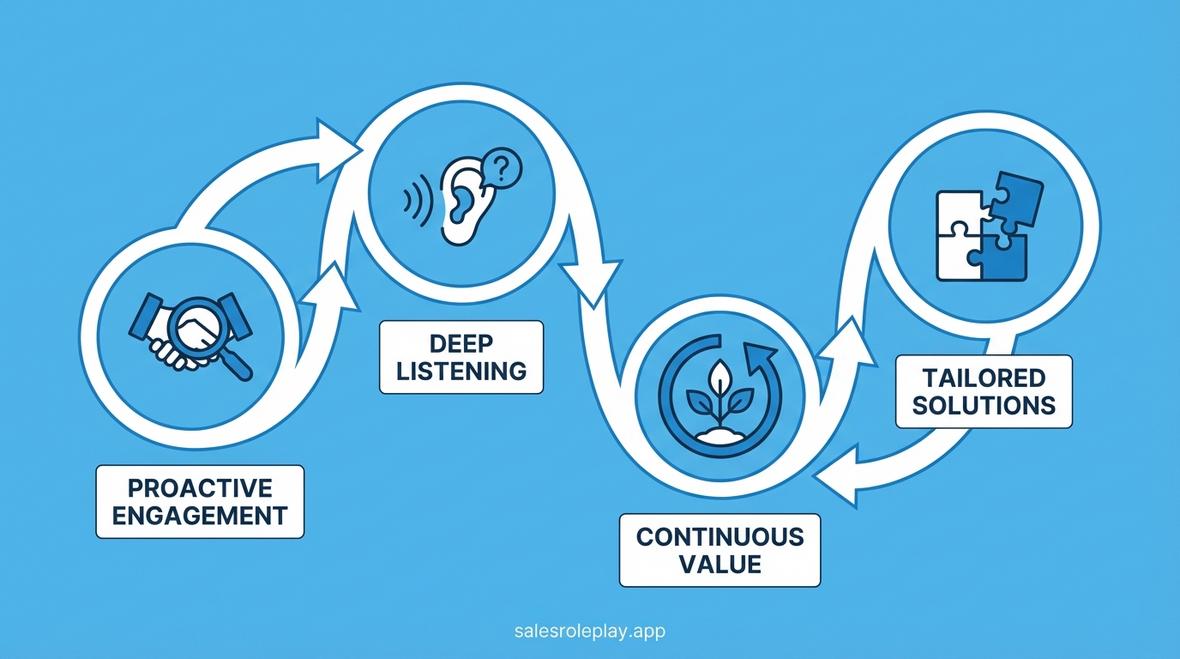
Mastering account manager best practices requires commitment to continuous improvement, customer-centricity, and strategic relationship building. The strategies outlined from proactive engagement and deep listening to tailored solutions and expansion methodologies provide a comprehensive framework for account management excellence. As customer expectations evolve and technology reshapes engagement models, the fundamentals of understanding customer needs, delivering consistent value, and building trusted partnerships remain paramount. Organizations that invest in developing account management capabilities position themselves for sustainable growth through customer retention and expansion. By implementing these proven practices and adapting them to your specific context, you transform account management from a support function into a strategic growth driver that creates competitive advantage and long-term customer partnerships.
Ready to Transform Your Sales Training?
See how Salesroleplay can help you transform your sales training.